Virtual Game Night Ideas: 24 Games to Play on Zoom or a Video Call With Friends and Remote Teams
By The Rondovo team · Published · Updated · 11 min read
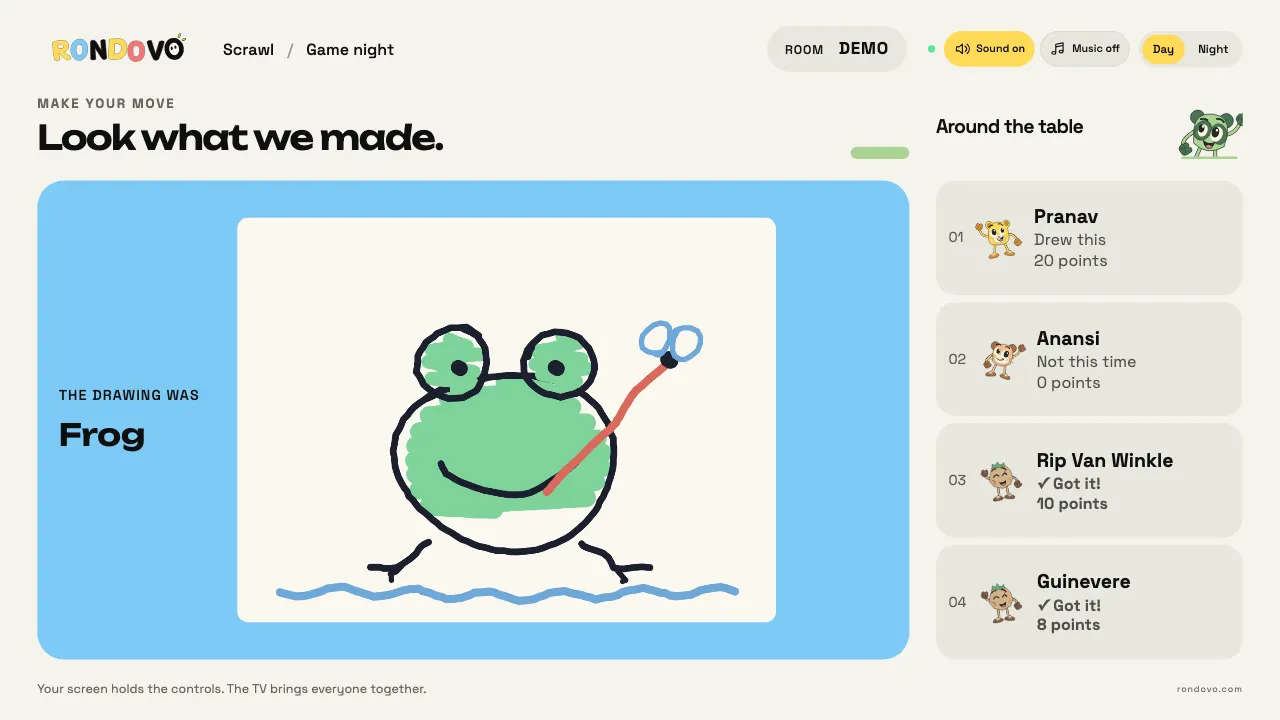
The best virtual game night ideas are games where everyone can see the same thing and act at the same time: trivia, drawing and guessing games, word games, social deduction games like Mafia, charades on camera, and bingo or tambola. Run the video call on one device for faces and voices, and play the game in a browser where each person joins on their own screen with a code, so nobody has to squint at a shared screen or wait for the host to click for them. Plan 60 to 90 minutes, three or four games, and an icebreaker to start.
In short
- Setup: video call for talking, plus a game where everyone plays on their own screen. Screen sharing works for simple games but is slower.
- Best games on a call: drawing games, fill-in-the-blank, trivia, word puzzles, charades, Mafia, tambola and bingo.
- For remote teams: keep it to 30 to 45 minutes, start with an icebreaker, pick games that do not reward being the loudest.
- Timing: about 10 to 20 minutes per game, three or four games, a short break in the middle.
- Free call limits: as of October 2026, Zoom's free plan ends group meetings after 40 minutes and Google Meet's free plan ends group calls (three or more people) at 60 minutes, so check yours.
How to set up a virtual game night
There are two ways to play games over a video call. Which one you pick decides what you can play.
Option 1: one person shares their screen
The host opens a game, shares their screen on the call, and everyone plays by talking: shouting answers in trivia, giving directions in a puzzle, guessing a drawing.
- Good for: trivia, picture quizzes, crosswords, charades lists, a host-run bingo.
- Weak at: anything with hidden information (cards, secret roles, private answers), and anything where people act at once. The host becomes the mouse for everyone.
- Watch for: shared screens look blurry on small devices, and the video delay makes timed games unfair.
Option 2: everyone plays on their own screen
The video call runs as normal for faces and voices. Each player also opens the game in a browser tab or on a second device and joins with a code. Everyone sees their own cards, types their own answers and votes privately.
- Good for: almost everything: drawing games, fill-in-the-blank, word games, social deduction, card games, tambola.
- Weak at: people who only have one device need to switch between the call and the game. On a laptop that is easy (two windows side by side); on a small screen it is fiddly.
- Tip: on a laptop, put the call on one half of the screen and the game on the other. Or join the call on one device and play on another.
Some groups mix the two: the host shares a game's main board on the call as well, and players act from their own screens. If every player can already see the board on their own screen, the share is optional.
What you need
- A video call app everyone can use (Zoom, Google Meet, Microsoft Teams, FaceTime, Discord, WhatsApp video).
- A stable connection for the host. Ask everyone to plug in their laptop charger.
- A list of games and their links, sent before the call.
- Headphones for anyone in a noisy home, to stop echo.
24 virtual game night ideas
Drawing games
1. Draw and guess. One person draws a word, everyone else races to type the answer. Free classics include skribbl.io; our Scrawl shows the drawing live on everyone's screen and scores the fastest guessers. For a full list, see online drawing games.
2. Telephone drawing. Everyone writes a phrase, the next person draws it, the next guesses the drawing, and so on. Gartic Phone is the best known; ours is Chain Sketch. Watching the chains replay at the end is the best five minutes of the night.
3. Drawing from memory. Everyone draws the same words under a timer, then tries to name their own drawings later. Our Doodle Recall does this, and it works well with mixed skill levels because you compete with your own scribbles.
4. Draw it blind. Everyone draws a cat (or the host, or their boss) with their eyes closed and holds it up to the camera. No app needed. Vote on the best.
Word and writing games
5. Fill-in-the-blank. A sentence with a gap appears, everyone writes the funniest ending, and the group votes on anonymous answers. Quiplash in a Jackbox Party Pack is the famous paid version; our Fill-In is free. See games like Jackbox for more.
6. Daily word puzzle race. Everyone solves the same five-letter word at the same time and compares how many guesses they took. Ours, Five Letters, shows only colours on the shared board so nobody can copy. More in Wordle with friends.
7. Forbidden words. Describe a word without saying five or six banned ones while your team guesses. Works well on camera. Our version is Hush.
8. Category race. Pick a letter. Everyone has 60 seconds to write a country, a food, a film and an animal starting with it. Read out answers; only unique answers score.
9. Rebus puzzles. Words and letters arranged to make a phrase ("head" over "heels"). Share a few on screen or play Speed Wits, where faster answers score more.
Clue and team games
10. Codenames style word grids. Two teams, one clue giver each, a grid of words. Codenames has an official free online version; our take is Spy Grid. Use breakout rooms so teams can talk in private.
11. Scale guessing. One person gives a clue for a hidden point on a scale between two extremes, and everyone else guesses where it sits. It shows how each person thinks. Ours is Mindline.
12. Online trivia quiz. The host reads questions or uses a quiz tool like Kahoot, and teams answer in breakout rooms or the chat. Make one round about the group itself.
Social deduction games
13. Mafia or Werewolf. Secret roles, a night phase, a day of accusations. Video makes it better because you can watch faces. With a moderator app or a game that hands out roles on each player's screen, nobody has to close their eyes on camera. Our version is Nightfall.
14. Odd one out. Everyone gets the same secret word except one person, who gets a similar one. Each player gives a one-word hint, then everyone votes for the odd one. Ours is Odd One Out.
15. Two truths and a lie. Each person shares three facts, one false, and the group guesses. Perfect for a team call. More in our two truths and a lie guide.
Acting and camera games
16. Charades. The actor gets a word privately, acts it on camera, everyone else guesses. Ask actors to stand back so their whole body is in frame.
17. Heads up style guessing. One person cannot see the word; everyone else describes it. On a call, the host sends the word to everyone except the guesser in a private message, or use a game that does it.
18. Scavenger hunt. The host calls an item ("something older than you", "something blue and soft") and the first person to show it on camera scores. Ten items, about 15 minutes, lots of running about.
19. Guess the room. Everyone turns their camera to something odd in their house, zoomed in close. Others guess what it is.
Numbers and luck games
20. Bingo. Everyone gets a card, the host calls numbers, first to a line wins. Works for any group size and any age. Our Bingo lets players build their own card.
21. Tambola (housie). The 90-ball version loved at Indian family and office events, with prizes for Early Five, lines, corners and full house. Our Tambola deals each player a ticket and checks claims automatically. Rules are in our tambola guide.
22. Online board games. Ludo, four in a row and similar games play well over a call because they are turn based. Try Ludo or Drop Four.
Quick fillers
23. Would you rather. Read a question, everyone holds up one or two fingers. Ten questions take five minutes.
24. Most likely to. "Who is most likely to forget they are unmuted?" Everyone votes. Our Most Likely To keeps votes hidden until the reveal.
Virtual icebreakers to start the night
The first five minutes decide whether people relax. Short, low pressure openers work best.
- Show and tell in 30 seconds. Everyone grabs one object within reach and explains why it is there.
- Background check. Each person explains one thing visible behind them.
- Desert island pick. One snack, one song, one person (not on this call) to take to an island.
- This or that, fast. Tea or coffee, mountains or beach, call or text. Everyone answers in the chat at the same time.
- Rate your week with an emoji in the chat, then two people explain theirs.
For more, see our icebreaker games.
Online games for remote teams
Team game nights have different rules from friends' nights. People do not all know each other, some are shy, and nobody wants to feel judged by their manager.
- Keep it to 30 to 45 minutes, during work hours if you can. An evening slot eats into personal time.
- Pick inclusive games: drawing games, word puzzles, two truths and a lie, trivia in teams, bingo. Avoid anything that rewards whoever talks the loudest.
- Anonymous answers help. Games where answers are hidden until a vote (fill-in-the-blank, most likely to) let quieter people be funny without the spotlight.
- Mix the teams. Use breakout rooms to put people from different departments together.
- No forced cameras. Make cameras welcome but optional.
- Mind time zones. For a team across India, Europe and the US, a late morning US Eastern slot reaches India in the evening.
- Avoid drinking games and anything about money.
For a longer list, see our team building games.
How long should a virtual game night be?
| Group | Length | Games |
|---|---|---|
| Remote team | 30 to 45 minutes | Icebreaker plus two short games |
| Friends | 60 to 90 minutes | Icebreaker plus three or four games |
| Family across cities | 45 to 60 minutes | One game everyone knows plus one new one |
A rhythm that works for most groups:
- 5 minutes: say hello, check everyone can hear.
- 5 minutes: icebreaker.
- 15 to 20 minutes: a quick game everyone gets straight away (drawing or fill-in-the-blank).
- 20 minutes: the main game (Mafia, trivia, a word grid).
- 5 minutes: break.
- 15 minutes: a final fast round, then vote on the night's winner.
If you are on a free call plan with a time limit, schedule two calls back to back and use the break to rejoin.
Running a virtual game night on Rondovo
Rondovo is a free website of party, board and card games. The host opens a room and gets a four letter code, everyone joins from any device, and nobody installs anything. Guests do not need an account. For a video call it works like this:
- Start your call as usual on Zoom, Meet, Teams or anything else.
- The host opens a room on Rondovo and pastes the code or link in the chat.
- Everyone joins at rondovo.com on their own device and picks Just this screen, which puts the board and your controls together. Nobody needs to watch a shared screen, and with no TV connected the game's narration comes to every player's screen too.
- If you prefer, the host can also share their screen so the board shows on the call, but it is optional.
Our games that work best on a call are Scrawl, Fill-In, Spy Grid, Five Letters, Two Truths, Nightfall and Tambola. Depending on the game, they take between 2 and 16 players.
Where it is weaker: Rondovo has no built-in video or voice, so you still need a call app alongside, and with more than 16 people you will need two rooms. A paid party pack like Jackbox has more polished writing; we are free and need no purchase.
For the bigger picture, our game night games guide covers in-person nights too, online party games goes deeper on what works over the internet, and party games lists everything. Calling just one or two friends? See games to play on FaceTime.
Questions people ask
What games can you play on Zoom with friends?
Drawing games, fill-in-the-blank, trivia, word puzzles, charades, Mafia, two truths and a lie, bingo and tambola all work well on Zoom. Pick games that run in a browser so everyone can play on their own screen while the call carries the voices.
How do you host a virtual game night?
Send a call link and the game links ahead of time, start with a five minute icebreaker, play three or four games of 10 to 20 minutes, and take a short break in the middle. Have one person in charge of the timer and scores.
What are good online games for remote teams?
Short, inclusive games with anonymous answers or team play: fill-in-the-blank, trivia in breakout rooms, drawing games, word puzzles, two truths and a lie, and bingo. Keep it under 45 minutes and avoid anything that singles people out.
Can you play games on a video call without downloading anything?
Yes. Browser games like skribbl.io, the official Codenames online version and Rondovo run in a web browser. Players open a link, type a name and play.
How many people can play a virtual game night?
Most browser party games handle 2 to 16 players per room. For larger groups, split into teams in breakout rooms or run two rooms side by side and compare scores at the end.
Do I need to share my screen to play games on Zoom?
Not if the game lets everyone play on their own screen. Screen sharing helps when you want everyone to see the same board, but for games with hidden cards or private answers each player should have their own view.
Zoom, Google Meet, Microsoft Teams, FaceTime, Discord, WhatsApp, skribbl.io, Gartic Phone, Jackbox, Quiplash, Codenames, Kahoot, Wordle and Heads Up are trademarks of their owners. Rondovo is not affiliated with them.