Tambola Rules, Tickets and Prizes: How to Play Tambola (Housie) at Home or Online
By The Rondovo team · Published · Updated · 13 min read
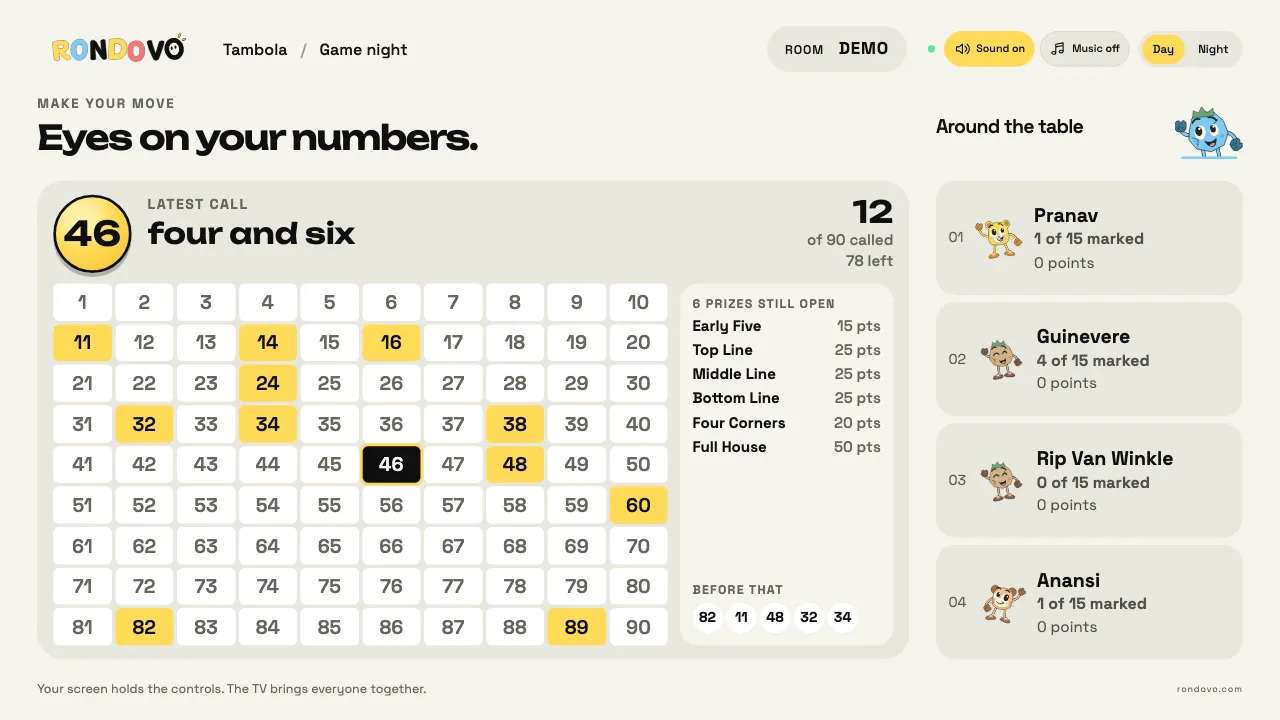
Tambola, also called housie, is a numbers game played with tickets of 15 numbers between 1 and 90. A caller draws the numbers at random and reads them out, players strike off matching numbers on their tickets, and the first person to complete each pattern (Early Five, a line, the four corners, a full house) shouts and claims that prize. The game ends when someone claims the full house. It is the same family as British 90-ball bingo, and it is a fixture of Indian kitty parties, Diwali gatherings, society functions and office events.
In short
- A ticket is a grid of 3 rows by 9 columns with 15 numbers: 5 in every row.
- Numbers 1 to 90 are called one at a time, in random order, until the full house goes.
- Standard prizes: Early Five, Top Line, Middle Line, Bottom Line, Four Corners, Full House. Many groups add more.
- A wrong claim (a "bogey") usually costs the claimer that prize, or the game pays them nothing and carries on.
- Agree the prize list and the rules for wrong claims and ties before the first number.
What is tambola?
Tambola is the Indian name for the 90-ball bingo game the British call housie or house, and it shares its roots with the Italian tombola. Families play it at home for small prizes, clubs and housing societies run it as a fundraiser, and kitty parties use it as the main event. People also call it housie, tombola, or Indian bingo.
What makes tambola different from American 75-ball bingo is the ticket. Bingo uses a 5 by 5 card with a free middle square. Tambola uses a long, thin ticket with gaps, and the prizes are lines and shapes on that ticket.
How tambola tickets work
A tambola ticket has 3 rows and 9 columns, 27 boxes in all. Fifteen boxes hold numbers and twelve are blank.
- Every row has exactly 5 numbers and 4 blanks.
- Each column covers its own range. The first column holds numbers from 1 to 9, the second 10 to 19, the third 20 to 29, and so on, with the last column holding 80 to 90.
- Every column has at least one number, and none has more than three.
- Numbers in a column run in order from top to bottom.
So if you see 34 on a ticket, it is always in the fourth column. That is what makes tambola quick to mark: when the caller says 34, everyone looks at one column only.
How many tickets can a player have?
Most home games give one ticket per person, and some let players buy two or three. Printed tambola books often come as sheets of several tickets. A traditional bingo strip is six tickets that between them use all 90 numbers once, so every number called marks exactly one of the six. If you print your own tickets, use a generator that follows the column rules above, because hand-made tickets often break them.
Tambola ticket example
Here is how a ticket reads, with blanks shown as dots:
| 1 to 9 | 10s | 20s | 30s | 40s | 50s | 60s | 70s | 80 to 90 |
|---|---|---|---|---|---|---|---|---|
| 4 | · | 23 | · | 45 | · | 61 | · | 83 |
| · | 12 | · | 37 | 48 | · | · | 76 | 88 |
| 8 | · | 29 | · | · | 54 | 67 | 79 | · |
Top Line here is 4, 23, 45, 61 and 83. Four Corners are 4 and 83 (the ends of the top row) plus 8 and 79 (the ends of the bottom row).
Tambola rules, step by step
- Hand out tickets and something to mark them with: a pen, a dabber, or just a pencil.
- Announce the prizes and what each one pays, in gifts, points or shares of a kitty.
- The caller draws a number from a bag of 90 tokens, a drum, or a random number app, and reads it out, often with a nickname (more below).
- Players strike off the number if it is on their ticket. Most groups let you mark a number that was called earlier if you missed it, as long as it really was called.
- When you complete a prize, shout ("Top Line!" or "Housie!") before the next number is drawn.
- The caller checks the claim against the list of called numbers. A valid claim takes the prize and the game carries on.
- The game ends with the full house. Some groups play on for a second and third full house.
Wrong claims (bogeys)
A claim that turns out to be wrong is called a bogey. Common rules, from mild to strict:
- The claimer is warned and play continues.
- The claimer is barred from that prize for the rest of the game.
- The claimer is out of the game, or pays a small forfeit into the next prize.
Ties
If two players claim the same prize on the same number, most groups split it. If the prize is a gift, give it to the earlier shout or draw lots.
Late claims
Many groups say a claim must be made before the next number is called. Others are relaxed about it. Decide which, because "I had it two numbers ago" is the argument tambola is famous for.
Tambola prizes list (dividends)
Prizes in tambola are often called dividends, a name that comes from games where each prize is a share of the money collected. Here are the common ones. The first six are near universal; the rest are popular add-ons.
| Prize | What you need |
|---|---|
| Early Five (also Jaldi Five) | Any five numbers marked on your ticket. The first prize to go, usually within 10 to 20 calls. |
| Top Line | All five numbers in the first row. |
| Middle Line | All five numbers in the second row. |
| Bottom Line | All five numbers in the third row. |
| Four Corners | First and last numbers of the top row, plus first and last of the bottom row. |
| Full House | All 15 numbers. The big one, and it ends the game. |
| Early Seven | Any seven numbers. Used instead of Early Five in big groups. |
| Star | Four Corners plus the middle number of the middle row. |
| Two Lines | Any two complete rows. |
| Second and Third Full House | The next people to complete the whole ticket after the first. |
| Breakfast, Lunch, Dinner | All numbers in columns 1 to 3, 4 to 6, or 7 to 9 respectively. |
| Pyramid | One number from the top row, two from the middle and three from the bottom, read as a shape. Rules vary by group. |
| Odd or Even | Every odd number, or every even number, on your ticket. |
| Bulls Eye or Lucky Number | A number the host secretly picks in advance. Whoever holds it wins when it is called. |
Variants like Pyramid and Star are defined differently from group to group, so read out your definition before you start.
How to split the prizes
For a home game with a kitty, a split that keeps everyone interested looks like this:
| Prize | Share of the pot |
|---|---|
| Early Five | 10% |
| Top, Middle and Bottom Line | 15% each |
| Four Corners | 10% |
| Full House | 35% |
If you play for gifts instead, the same idea works: the full house gets the best gift, lines get mid-range ones, and Early Five gets something small and fun. Gifts and points avoid any question about whether playing for money is allowed where you live, which varies by state and country.
Calling the numbers: the nickname tradition
Part of the fun of tambola is the caller. In British housie, callers gave many numbers a rhyming or joking nickname, partly to make them easy to hear across a noisy hall and partly for the performance. A few of those old calls, like "legs eleven" for 11, are still known everywhere. Indian tambola callers kept the habit and made it their own, mixing in Bollywood, cricket, festivals and family jokes, and every family has its own versions.
You do not need the traditional list. Writing your own is better, because they will be about your people. Here are some we wrote for a Diwali or family game. Use them, change them, or swap in names from your own group.
| Number | Our call |
|---|---|
| 1 | Only child, number one |
| 3 | Third cup of chai, number three |
| 5 | Five fingers in the mithai box, five |
| 8 | Ashta, the cowrie's best throw, eight |
| 9 | Nine nights of garba, nine |
| 11 | Two candles on the windowsill, eleven |
| 12 | A dozen bananas from the thela, twelve |
| 15 | Half a month to payday, fifteen |
| 20 | Cricket in a hurry, twenty |
| 24 | Hours in a day, two and four, twenty-four |
| 32 | Teeth in a grown-up smile, thirty-two |
| 36 | Six sixes, Ludo heaven, thirty-six |
| 42 | Four and two, a rangoli for you, forty-two |
| 50 | The grandparents' golden year, fifty |
| 64 | Squares on the chessboard, sixty-four |
| 80 | An eight and an empty plate, eighty |
| 88 | Two laddoos stacked up, eighty-eight |
| 90 | The last stop on the bus, ninety |
Caller tips. Say the nickname first and the plain number last ("Two laddoos stacked up, eighty-eight"), so nobody mishears it. Read each number twice for older guests. Keep a written list or a 1 to 90 board of what has been called, because every claim will be checked against it. Leave around 8 to 10 seconds between numbers: long enough to find a number, short enough to keep it moving.
Hosting tambola at a kitty party
Tambola is the classic kitty party game because it needs no skill, works for 6 people or 60, and fits in 30 to 45 minutes. A few things make it run smoothly.
- Print tickets in advance, at least one per guest and a few spares. Use a generator that follows the column rules so no ticket is impossible.
- Fix the prize list and amounts before anyone arrives, and write it on a board or a card everyone can see.
- Pick a caller who enjoys it. A shy caller makes a flat game. Rotate callers between games if several people want the job.
- Use a theme. At a Diwali kitty, call numbers with festival nicknames and give prizes like diyas, dry fruit boxes or small brass pieces.
- Keep a called-numbers board. A printed 1 to 90 sheet where you circle each number makes checking claims instant.
- Plan for arguments. Say out loud: claims must come before the next number, wrong claims lose that prize, ties split.
- Two games is the sweet spot. One game feels short; three gets tiring. Fill the gap with food or a quick party game.
If your group is used to playing tambola for money, keep stakes small and remember that rules on gambling differ by state and country. Playing for gifts or points keeps everyone comfortable, including guests who do not want to put money in.
Tambola with a twist
Once your group knows the standard game, a twist keeps the next round fresh. Some that work well at kitty parties and birthdays:
- Song tambola. The caller hums or plays a few seconds of a song instead of reading the number, and the title of the song points to it (a song with "seven" in its title for 7, say). Tickets stay the same. Guests have to work out the number before marking it.
- Question tambola. Each number comes with a small question or task. Whoever marks that number has to answer it: name three Bollywood films from the 1990s, say something nice about the host.
- Picture tambola for kids. Swap numbers for pictures (fruits, animals, vehicles). Draw them on homemade tickets and call by showing a picture card.
- Tambola with playing cards, no tickets. Deal each player five playing cards as their ticket. The caller draws from a second shuffled deck and calls each card. First to have all five called wins. No printing needed.
- Theme prizes. At a baby shower, call the full house "Due Date"; at a wedding, "Saat Phere" for a prize that needs seven numbers.
Tambola online
You can play tambola online in a few ways.
- Tambola apps. Several apps let a host create a game, share tickets and call numbers automatically. Check the current features and any costs on the store listing before you rely on one for a party.
- Printed tickets over a video call. Email or message tickets as images, then call the numbers on the call. It works, but checking claims by screenshot is slow.
- Browser games where everyone joins a room and gets a ticket on their own screen.
The thing to look for is automatic claim checking. When software checks the ticket, there are no arguments and no waiting.
Playing tambola on Rondovo
Our Tambola is our own take on housie, built for a living room or a video call. It is free. The host opens a room and gets a four letter code, everyone joins at rondovo.com on their own screen, and a TV (if you have one, at rondovo.com/tv) becomes the caller's board. Without a TV, the calls come to every player's screen. Guests need no account or download. It takes 2 to 16 players.
How it plays, from our game's rules:
- One ticket each, dealt by the game with the standard layout: 3 rows by 9 columns, 15 numbers, 5 a row, each column in its own range.
- The game calls a number every 9 seconds by default (the host can set anywhere from 5 to 16), with a caller's line for every number, written by us and varied each game.
- You mark your own ticket. That is the real thing: miss a number and you might miss the prize. You can still mark a number that was called earlier. There is a "mark my ticket for me" setting for children or anyone who just wants to watch.
- Prizes: Early Five, Top Line, Middle Line, Bottom Line, Four Corners and Full House. The host can also choose lines and house only, or full house only.
- Claims are checked instantly. Tap the claim button and the game checks your marked numbers. A wrong claim closes that prize to you, and the room hears about it.
- Points, not money. Early Five is worth 15, each line 25, corners 20 and the full house 50. The highest total wins.
Where it is weaker: one ticket per player, no Star, Pyramid or second full house, and no custom prizes yet. If your group plays with three tickets each and a long list of dividends, paper is still better. Where it is better: nobody has to print anything or check claims by hand, and it works just as well when half the family is on a video call: each person opens the room on their own device and picks "Just this screen", so nobody has to share a screen.
If your group prefers the 75-ball American game, our Bingo lets each player build their own 5 by 5 card, and the host picks the winning shape: a line, four corners, the cross or a blackout. For a gentler board game between rounds, try Ludo.
For more ideas around a festival evening, see our Diwali party games list and our kitty party games. If your group is too big for most games, try party games for large groups, and for the American version online, bingo online with friends. Our full guide to party games covers everything else.
Questions people ask
How many numbers are on a tambola ticket?
Fifteen. A ticket has 3 rows and 9 columns, with 5 numbers in each row and 12 blank boxes in all.
What numbers are used in tambola?
1 to 90. Each column covers its own range: 1 to 9, 10 to 19, and so on up to 80 to 90 in the last column.
What is Early Five in tambola?
The first player to mark any five numbers on their ticket wins Early Five. It is usually the first prize to go. Some groups call it Jaldi Five.
What are the Four Corners in tambola?
The first and last numbers of the top row and the first and last numbers of the bottom row. The corners are numbers, not boxes, so a blank in a corner box does not count.
What is the difference between tambola and housie?
There is none. Tambola, housie and tombola are names for the same 90-ball game. Housie is the older British name, tambola is the common name in India.
Can you play tambola without tickets?
Yes. Deal playing cards as tickets and call from a second deck, or use a game that deals tickets to each player's screen.
Is tambola the same as bingo?
They are cousins. Tambola is 90-ball bingo with 3 by 9 tickets and several prizes in one game. American bingo uses 75 balls and a 5 by 5 card with a free square, and usually one winning pattern per game.
What happens if two people claim full house at the same time?
Most groups split the prize. If the prize cannot be split, draw lots or give it to the first clear shout. Decide this before the game starts.
How long does a game of tambola take?
With a number every 8 to 10 seconds, a full house in a home game of 5 to 20 players usually comes after 70 to 80 calls, so a game runs 10 to 15 minutes. Early Five tends to go within the first 20 calls. With a slow caller and lots of chatter, 30 minutes is normal.