Bingo Online With Friends: How to Host a Free Game, Make Cards and Pick Patterns
By The Rondovo team · Published · Updated · 11 min read
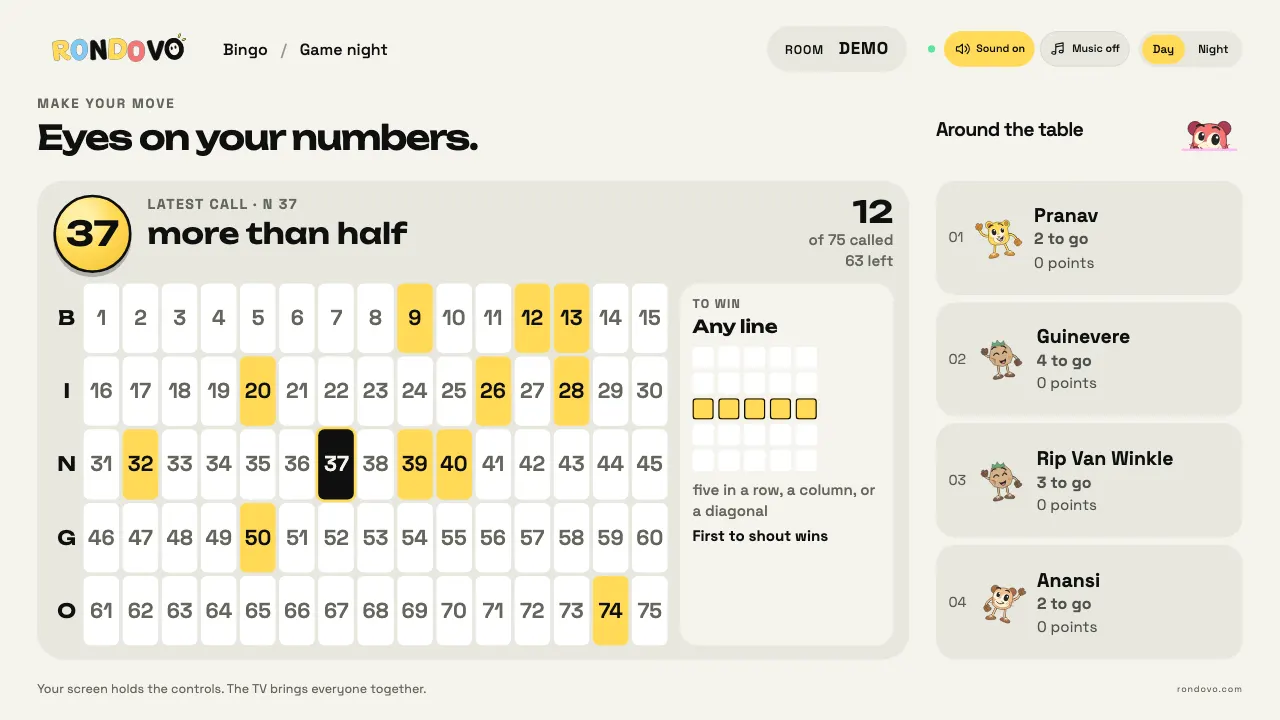
To play bingo online with friends for free, one person opens a bingo room or a free online caller, sends the link or code to the group, and everyone marks a card on their own device while the numbers are called. Free options include card generators with a virtual caller (such as myfreebingocards.com, free for up to 30 players as of October 2026) and party game sites like Rondovo, where each player builds their own card and the room races to a shape. For a family call, you can even make cards by hand and call numbers over video.
This guide covers how to host, the difference between 75 ball and 90 ball bingo, how to make cards, which patterns to use, and how to adapt the game for seniors, kids and baby showers.
In short
- 75 ball bingo uses a 5 by 5 card with a free centre square and the letters B I N G O. It is the American game and the one most online games use.
- 90 ball bingo uses a ticket of 3 rows and 9 columns with 15 numbers. It is the British game, and Indian tambola (housie) uses the same ticket.
- To host online: pick a tool, choose a pattern, share the link, call at a steady pace, and check every claim.
- Patterns change the game. A single line ends in minutes; a blackout takes most of the balls.
- Free means play for fun. Bingo for money is regulated almost everywhere; this guide is about prizes like chocolate, bragging rights or the next round's choice.
What is bingo?
Bingo is a game of chance where each player has a card of numbers. A caller draws numbered balls at random and announces each one. Players mark the numbers on their card, and the first to complete the agreed pattern shouts "Bingo!" and wins, after a check.
There is no skill in which numbers come up. The skill, such as it is, lies in keeping up, not missing a number, and not shouting too early. That simplicity is why bingo works across ages: a seven year old and a great grandparent play on exactly equal terms.
75 ball vs 90 ball bingo
The two main versions look different and play differently. Know which one your group expects before you start.
| 75 ball bingo | 90 ball bingo | |
|---|---|---|
| Where it is played | US and Canada, most online games | UK, Ireland, Australia; India as tambola |
| Numbers | 1 to 75 | 1 to 90 |
| Card | 5 by 5 grid, free centre square | 3 rows by 9 columns |
| Numbers per card | 24 | 15 (5 per row, 4 blanks per row) |
| Columns | B 1 to 15, I 16 to 30, N 31 to 45, G 46 to 60, O 61 to 75 | 1 to 9, 10 to 19, and so on up to 80 to 90 |
| Usual wins | A pattern: line, corners, shapes, blackout | One line, two lines, full house |
| Feel | Lots of shapes, many variations | Several prizes in one game |
In 75 ball bingo, the column tells you where to look. When the caller says "N 38", you only check the N column. That makes it quick for beginners and easy to call online.
90 ball bingo pays several prizes per game. The first player to complete any one row wins, then two rows, then the full house. Tambola adds Early Five and Four Corners; see our tambola rules and tickets guide for the full Indian version.
How to host bingo online with friends
Step 1: Pick your setup
You have three realistic choices for free online bingo with friends.
- A card generator plus a virtual caller. Sites such as myfreebingocards.com let you make cards, send each player a link to their own card, and call numbers with a built in caller that can check winners. As of October 2026 its virtual bingo is free for up to 30 players, and paid games for larger groups start at $10. Bingo Baker also lets players open a virtual card from a link and play on any device.
- A party game room. On a site like Rondovo (free, no sign up for guests), the room handles cards, calling and checking. The host makes a room, everyone joins at rondovo.com with the four letter code and marks their own card. On a video call, each player picks "Just this screen", so the called balls show on their own device and nobody has to share their screen.
- Cards by hand and a video call. The host draws numbers from a hat or a random number generator, everyone marks paper cards, and claims are checked by reading the numbers back. It costs nothing and suits grandparents who do not want a link.
Step 2: Choose a pattern and say it out loud
Announce the winning pattern before the first ball and keep it on screen or in the chat. Arguments in bingo are almost always about the pattern, not the numbers.
Step 3: Send the link or code in writing
Paste it into the group chat. Read aloud, codes get misheard.
Step 4: Call at a steady pace
Online, 6 to 10 seconds between balls is comfortable for most groups. Slower for seniors and young kids, faster for a group that has played before. Say each number twice, with its letter in 75 ball bingo: "B 7, B 7".
Step 5: Check every claim
A digital game checks claims for you. With paper, ask the claimant to read back their marked numbers and compare with the called list. A false claim usually means the game continues and the player is out for that pattern, or sits out a few balls. Agree the rule before you start.
Step 6: Play several short games
Three or four 10 minute games beat one long one. Rotate patterns: start with a line, finish with a blackout.
How to make bingo cards (bingo card generator tips)
A bingo card generator saves time, but you can make good 75 ball cards by hand in two minutes.
- Draw a 5 by 5 grid and write B I N G O across the top.
- Mark the centre square FREE.
- Pick 5 different numbers from each column's range: B from 1 to 15, I from 16 to 30, G from 46 to 60, O from 61 to 75.
- Pick 4 numbers for the N column (31 to 45), because the free square takes the fifth.
- Mix the order inside each column. Never copy a card for two players.
That is 24 numbers per card. With these rules every card is valid and no two players need share a card.
Generators also make word bingo, picture bingo and theme bingo cards: replace numbers with words, then call the words. These are the cards most people mean when they search for bingo for baby showers or classrooms.
Bingo patterns: from quick to long
The pattern decides how long a game lasts. Here are the common ones, roughly from fastest to slowest.
| Pattern | What you need | How long it takes |
|---|---|---|
| Any line | Five in a row across, down or diagonally (the free square counts) | Fastest |
| Four corners | The four corner squares | Fast |
| Postage stamp | A 2 by 2 block in any corner | Fast to medium |
| Letter T or L | The top row and the middle column, or the left column and bottom row | Medium |
| The cross (X) | Both diagonals, corner to corner | Medium |
| Picture frame | Every square on the outside edge | Long |
| Blackout (coverall) | Every square on the card | Longest |
Start with a line for beginners, so someone wins in the first few minutes and everyone understands the shout. Save blackout for the last game, when you want tension.
For 90 ball bingo, the patterns are fixed: one line, two lines, full house.
Our Bingo: build your own card, race to the shape
Bingo on Rondovo is our own take on 75 ball bingo for 2 to 16 players, with one twist: you build your own card.
- Building the card. You are handed 24 numbers one at a time, and you drop each into any square of its column. Prefer not to? Take a random card. The build timer is 45 seconds by default (the host can set 20 to 90), and anyone still building when it runs out gets the rest filled in at random.
- The call. A ball every 8 seconds by default, adjustable from 4 to 14. The caller says each number with its letter and adds a line for some of them.
- Marking. You tap matching numbers on your own card. You cannot mark a number that has not been called.
- Patterns. The host picks any line, four corners, the cross (both diagonals) or blackout.
- Claims. Tap Bingo when your marked squares make the shape. The game checks it. A wrong claim stops you claiming for three balls, though you can still mark.
- Places. The host can pay one, two or three places (three by default with six or more players). First scores 50, second 30, third 20.
- Privacy. The shared screen shows the called balls and how close each player is, never anyone's numbers.
Building your card changes the feel more than you would expect. Players argue about whether to put their favourite numbers in the corners for a four corners game, and the room groans together when a number lands in everyone's diagonal.
Where it is weaker: it is 75 ball only, it has four patterns rather than dozens, and it has no word or picture cards. For a themed baby shower card, a generator is the better tool.
Tambola, the 90 ball cousin
If your group grew up with housie, play Tambola instead (2 to 16 players). Each ticket has fifteen numbers, and prizes go to the first valid claim: Early Five, top, middle and bottom lines, four corners and full house. The host can play all prizes, lines and house only, or full house only, and choose 5 to 16 seconds between numbers. A wrong claim bars you from that prize. There is an option to mark your ticket for you, off by default.
Bingo for seniors
Bingo is a staple of senior centres because it is social, gentle and easy to follow. A few changes make it work online for older players.
- Slow the call. 12 to 14 seconds between numbers, and repeat each one.
- Large print. On paper, use one card per sheet with big numbers. On a tablet, one card per screen.
- One pattern per game, starting with a single line.
- Use the device they already have. A tablet propped up beside the video call works better than switching apps on one small screen.
- Mark automatically if eyesight is an issue. In our Tambola, the mark-my-ticket option does this; in a paper game, a family member can mark for them.
Our games for seniors list has more ideas for mixed age groups, and family game night ideas has ways to fit bingo into an evening with the grandchildren.
Bingo for a baby shower
Baby shower bingo is usually gift bingo: each guest fills a blank card with gifts they expect the parents to open (bottles, a sleepsuit, nappies, a book). As the gifts are opened, guests mark matches. First to a line wins.
It keeps everyone watching the gift opening instead of their screens. For a virtual baby shower, send a blank 5 by 5 template beforehand and let guests fill it in, or use word bingo with baby words and call them at random. More ideas in our baby shower games guide.
Bingo for kids
- Picture bingo for under sixes: animals, colours, shapes.
- Small cards, 3 by 3, so a game ends before attention does.
- Maths bingo: call "6 times 7" instead of "42".
- Everyone wins something. Play until everyone has completed a line, or give the caller's job to the winner of each round.
Bingo house rules worth agreeing
- What counts as a line? Across only, or across, down and diagonal?
- Does the free square count? In 75 ball bingo it normally does.
- Two claims on the same ball usually share the prize.
- Late claims: most groups allow a claim until the next ball is called.
- Prizes: sweets, choosing the next game or pattern, or being the next caller. Playing bingo for money is regulated in most places, so check your local laws before any cash changes hands.
Questions people ask
How do you play bingo online with friends for free?
Use a free bingo site or party game room. The host creates a game and shares a link or code; each player gets a card on their own device; the numbers are called automatically or by the host; and the first valid claim wins. myfreebingocards.com is free for up to 30 players as of October 2026, and Rondovo's Bingo and Tambola are free for up to 16.
What is the difference between 75 ball and 90 ball bingo?
75 ball bingo uses a 5 by 5 card with 24 numbers and a free centre, and you win by completing a pattern. 90 ball bingo uses a 3 by 9 ticket with 15 numbers, and pays for one line, two lines and a full house. 75 ball is common in North America, 90 ball in the UK, and tambola is the Indian 90 ball game.
What numbers go in each bingo column?
B holds 1 to 15, I 16 to 30, N 31 to 45, G 46 to 60, and O 61 to 75. Each column has five numbers except N, which has four because of the free square.
Can you play bingo on Zoom or FaceTime?
Yes. The host calls numbers on the call, and players mark either printed cards or digital ones opened from a link. In a room game like Rondovo's Bingo, everyone picks "Just this screen" and the calls come up on each person's own device, so nobody needs to share their screen. Free Zoom meetings end at 40 minutes as of October 2026, which is plenty for three or four games. Our games to play on FaceTime guide covers call setups.
What is the fastest bingo pattern?
A single line or four corners. Blackout, where every square must be marked, is the slowest and usually needs most of the balls.
Is online bingo with friends legal?
Playing for fun, with no money involved, is just a game. Bingo with cash stakes or paid tickets is regulated as gambling in many countries and states, with separate rules for charity fundraisers, so check local laws before you charge for cards.
Call the first ball
For the quickest start, open Bingo, pick a line as the shape, and send the four letter code. Everyone builds a card in under a minute, and the first ball drops as soon as the cards are down.
myfreebingocards.com, Bingo Baker, Zoom and FaceTime are trademarks of their owners. Rondovo is not affiliated with them.