Games for Seniors: Party, Word and Table Games That Are Easy to See, Hear and Play
By The Rondovo team · Published · Updated · 11 min read
The best games for seniors are familiar, social and forgiving: bingo and tambola, card games like rummy, dominoes, word games, gentle trivia, charades and reminiscence games built around shared memories. A good choice has large, clear print, needs little fine finger work, lets people play at their own pace, and is just as enjoyable for someone who doesn't win. For residents living with dementia, simpler, failure-free versions of the same games work well, ideally planned with the care staff who know each person.
In short
- For a group or a senior centre: bingo, tambola, trivia in teams, charades and "name that tune" (titles only) are the reliable favourites.
- For word lovers: word ladders, categories, crosswords, Scrabble style tile games and a daily five letter word puzzle.
- For family visits: card games, dominoes, Ludo, and photo based memory games that get stories flowing.
- For video calls with grandchildren: games where both sides only need to see and talk: I spy, twenty questions, a shared online board game.
- For dementia: keep it short, familiar and impossible to fail. Check with care staff about what suits each person.
What makes a game good for older adults
Most games can be adapted for older players, but a few features decide whether people join in or quietly watch.
Easy to see. Large numbers, high contrast, nothing printed in pale grey on white. Cards with jumbo print exist for most classic games, and large print bingo cards are easy to find.
Easy on the hands. Picking up small tiles, shuffling cards and pressing tiny buttons are the hard parts for anyone with arthritis or a tremor. Card holders, oversized dice, a dealer who does the shuffling, or a game where someone else moves your piece all help.
Easy to hear. In a busy lounge, announcements get lost. Repeat calls, write them on a board, or use a screen everyone can see.
A gentle pace. Speed rounds can be exciting for some players and stressful for others. Offer a relaxed table and a competitive table if you can.
Social first. The best senior games are excuses to talk. Trivia leads to "I remember when". A card game leaves room for chat between hands. That matters more than the rules.
Party games for senior citizens
These work for a group of 6 to 30 in a care home lounge, a community hall or a family gathering.
- Bingo. The most popular group game for seniors for good reason: everyone knows it, each player only watches their own card, and a caller can slow down as needed. Give out large print cards and dabbers instead of small counters.
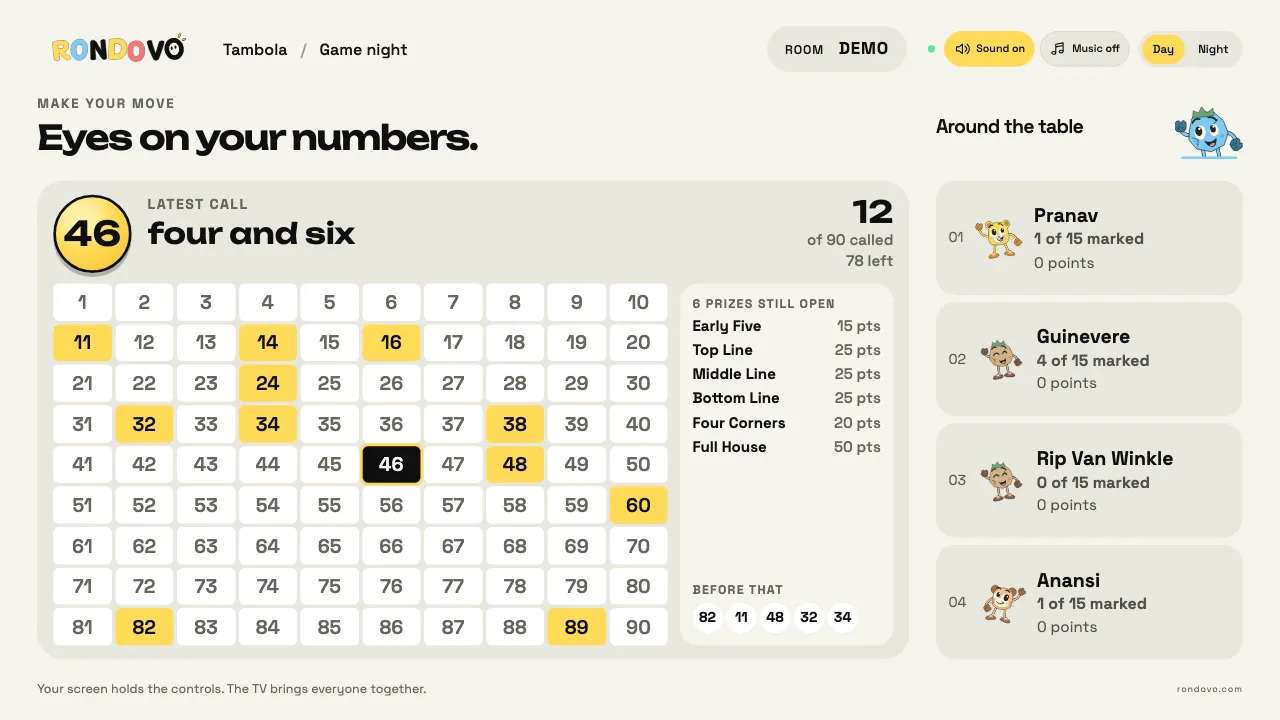
- Tambola (housie). The Indian and British cousin of bingo, played on tickets of 15 numbers with prizes for the first five, each line, the corners and a full house. More prizes means more winners. Our guide to tambola rules and tickets explains every prize.
- Trivia in teams. Tables of four or five, a quizmaster, answers written on paper. Team play takes the pressure off anyone who doesn't know an answer.
- Charades for seniors. Use film titles, household jobs (ironing, gardening, baking a cake) and famous people from their youth. Players can act seated.
- Name that tune. Play the first few seconds of a well known song from the 1950s to the 1970s and let teams shout the title.
- Pictionary for seniors. On a big flip chart, with thick markers. Simple words: house, boat, umbrella, teapot.
- Finish the saying. Read the first half of a proverb ("Too many cooks...") and the group finishes it. Easy, social and good for people with memory loss, because old sayings are often well remembered.
- Balloon volleyball, seated. Everyone sits in a circle and keeps a balloon in the air. Gentle movement, lots of laughter.
- Never have I ever for seniors. Keep it to life experience: never have I ever ridden a motorbike, met a famous person, lived abroad, milked a cow. People put a finger down for each "yes" and the stories come out by themselves.
Word games for seniors
Word games suit people who love crosswords and are happy at a slower pace. Many can be played on paper, aloud, or on a screen.
- Word ladders. Change one letter at a time to turn one word into another: COLD to CORD to WORD to WARD to WARM. Do it together on a whiteboard.
- Categories. Pick a letter and a list (a flower, a town, a girl's name, a food). Everyone writes one answer for each. Unique answers score.
- Hangman for seniors. Play on a big board with a theme ("things in a kitchen") to make guessing easier.
- Scrabble for seniors. Large print editions and turntable boards help. Playing in pairs is friendlier than playing alone.
- A daily five letter word. Six guesses to find a hidden word, with colours to show which letters are right. Popular with all ages and quick enough for a coffee break.
- Picture puzzles (rebuses). Words arranged to show a phrase: the word MIND written over the word MATTER means "mind over matter". These spark lots of group discussion.
- Alphabet chain. Name an animal for each letter of the alphabet, going round the room. Help is allowed.
- Spot the odd one out. Read four words aloud (apple, pear, carrot, plum) and the group picks which doesn't belong and why. Several answers can be right, which is the point.
Trivia for seniors with answers
Here are twelve warm-up questions we wrote, mixed in difficulty, for a team quiz. Read them aloud and let teams confer.
| Question | Answer |
|---|---|
| Which planet is called the red planet? | Mars |
| How many days are there in a leap year? | 366 |
| What colour do you get when you mix blue and yellow? | Green |
| In which country are the pyramids of Giza? | Egypt |
| How many sides does a hexagon have? | Six |
| Which fruit is dried to make raisins? | Grapes |
| What is the largest ocean on Earth? | The Pacific |
| In which year did people first walk on the Moon? | 1969 |
| What is the capital city of Italy? | Rome |
| How many strings does a standard violin have? | Four |
| Which bird is famous for copying human speech? | The parrot |
| What do you call a baby kangaroo? | A joey |
Swap in local questions: the name of the town's old cinema, the year the bridge opened, the football team's nickname. Local questions spark the best conversations.
Games for seniors with dementia
Games can be a pleasant, social part of the day for people living with dementia, as long as they are chosen with care. We are not clinicians, and we make no claims that any game slows or treats dementia. What carers and families tend to find is that the right game, at the right moment, simply gives people a good time together.
Some general principles, which match the advice from the Alzheimer's Association on activities:
- Build on what the person already enjoyed. A lifelong card player may still enjoy dealing or sorting cards by suit, even if the full game is too much.
- Make it impossible to fail. Drop scoring, accept any answer, and praise taking part. "Finish the saying" and singing along to old songs work because the answers often come easily.
- Keep it short. Ten or fifteen minutes is plenty. Stop while people are still enjoying it.
- Watch the mood and the time of day. If someone seems tired or anxious, change the activity or try again later.
- Check with the care team. Staff know each resident's abilities, hearing, eyesight and what might upset them. A quick word before a family game day avoids surprises.
Games that often suit people with mild to moderate dementia:
- Simplified bingo with large cards, picture bingo (with pictures instead of numbers), or bingo where a helper marks the card.
- Snap or matching pairs with large cards.
- Dominoes, matching ends only, no scoring.
- Reminiscence cards. Old photos, advertisements or objects (a ration book, a school slate, a record) to talk about. No right answers.
- Sorting games. Sort buttons by colour, cutlery into a drawer, cards into suits. Calm and satisfying.
- Word games for dementia patients: finish the proverb, name the song from its first line, or name things that are red.
- Ball toss, seated, with a soft ball and a large bucket.
Games for family visits and video calls with grandchildren
Games bridge the age gap nicely, because the rules give everyone something to do besides making conversation.
In person: dominoes, Uno, Ludo, rummy, Snakes and Ladders, and draughts are known across generations. Let the grandchild teach a new game too; seniors often enjoy being taught.
On a video call: start simple. I spy works over video ("I spy something blue on Grandma's shelf"). Twenty questions needs no equipment. Show and tell with an object from the house leads to stories. For a proper game, use an online board game both sides can open in a browser while you talk. Our guide to games to play on FaceTime has more for long calls.
Christmas games for seniors: a family bingo with small wrapped prizes, carol name that tune (titles only), and a quiz about the family itself ("what year did Grandpa buy his first car?").
- Ludo across the miles. Ludo is known to grandparents and grandchildren alike, and an online version lets a grandparent and three grandchildren play from four homes. See how to play Ludo for the rules.
- Bingo on a call. One person calls, everyone marks their own card. Our guide to bingo online with friends covers the free options.
Our games that suit older players
Rondovo is a free site of games played together: one person hosts a room, everyone joins with a four letter code on any device (a tablet works well for older players), and a TV can show the shared board. Nobody needs to download anything or make an account. Several of our games fit the needs above, and the host can slow most of them down.
- Tambola, 2 to 16 players. Each player gets a ticket of 15 numbers on their own screen. On the TV, the number being called is the biggest thing on the screen, with a short calling line under it. The host can set 9 seconds between numbers by default, anywhere from 5 to 16, choose which prizes to play (all prizes, lines and house, or full house only), and switch on "mark my ticket for me" so tickets mark themselves and players only need to tap to claim a prize.
- Bingo, 2 to 16 players. A 75 ball game. Players can build their own card square by square or simply take a random one. The host can allow 4 to 14 seconds between balls and pay up to three places, so more people win something.
- Ludo, 2 to 4 players. The host can give each player up to 60 seconds a turn and fewer tokens (one to four) for a shorter game. If time runs out, the die rolls itself and the board moves for you, so nobody is stuck. With the TV's sound on, it also calls out knocks and wins aloud.
- Five Letters, 2 to 16 players. Everyone solves the same five letter word on their own screen, with six guesses. The host can allow up to four minutes a word and choose easy words (the default). It is a pleasant game for a grandparent and grandchild to race on, apart or side by side.
- Speed Wits, 2 to 16 players. Picture puzzles built from words, like the rebus examples above. The host can cap the difficulty at gentle and allow up to three minutes a puzzle.
- Mindline, 2 to 16 players. One player gives a clue for a secret spot between two ideas, such as Freezing and Scorching; everyone else slides a guess. No spelling, no speed, and a lot of good-natured arguing.
Where we are weaker, honestly: every game here runs on a timer, even if you set it long, so it suits people who can follow along with a little help. The current number is large on the TV, but the full board of called numbers and the player list are smaller, so sit within a few metres of the screen. Touchscreens can be tricky with a tremor; a helper sitting alongside, or the automatic marking in Tambola, helps. And someone comfortable with a browser needs to host. On a video call, each person opens the room on their own device and picks "Just this screen", so a grandparent sees the board and their own ticket together without anyone sharing a screen. For residents who find screens confusing, paper cards and a human caller remain the better choice.
For bigger family gatherings, our family game night ideas mix games for every age, and our party games guide covers groups of every size.
Questions people ask
What games are good for seniors in a group?
Bingo, tambola, team trivia, charades played seated, name that tune and Pictionary on a flip chart. They work for large groups, need little equipment and let people play at their own level.
What are good free games for seniors?
Many classics cost nothing: categories, word ladders, I spy, twenty questions, finish the saying and trivia. Online, free options include daily word puzzles and browser games like ours that need no download or account.
What word games are good for seniors with dementia?
Simple, familiar ones without a wrong answer: finishing proverbs, naming songs from a first line, naming things of one colour, or an alphabet chain where help is welcome. Keep sessions short and check with care staff about each person's needs.
How can grandparents play games with grandchildren over video?
Start with I spy, twenty questions or show and tell. For a full game, open an online board game or bingo in a browser on both ends while you stay on the call. Ludo and five letter word races are popular across ages.
Are there large print versions of board games?
Yes. Large print playing cards, bingo cards, Scrabble style tile games and dominoes are widely sold. On a screen, a TV or tablet makes the text bigger for everyone.
Scrabble, Uno, Pictionary and FaceTime are trademarks of their owners. Rondovo is not affiliated with them.