How to Play Ludo: Full Rules, House Rules, Strategy and Where to Play Online With Friends
By The Rondovo team · Published · Updated · 13 min read
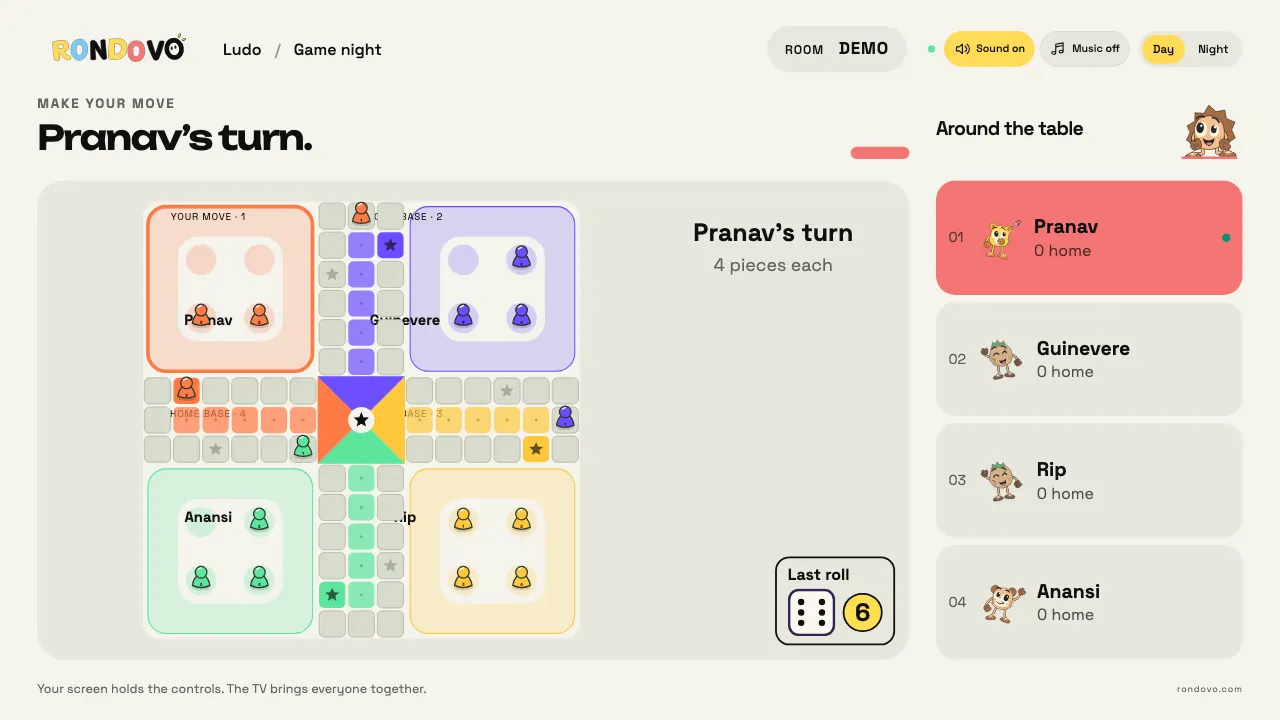
Ludo is a race game for 2 to 4 players. Each player has four tokens in a corner yard; you roll one die, need a six to bring a token out, walk it once round the shared track and up your own coloured column, and the first player to get all four tokens into the middle wins. Land exactly on a rival's token and it goes back to its yard. That is the whole game. Everything else (safe squares, extra rolls, three sixes, blocks) is a rule your family either plays or argues about.
In short
- 2 to 4 players, 4 tokens each, one six-sided die. A game takes 20 to 45 minutes.
- Roll a six to leave the yard. A six also gives you another roll.
- Land on an opponent outside a safe square and you send them back to start.
- Most groups play that three sixes in a row loses the turn and that you need the exact number to reach home.
- Agree the house rules before the first roll. Almost every Ludo fight is about a rule nobody said out loud.
What is Ludo?
Ludo is the simplified, die-rolling cousin of Pachisi, a cross-and-circle race game from India. Pachisi takes its name from the Hindi word for twenty-five, the top throw of the cowrie shells it was played with, and it is old enough that the Mughal emperor Akbar is said to have played it on a giant courtyard board at Fatehpur Sikri, with people as the pieces. The version most of the world knows was sold in England as Ludo from 1896, swapping the shells for a cube die. Today it is one of the most played board games in India, often on a printed board on one side with Snakes and Ladders on the back, and on screens through apps.
If you grew up with Pachisi or a regional cowrie game such as Ashta Chamma, you will recognise the bones: a shared track, safe squares, captures that send pieces home, and a slow walk to the centre.
What you need
- A Ludo board: a 15 by 15 grid shaped like a plus sign, with a coloured yard in each corner and a triangle home in the middle.
- Four tokens per player in four colours (usually red, green, yellow and blue).
- One six-sided die, ideally with a cup.
The shared track runs round the arms of the cross: 52 squares in all. Each colour also has its own home column, five squares leading into the middle. Every token walks the same distance: 51 squares of track from its own start, then five up its column, then one step into home.
Ludo rules, step by step
Setup
Each player picks a colour and puts their four tokens in the yard of that colour. With two players, sit in opposite corners so nobody starts right behind the other. Everyone rolls once; the highest roll goes first, and play goes clockwise.
Getting out of the yard
You need a six to bring a token out. It goes onto the coloured start square just outside your yard. If you have no tokens on the track and you do not roll a six, your turn ends.
When you roll a six and already have tokens out, you choose: bring a new token out, or move one that is already on the track six squares.
Moving
Move one token clockwise by the number you rolled. You cannot split a roll between two tokens. If you have a legal move, most rules say you must take one, even a bad one. If no token can move (all in the yard without a six, or every move would overshoot home), you pass.
Extra rolls
Rolling a six gives you another roll after you move. Most groups also give an extra roll for capturing a token, and some for bringing a token home.
Capturing
If your token finishes its move on a square holding an opponent's token, that token goes back to its yard and has to wait for another six. You only capture by landing exactly on the square; passing over a token does nothing.
Safe squares
Most boards mark safe squares, usually with a star or a globe. A token on a safe square cannot be captured. Many Indian boards have eight: the four coloured start squares and a star on each arm. Some boards have no safe squares at all, which makes the game far more vicious.
Going home
After a full lap your token turns off the track into its own home column. Nobody else can enter your column, so a token there is safe. To land in the middle you usually need the exact number: a token three squares from home needs a three. The first player with all four tokens home wins; the others can keep playing for second and third place.
Common Ludo house rules
These are the rules people mean when they say "that's not how we play". None of them is wrong. Pick yours before you start.
| House rule | How it works | What it does to the game |
|---|---|---|
| Need a six to come out | Only a six releases a token. Some families also allow a one. | Allowing one makes the opening much faster. |
| Three sixes in a row | The third six in one turn is cancelled and the turn ends. Some play that the token moved on the first six goes back too. | Stops one lucky player running away with the game. |
| Extra roll for a capture | Knocking someone home earns another roll. | Makes captures worth chasing. |
| Exact roll to finish | A token needs the exact count to reach home. | Adds the tense ending where you sit one square away for five turns. |
| Capture before home | Your home column stays closed until you have captured at least one token. Played in many Indian homes and in several African countries. | Nobody can win by running and hiding. It forces fights. |
| Blocks | Two of your tokens on one square form a wall that rivals cannot pass or land on. | Adds a defensive layer. Some families ban it as unsporting. |
| Doubling up on a safe square | Two different colours can share a star. | Avoids arguments about who gets the star. |
| Fast Ludo | Start with one token already out, or play with two tokens each. | Halves the game time. Good for kids or a quick round. |
A good rule of thumb for a mixed table: play six to come out, three sixes lose the turn, extra roll for a capture, exact roll home, and leave blocks out. That covers what most people grew up with and keeps the game under 45 minutes.
Ludo strategy that actually helps
Ludo is mostly luck, but a strong player still wins more often than a careless one. These are the habits that make the difference.
Get two tokens out early
One token on the track gives you nothing to choose between. With two or three out, every roll has options: you can run, chase or hide. Use your first few sixes to bring tokens out rather than racing a single one.
Count the danger zone
A rival token can hit you if it sits one to six squares behind you. Before you move, look at the six squares behind where you will land. If an opponent sits there, you have roughly a one in six chance of being hit on their next roll (more if they have several tokens lined up, or if sixes give them extra rolls).
Use the stars
Parking on a safe square costs you nothing and buys a turn of peace. If you can choose between landing six squares past a rival and landing on a star, take the star.
Chase near their home, run near yours
A token that is about to enter its home column has walked 50 squares. Sending it back costs its owner far more than capturing a token that has just come out. Likewise, your own tokens become precious as they get close to home, so stop taking risks with them in the last quarter.
Do not leave a token sitting on your rival's start square
Tokens come out onto their start square. Standing just in front of a yard full of tokens is asking to be hit by the next six.
In the capture-before-home rule, hunt early
If your table plays that you must capture before entering home, do not leave the capture until late. A token circling a second lap with nothing to hit is wasted time.
With two players, play the long game
In a two player game there is only one rival to watch, so you can afford to hold a token back as a hunter just behind their leaders while your others move up.
How long does a game of Ludo take?
A four player game with four tokens each usually runs 30 to 45 minutes. Two players with four tokens take about 20 to 30. Playing with two tokens each, or allowing a one to come out, gets most games under 20 minutes. The slowest part is almost always the ending, waiting for the exact number, so dropping that rule is the easiest way to speed things up.
Ludo online with friends
Ludo moved onto screens years ago, and you have a few honest options.
- Ludo King (Gametion) is the best known app. As of October 2026 its App Store listing says it is free with in-app purchases and ads, supports 2 to 6 players online and local, and offers private rooms for inviting Facebook friends plus voice chat. Good if your group already has the app and does not mind ads.
- Other Ludo apps such as Ludo Club and Ludo Star also let you play with friends. Features change often, so check each store listing before you pick one for a group.
- A physical board on a video call. One person moves everyone's tokens and rolls for remote players. It works for a family call with grandparents, but it is slow.
- Browser games that need no install. Rondovo is one; there are others.
The main trade off is installs and accounts. Apps tend to have the most features and the most players, while browser options are quicker to start with people who will not download anything.
Playing our Ludo on Rondovo
Our Ludo is our own take on the classic, played in the browser. The host opens a room, friends join on their own screens with a four letter code, and a TV is optional: the board can sit on the big screen while each player rolls and picks tokens from the device in their hand. Guests do not need an account, and nobody downloads anything.
The rules, checked against our game engine:
- 2 to 4 players, sitting opposite each other in a two player game.
- A six brings a token out, and a six gives another roll. Three sixes in a row lose the turn.
- Eight safe squares: the four coloured start squares and the four stars. Nobody can be captured on them.
- Capture before home is on: your home column opens only after you have sent an opponent back to their yard. Until then your tokens keep circling. We chose this because it keeps the game a fight, but if your family plays without it, our version will feel different.
- No blocks. Two of your tokens can share a square, but they do not form a wall, and a rival who lands on them sends both back.
- Short a player? The host can add a bot to fill a seat.
- The host can change four things in the lobby: tokens each (1 to 4), seconds a turn (10 to 60, 20 by default; run out and the die rolls and moves for you), exact roll to get home (on by default) and another roll for a capture (on by default).
Where it is weaker: it seats four, not six like Ludo King, and you cannot turn off the capture-before-home rule or play with blocks. Where it is better for a living room: nothing to install, the board on the TV, and a turn timer so nobody stalls the table.
Ashta Chamma: Ludo's traditional cousin
If your grandparents played on a chalk grid with shells, they probably played something like Ashta Chamma, the cowrie race known across south India (Chowka Bhara in Kannada, among other names). The ideas are the same as Ludo: get your pieces round and into the centre, and send rivals back when you land on them. The feel is different.
- Four cowrie shells instead of a die. Count the shells landing mouth up. All four face down counts as eight.
- A four (chamma) or an eight (ashta) brings pieces in and earns another throw. A third four or eight in a row loses the turn, much like three sixes in Ludo.
- A 5 by 5 or 7 by 7 grid. Pieces walk the outer ring, then spiral inward to the middle square, which needs an exact count.
- Crossed squares are safe, and you usually have to capture before you can turn inward.
Our Ashta Chamma follows those rules on either board size, with 2 to 4 pieces each. It is a nice way to show children what their parents played before the plastic Ludo board arrived.
If you like Ludo, try these
- Snakes and Ladders is the other side of most Indian Ludo boards: pure luck, good with small children.
- Pachisi, and Parcheesi, its American cousin played with two dice, have longer tracks and play longer.
- Drop Four is a quick two player or two team game for when Ludo is too long. Ours is at /games/dropfour.
- For more games that work across devices, see our list of free board games online with friends, two player online games and local multiplayer board games.
Questions people ask
How many players can play Ludo?
Classic Ludo is for 2 to 4 players, one colour each. Some apps, including Ludo King, offer boards for 5 or 6. With two players, each can also play two colours to make the game more tactical.
How do you play Ludo with 2 players?
Sit in opposite corners so neither player starts right behind the other, and play the normal rules. For a longer, more tactical game, each player takes two colours and must bring all eight tokens home.
Can 6 people play Ludo?
Not on a standard board, which has four yards. Six player Ludo boards exist with a hexagon shaped track, and some apps offer six player rooms. With six people and one four player board, play in teams of two or three, sharing a colour and taking turns to roll.
Is Ludo good for kids?
Yes. Children from about five can play once they can count the dots on a die. Play with two tokens each, allow a one or a six to come out, and drop the exact roll rule so the game stays short.
Do you need a six to start in Ludo?
In standard rules, yes: a token only leaves the yard on a six. Some families also allow a one, which makes the start much faster. Decide before you play.
What happens if you roll three sixes in Ludo?
Under the most common house rule, the third six is cancelled and your turn ends. Some groups also send back the token moved on the first six, and some do not play the rule at all.
Can two tokens of the same colour block the way?
Only if you play the block rule. In many families two tokens on one square form a wall that rivals cannot pass. In others, including our version, they are simply two tokens that can both be captured.
Do you need an exact roll to get home in Ludo?
Most rules say yes. If you need a three and roll a five, that token cannot move. Some groups allow any roll that reaches the middle, which shortens the ending.
Is Ludo a game of luck or skill?
Mostly luck, since the die decides how far you move. Skill comes in choosing which token to move, when to chase, and when to hide on a safe square. Over many games a careful player wins noticeably more.
What is the difference between Ludo and Pachisi?
Pachisi is the older Indian game, thrown with cowrie shells on a cloth cross with longer arms. Ludo is the simplified version sold in England from 1896, with one die and a smaller board.
Ludo King, Ludo Club, Ludo Star, Parcheesi and Facebook are trademarks of their owners. Rondovo is not affiliated with them.