Family Game Night Ideas: Games for All Ages, How to Run the Night, and Rules That Keep It Fair
By The Rondovo team · Published · Updated · 9 min read
The best family game night ideas are games that a six year old and a grandparent can both win: short rounds, simple rules, and a bit of luck so the adults do not dominate. Good picks for all ages are card games like Uno, drawing and guessing games, charades, Ludo and other race games, quick dexterity games like stacking towers, and team games where kids pair with adults. Plan one game everyone plays, keep rounds under 20 minutes, and stop while people still want more. For game nights with other crowds, our game night games guide covers the lot, and game night ideas for adults is the one for a grown-ups only evening.
In short
- Mixed ages (5 and up): charades, drawing games, Ludo, matching card games, team trivia.
- Older kids and teens: word games, Codenames-style clue games, deduction games, quick strategy games.
- Adults plus teens: social games where you guess each other, longer board games.
- No screens: a deck of cards, paper and pens, and a timer are enough for a dozen games.
- With screens: browser games where everyone plays on their own device, with the board on the TV if you have one.
How to pick games for family game night
Before the list, three questions decide what will work.
Who is the youngest player? Their reading level sets the floor. Under 7, pick games with pictures, colours or actions instead of words. From about 8, simple word and number games work. From 10 or 11, most adult party games are fine with a little help.
How long can they sit? Young children manage 15 to 20 minutes per game. Teenagers will play for an hour if the game is good, and will leave after five minutes if it is not.
How competitive is your family? If someone always cries or sulks when they lose, choose games with lots of luck, team games, or cooperative games where you all win or lose together.
Family game night ideas by age mix
Little kids with parents (ages 4 to 7)
- Animal charades. Act an animal, everyone else guesses. No reading needed. Let the youngest go first.
- Memory (pairs). Lay a deck of picture cards face down and take turns turning two over. Children often beat adults at this one, which is why it works.
- Snakes and Ladders. Pure luck. A good first board game for learning to count squares and take turns.
- Colour matching card games. Uno and similar games teach colours and numbers. For very young players, take out the action cards.
- Simon says, family edition. Each person gets a turn as Simon. Short, loud, and it burns energy before bed.
- Draw what I say. One person describes a simple picture ("a house with a red door and a cat on the roof") and everyone draws it. Compare at the end.
Kids with parents (ages 7 to 11)
- Ludo. Simple rules, captures that make kids shriek, and the dice keep it fair. See our how to play Ludo guide for rules and the house rules to agree first.
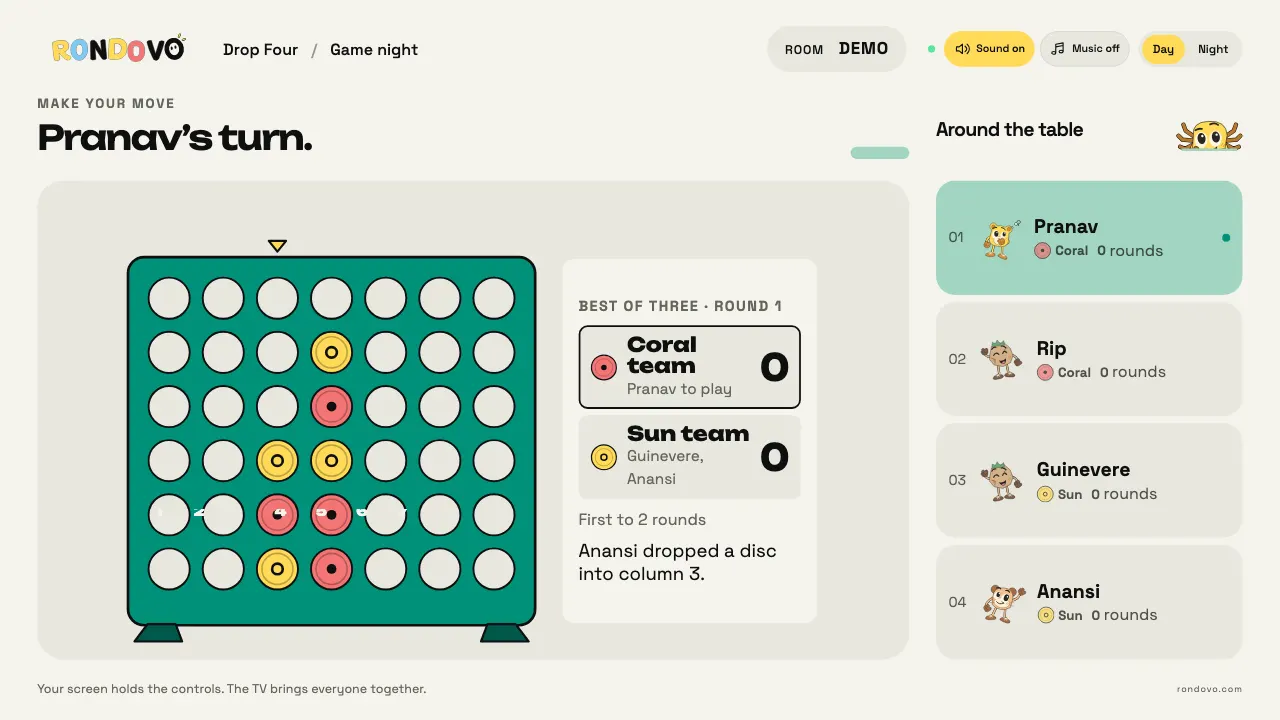
- Four in a row. Fast, two players or two teams, and kids learn to block. Ours is Drop Four, which also plays as teams for up to 8.
- Pictionary-style drawing games. One draws, the rest guess. Kids are often better at guessing than drawing, which levels the field.
- Dots and boxes. Paper and pen, two to four players. Take turns drawing lines; close a box and it is yours.
- Twenty questions. Think of an animal, an object or a family member. Everyone else has twenty yes or no questions.
- Category race. Pick a letter and five categories (animal, food, country, name, thing). Everyone writes one for each. Points for answers nobody else has.
Tweens and teens with adults (ages 11 and up)
- Charades with films and songs. Teens bring the songs, adults bring the films. Mix the cards so both have to act the other's. Our charades ideas has ready-made lists.
- Word guessing with banned words. Describe a word without saying five or six forbidden ones. Fast and noisy. Our version is Hush.
- Clue word games. Two teams, a grid of words, a spymaster who gives one-word clues. Codenames is the famous one. Teens pick it up in one round.
- Wavelength style guessing. One person gives a clue for a spot on a scale ("cold to hot"), everyone guesses where it sits. It shows how differently each person thinks. Ours is Mindline.
- Five letter word puzzles. Everyone solves the same word, then compares how many guesses it took.
- Strategy games. Ticket to Ride, Catan and their cousins work once the youngest is about 10 and can wait their turn.
Three generations
- Tambola or bingo. Nobody needs skill, grandparents often know it best, and the caller can be a child.
- Card games everyone knows. Rummy, go fish, crazy eights, or whatever your family played growing up. Let grandparents teach their version.
- Family trivia. Questions about your own family: "What was Grandpa's first job?", "Which of us broke the kitchen window?" Older relatives win easily, and the stories that come out are the point.
- Heads up style guessing. One person holds up a card or a screen they cannot see, everyone else gives clues. Ours is Face Up.
Family game night without screens
Plenty of families want one night a week with every screen in a basket. All you need:
- A deck of cards: go fish, crazy eights, snap, rummy, spoons, war.
- Paper and pens: dots and boxes, category race, hangman, consequences, noughts and crosses.
- A timer: charades, 30 second categories ("name as many fruits as you can"), speed drawing.
- A die or two: dice games like pig (roll as often as you like, but a one wipes your turn).
- Board games you own: Ludo, Snakes and Ladders, Monopoly, Scrabble, chess.
The no-screens night is great for younger children and for families who spend all day on devices. The weakness is setup and score keeping, which usually falls on one parent.
Family game night with screens
Screens are not the enemy of game night if everyone plays together in the same room. A few ways families do it:
- Console party games: anything with four controllers. Works well but needs a console and enough controllers.
- Party game packs like Jackbox, where the TV shows the game and players join on their own devices. Paid, and only the person hosting needs to buy it.
- Free browser games where one person opens a room and everyone joins from any device, with the board on the TV if you like. No installs. Rondovo is one; see our guide to TV games without a console for others.
Screens shine in two situations: when the family is too big for one board, and when someone is joining from another city.
How to run a family game night
Before
- Pick a fixed night. Same night every week or every fortnight. Kids will start counting down to it.
- Let a different person choose the main game each time. Including the youngest. Everybody plays one game they did not pick.
- Plan the food. Our game night food ideas has snacks that keep hands clean. For a fuller checklist, see how to host a game night.
- Learn the rules beforehand. Reading a rulebook aloud for twenty minutes kills the mood. Watch a short video or read a guide the day before.
During
- Start with a short, easy game. Five minutes, everyone wins or loses fast, and the latecomers can join.
- Play the main game second. This is when everyone is warmed up and nobody is tired yet.
- Finish with something silly. Charades or a drawing game sends everyone to bed laughing rather than sulking over the last result.
- Keep it to 60 to 90 minutes with young children. Stop while people still want one more round.
Snacks
Finger food that does not leave greasy hands on cards: popcorn, fruit, cut sandwiches, cheese cubes, pretzels. Keep drinks on a separate table so nobody knocks juice across the board. A pizza night tradition works well because nobody has to cook during the games.
House rules that keep family game night fair
Mixed ages mean the adults can win every time if nobody adjusts. These keep it fun for everyone.
- Team up uneven players. Pair the youngest with the strongest player, or kids against adults with a handicap.
- Handicaps. Adults start with fewer cards, fewer tokens, or a shorter turn timer. Younger players get an extra roll or a hint.
- Cooperative games once in a while. When everyone wins or loses together, nobody sulks.
- Rotate who goes first. The youngest goes first in the first game, then it moves round.
- No coaching other people's turns unless they ask. Teens hate it, and kids learn faster by trying.
- A loser's privilege. The player who came last picks the next game or the dessert. Losing becomes less painful.
- Agree rules before you start. Most family game night arguments are about a rule nobody mentioned. Say it out loud first.
- Good sport points. Some families give a point for congratulating the winner. It sounds corny and it works.
Family game night on Rondovo
Rondovo is a free website of party, board and card games played together. One person makes a room and gets a four letter code, the rest join at rondovo.com from any device, and nobody downloads anything. Guests need no account. A TV is optional: open rondovo.com/tv in its browser and add it to the room. It is not the only way to play together on screens, and it does not replace a board game on the table, but it helps when you have more players than a board seats or someone is joining from far away.
The games that work best across ages:
- Drop Four: four in a row for 2 to 8, two players or two teams, 10 minutes.
- Ludo: the classic race for 2 to 4, with the board on the TV and turns on each player's screen.
- Face Up: hold your screen up for the group to see, and guess the word from their clues. 3 to 12 players.
- Scrawl: draw on your screen, everyone else guesses. 3 to 16 players.
- Doodle Recall: everyone draws the same words against the clock, then names their own drawings from memory. Little kids love seeing their drawings on the TV.
- Mindline: guess where someone's clue sits on a scale. Good for teens and adults.
Where it is weaker for families: most of our word games need reading, so children under 7 need a grown-up partner, and there is no real cooperative game yet. For birthdays and bigger gatherings, our party games guide picks up from here.
Questions people ask
What games are good for family game night with all ages?
Games with short rounds, simple rules and some luck: charades, drawing and guessing games, Ludo, Snakes and Ladders, matching card games, tambola or bingo, and team trivia about your own family.
How do you make family game night fun for teenagers?
Let them choose the game sometimes, include party games where they can be funny, keep it under 90 minutes, and include games they already like on screens. Pairing them with younger siblings as a team also works.
Can you have a family game night online for free?
Yes. Free browser games like ours let one person open a room and everyone else join from any device with a code, including relatives in other cities on a video call. Each person picks "Just this screen" and sees the board on their own device, so nobody has to share their screen, and nobody needs to install anything.
How often should you have a family game night?
Once a week or once a fortnight works for most families. A fixed night matters more than the frequency, because children look forward to it.
What do you need for a family game night?
A deck of cards, paper and pens, a timer and a couple of board games cover most nights. Snacks and small prizes help. A TV and a free browser game add options for bigger groups.
How do you stop arguments during family games?
Agree the rules before you start, pair strong and weak players, rotate who goes first, and give the last place player the next pick. Cooperative games help when one person always gets upset.
Uno, Codenames, Ticket to Ride, Catan, Monopoly, Scrabble, Jackbox, Wavelength, Pictionary and Heads Up are trademarks of their owners. Rondovo is not affiliated with them.