Party Games for Large Groups: What Works at 6, 10 and 16 Players
By The Rondovo team · Published · Updated · 11 min read
The best party games for large groups do one of two things: everyone plays at the same moment, or the group splits into two teams. Games where people take turns one at a time are fine at 6 players and painful at 16. For 10 or more people, start with a team game (charades, a taboo style word game, a Codenames style grid) or an everyone-at-once game (drawing and guessing, voting games, Mafia), and keep each round under five minutes.
In short
- Count the wait, not the players. If a player can go more than three or four minutes without doing anything, the game is too slow for your group.
- 6 players can play almost anything. 10 is where turn-by-turn games start to drag. 16 needs teams or simultaneous play.
- Teams suit loud rooms and mixed ages. Everyone at once suits groups that like scores and quieter players.
- On a video call, pick games where talking is the game (Mafia, imposter games) and avoid anything that relies on shouting over each other.
- Above 16, split into two groups. Rondovo rooms cap at 16, and so do many online party games.
Why some party games break in large groups
When a game falls apart at 12 players, the rules are rarely to blame. The waiting is, and you can work it out in advance.
Take a drawing game where each person draws for 60 seconds. At 6 players, a full round where everyone draws once takes about 6 minutes. At 16, it takes 16 minutes or more with the reveals. If guessers have something to do the whole time, that is fine. If they are just watching, half the room has drifted into side conversations by minute five.
Three things break first as the group grows:
- Turn order. Anything where one person acts and everyone else waits. The wait grows with every new player.
- Crosstalk. Games where everyone shouts answers work at 8. At 15, only the three loudest people are playing.
- The spotlight. In a 16 player game, each person gets one sixteenth of the attention. Games that rely on one person performing (a long story, a monologue) leave everyone else as an audience.
Games that scale well get around this in one of a few ways. Everyone acts at the same moment (all draw, all vote, all solve). The group splits into two teams, so you are always either acting or defending. Or one person is on the spot but everyone else has a job during their turn, like guessing on their own screen or voting.
Team games vs everyone at once
These are the two shapes that survive large groups. They feel very different.
Team games (charades, taboo style word games, a Codenames style grid) turn 16 people into two groups of 8. Everyone is involved even when they are not the one acting, because their team is either guessing or watching for mistakes. They are loud and physical, need almost no reading, and work across ages. The downside: within a team, the confident players do most of the guessing.
Everyone at once games (drawing and guessing, vote games, word races) give every player the same task at the same time, usually on their own device. Scores are individual. Quiet players get the same number of turns as loud ones. The downside: they can feel like a room full of people staring at screens unless the game has a reveal moment that pulls everyone back together.
A good night for a big group often uses both: a team game to warm up the room, then an everyone-at-once game when people want a winner.
Party games for 6 players
Six is the easiest large-ish group. Most games work, including turn-by-turn ones.
- Imposter games (everyone has a secret word except one player) are at their best around 6 to 8. Each hint matters and everyone gets to accuse. Odd One Out runs this on everyone's own screen.
- Two truths and a lie works well because 6 turns pass quickly. Our guide to two truths and a lie has example statements and scoring.
- Drawing games like Scrawl or Spindoodle run two full rounds in about 15 minutes.
- Mafia works at 6, but it is fragile: one Mafia, one Detective, one Doctor and three Villagers means a bad first vote can end the game early.
At 6, you can also play smaller board games that do not suit bigger groups. If half the group drifts to a card game, that is fine.
Party games for 10 players
Ten is the size where you have to choose your game with some care. Turn-by-turn games still work, but only if each turn is short and everyone else has something to do during it.
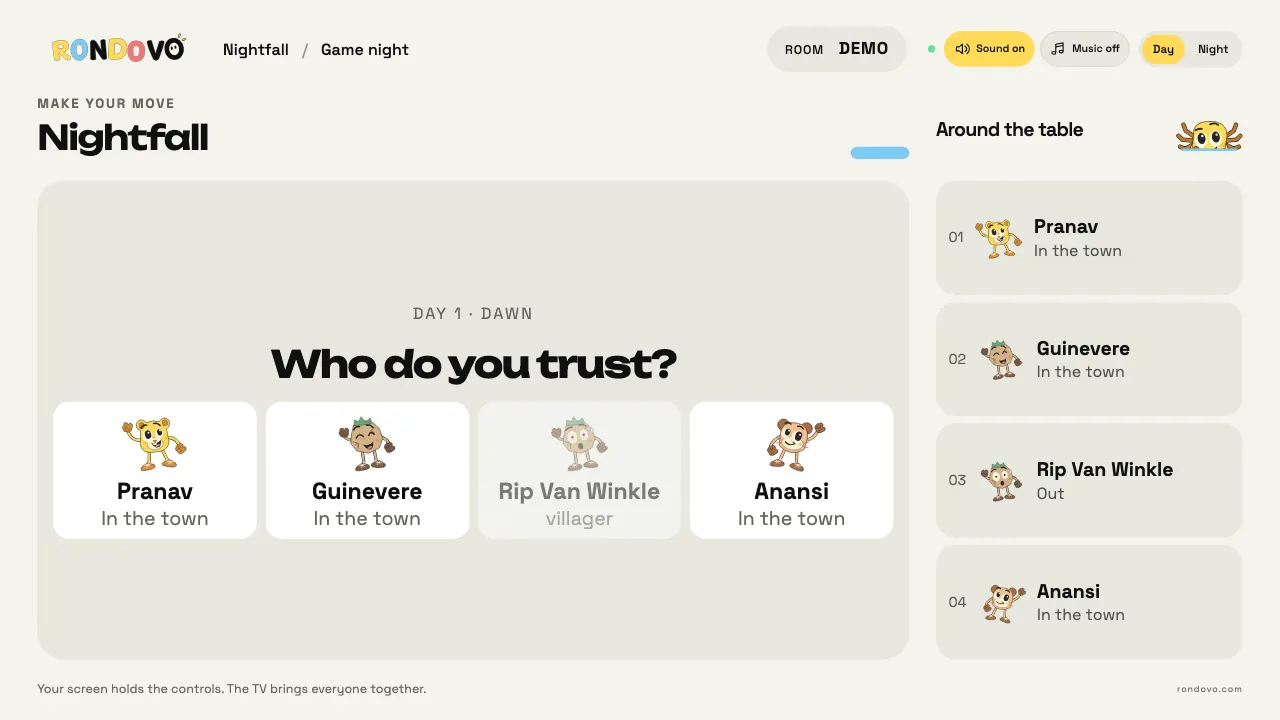
- Mafia comes into its own. With 10 players, two Mafia and a full set of special roles make the discussion tense rather than random. In Nightfall, our version, the game itself narrates, so nobody has to sit out to run it; at 10 or more players it allows 4 minutes of daytime discussion by default instead of 3. For the full rules, see how to play Mafia.
- Taboo style team games are excellent at 10, five per side. In Hush, the defending team sees the forbidden words and buzzes when the clue-giver slips. At 10 or more players it gives each team 4 turns by default so everyone gives clues at least once.
- Telephone drawing games like Chain Sketch work up to 12. Everyone draws or guesses at the same time, so there is no waiting at all; the long books are what make the ending funny.
- Imposter games still work at 10, but add a second imposter. In Odd One Out the host can set two odd ones out from 7 players up.
Party games for 16 players
At 16 people, only two shapes really work: teams, or everyone playing at once with a strong reveal.
Team games that hold 16:
- Charades. Two teams of 8. In Act It Out, the other team picks the first word of each turn, which makes it competitive, and the word only shows on the actor's screen. Default turns are 60 seconds.
- Taboo style. Hush takes up to 16.
- A Codenames style grid. Spy Grid splits the room into two teams with a handler each. Teammates discuss and tap words on their own screens, so the debate stays inside the team.
Everyone at once games that hold 16:
- Drawing and guessing. Scrawl drops to one round by default once 8 or more people join, so a 16 player game is about 16 to 20 minutes. Everyone guesses on their own screen while one person draws, so nobody is idle.
- Vote games. Most Likely To puts a "who is most likely to" prompt on the screen, everyone votes for a player, and the reveal does the work. Votes take 25 seconds, so ten prompts fly by. It gets funnier with more people, not less.
- Word races. Five Letters gives all 16 players the same five-letter word, with two minutes per word by default. The shared screen shows only coloured squares, so you can see who is close without spoiling it.
- Mafia at full size. Nightfall takes 16 players and deals 4 Mafia by default. A full game can run 30 minutes, and players who are out early will want something else to do.
- Number games. Bingo and its cousin Tambola (housie) are the most patient games there are. Nobody waits for a turn, and grandparents and kids play on equal terms.
Party games for more than 16 people
Very large groups (20, 30, a whole office floor) need a different approach.
- Split into rooms. Two games of 12 are better than one game of 24. Many online party games cap a room at around 16 (Rondovo does). Open two rooms and swap people between games.
- Use games without devices. Charades, Fishbowl (also called Salad Bowl: three rounds of describing, one word, then acting, all with the same slips of paper), and Wink Murder work with any number.
- Pick a host-led quiz. A quiz with a host reading questions and teams writing answers on paper scales to a whole pub. It is not much of a party game, but it works. Our office party games guide has full plans for 50 and 100 people.
- Check a game's real cap before inviting. Some browser games take more players: skribbl.io's private rooms take up to 20, for example.
Online party games for big groups: in person vs video call
The same game can be great in a living room and flat on Zoom. A few things change.
In person, a shared screen (a TV or a laptop on a shelf) becomes the campfire. Physical games shine: charades, a guessing game where you hold your screen to your forehead like Face Up, anything with buzzing and shouting. Sound carries, so team games are at their loudest and best.
On a video call, two problems appear. Audio only lets one person talk at a time, so shout-out games turn into a mess of half sentences. And if the game needs a shared screen, someone has to share it, which adds lag and makes drawings blurry.
What works on calls:
- Talking games where taking turns to speak is the point. Mafia and imposter games are almost better on a call, because everyone is already in their own box and you can watch faces.
- Everyone at once games on each player's own screen. Drawing, voting and word races where every device shows the board. Nobody needs to screen share; the call is just for reactions. On Rondovo, every player's screen carries the shared board when there is no TV, which is why our games work on calls.
- Gallery view on. For Mafia and Two Truths, people need to see faces. Ask everyone to turn cameras on.
What struggles: charades with poor cameras, fast buzzer games where audio delay decides who was first, and anything that needs one person to hold up a device to the group.
A quick picker by group size
| Group size | In the same room | On a video call |
|---|---|---|
| 6 | Odd One Out, Spindoodle | Odd One Out, Two Truths |
| 8 to 10 | Hush, Chain Sketch | Nightfall, Chain Sketch |
| 12 | Act It Out, Fill-In | Fill-In, Scrawl |
| 16 | Spy Grid, Most Likely To | Nightfall, Five Letters |
| 17 and up | Charades, Fishbowl, two rooms | Two rooms, or a hosted quiz |
Tips for hosting a big group
Explain while people play. With 15 people, a five-minute rules speech loses half of them. Pick games where the first round teaches the game. All our games show a short how-to-play on each player's screen before the first round.
Start with something everyone can do at once. A vote game or a word race gets everyone in without anyone feeling put on the spot. Save performing games (charades, acting) for when the room has warmed up.
Keep rounds short and stop early. End a game while people still want one more round. Ten minutes is a good target for a big group's first game.
Have a plan for people who are out. In Mafia, eliminated players get bored. Let them watch (in Nightfall they can follow the game but not vote), or keep the game small and run a quick second game for them. Someone who joins a Rondovo room mid-game watches until the next one starts.
Seat teams by friend group, then shuffle. Friends on the same team warm up faster; after one game, mix them so people meet.
For smaller gatherings and every other setting, our main party games list sorts 62 games by size and energy. If your crowd is mostly here because of a holiday, our Christmas party games list has seasonal picks. And if you were looking for something like Jackbox but bigger, see our guide to games like Jackbox.
How Rondovo fits a large group
Rondovo is a free site for party and board games. One person hosts a room and gets a four letter code; everyone else joins on their own screen in a browser, with no download and no account for guests. It is free, and a TV is optional. On a video call, everyone picks "Just this screen" and sees the board on their own device. Rooms hold up to 16 people, and 14 of our party games take all 16 (some, like Fill-In, Chain Sketch and Odd One Out, stop at 12).
Where we fall short for large groups: there is no audience mode, so the 17th person cannot join a room, and we do not have a general knowledge trivia game. For a crowd of 30, run two rooms or play something without devices.
Questions people ask
What is the best party game for a large group?
For 10 or more people, a team game like charades or a taboo style word game, or an everyone-at-once game like a drawing game or a Mafia style hidden role game. Avoid games where one player acts while the rest wait.
What games can 10 people play online?
Mafia, imposter games like Odd One Out, drawing games like Scrawl, vote games like Most Likely To, and Codenames style team games like Spy Grid. Pick games where each player sees the board on their own device, so nobody has to share a screen.
What games can 16 people play?
Team games (charades, taboo style, a Codenames style grid) and games where everyone plays at once (drawing and guessing, voting, word races, bingo). Mafia also works at 16 with four Mafia.
How do you keep a large group engaged?
Keep each player's wait under three or four minutes. Choose simultaneous or team games, keep rounds short, and stop each game while people still want more.
What are good party games for 20 or more people?
Charades, Fishbowl (Salad Bowl) and Wink Murder work with any number. For online games, split into two rooms of 10, since many online party games cap around 16 players.
Can you play party games for big groups on Zoom?
Yes. Talking games like Mafia and imposter games work especially well on video calls. Drawing and voting games work too if each player sees the board on their own device. Fast shouting and buzzer games suffer from audio delay.
Codenames, Taboo, Jackbox, Zoom and skribbl.io are trademarks of their owners. Rondovo is not affiliated with them.