Icebreaker Games: 22 Games for Adults, Work and Small Groups, Plus 120 Original Icebreaker Questions by Depth
By The Rondovo team · Published · Updated · 16 min read
Good icebreaker games are short, low stakes and easy to opt out of. For most adult groups, start with a light question everyone answers in one sentence, then move to a quick game like Two Truths and a Lie, This or That, or a shared guessing game, and keep the whole thing under ten minutes. Below are 22 icebreaker games sorted by setting (work, small groups, big groups, video calls and parties), 120 original icebreaker questions grouped from light to deep, and a short method for running them so nobody feels put on the spot.
In short
- The rule that matters most: anyone can pass, every time, with no explanation.
- Go first yourself. Your answer sets the depth and the length.
- Start light. "What did you have for breakfast?" beats "What is your biggest fear?" in almost every room.
- Small groups first. Pairs or threes before speaking to the whole room.
- Best for work: One Word Check-in, This or That, Two Truths and a Lie, Mindline.
- Best for video calls: Show One Thing, Chat Waterfall, a browser game everyone joins.
- Best for parties: Name Tag Swap, Find Someone Who, Fill-In.
What is an icebreaker game?
An icebreaker is a short activity at the start of a meeting, class, workshop or party that gets people talking before the real business starts. Its job is modest: give everyone a reason to speak once, early, in a way that feels easy. People who have spoken once tend to speak again.
The bad reputation icebreakers have comes from three mistakes. They go too deep too soon, they put one person in the spotlight for too long, and they run past their welcome. Avoid those and the groans stop.
How to run an icebreaker so nobody feels put on the spot
These are the habits that separate a warm room from an awkward one. They apply to every game and question below.
- Say the pass rule out loud. "Anyone can pass, no reason needed." Then honour it without comment. A pass is not a failure.
- Answer first, and answer briefly. If you give a light, funny, ten second answer, others will match it. If you tell a long emotional story, you have set a bar nobody asked for.
- Offer a choice. Put three questions on the screen and let each person pick one. Choice lowers the pressure more than any other trick.
- Write before you speak. For anything beyond the lightest questions, give everyone 30 seconds to jot an answer. Quieter people and those working in a second language get time to think.
- Use pairs before the whole room. Talking to one person is easier than talking to twenty. Have pairs share with each other, then ask for a few volunteers.
- Do not go round in a fixed order for anything personal. Waiting your turn while dreading it is the worst part. Popcorn style (whoever is ready speaks) works better.
- Keep it work safe at work. Skip questions about bodies, weight, money, relationships, religion, politics, alcohol, family plans and health. Someone in the room has a reason to avoid each of them.
- Keep it physically optional. No forced touching, standing or moving for anyone who would rather not. Offer a seated version of every active game.
- Time box it. Five to ten minutes for a meeting. Fifteen to twenty for a workshop kickoff. Stop while people are still enjoying it.
- Do not grade answers. "Great answer" for one person and silence for the next feels like a ranking.
Icebreaker games for work and meetings
These fit the first five to ten minutes of a meeting, need no supplies and stay professional.
1. One Word Check-in
Any size, 2 to 5 minutes. Everyone says one word for how they are arriving today. Nobody explains unless they want to. It is fast, honest and surprisingly useful for a facilitator reading the room.
2. This or That
Any size, 5 minutes. Read two options (mountains or beach, early bird or night owl) and people pick one, by raising a hand, moving to a side of the room or typing in chat. Nobody has to explain. Twenty pairs are listed further down.
3. Two Truths and a Lie
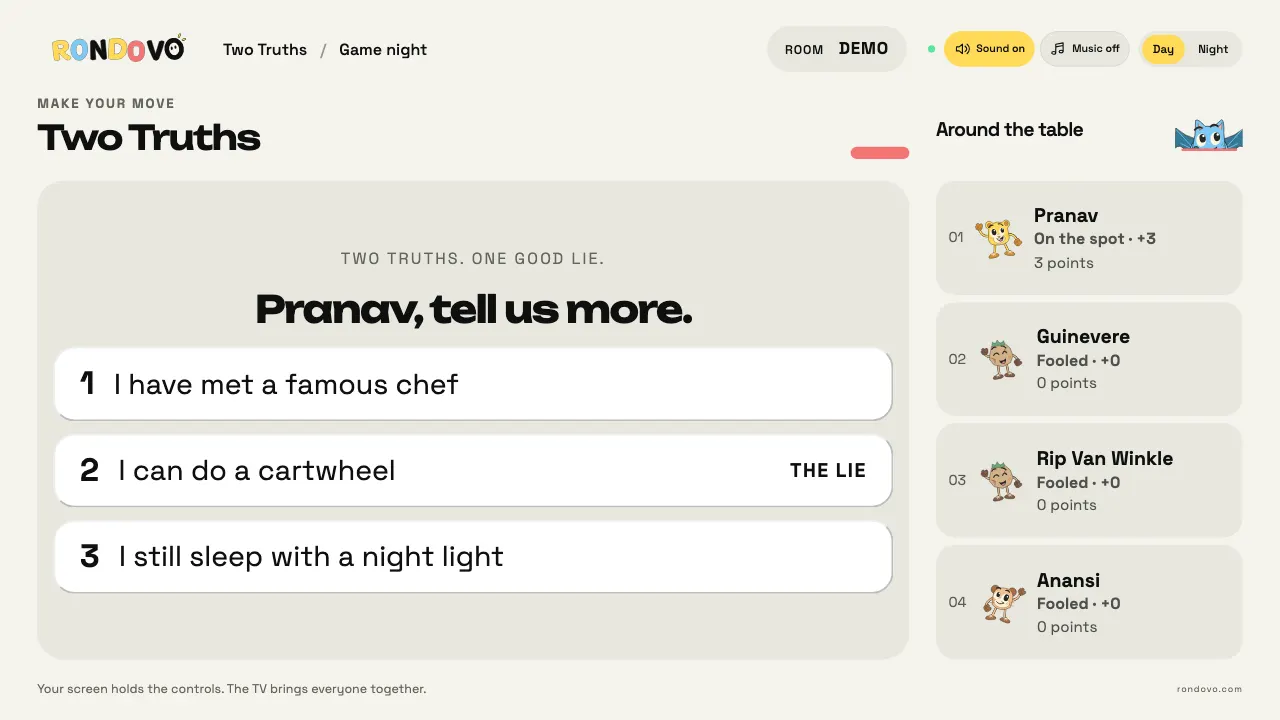
3 to 12 players, 10 to 15 minutes. Each person shares three statements about themselves, one false; the group guesses the lie. Tell people in advance so they can prepare harmless statements. Our Two Truths and a Lie guide has ideas, and our Two Truths game runs it with private voting on everyone's own screen.
4. Common Ground
Groups of 3 to 5, 5 to 10 minutes. Small groups have five minutes to find three things they all share that are not obvious ("we all work here" does not count). Each group reports its strangest one. It builds connection without anyone revealing much.
5. Desert Island Tool
Any size, 5 minutes. Everyone names one tool, app or object from their working day they would take to a desert island and why. Professional, slightly silly, and it tells you how people work.
6. Mindline
2 to 16 players, about 15 minutes. A clue giver sees a secret spot on a line between two extremes (such as Ordinary and Magical) and names a thing that sits there. Everyone else slides a guess on their own screen. It is a great icebreaker for teams because people learn how colleagues think without sharing anything personal. Play Mindline free in a browser with a four letter room code. Everyone sees the reveal on their own screen, or on a TV if you add one.
Icebreaker games for small groups
With three to eight people you can go a little deeper and give everyone more airtime.
7. Three Words
3 to 8 players, 10 minutes. Each person describes their week, their job or their hometown in exactly three words. Others can ask one follow-up question each.
8. The Question Jar
3 to 10 players, 10 to 20 minutes. Write questions on slips (pick from the lists below). People draw one and answer, or put it back and draw another. The put-it-back rule makes it feel safe.
9. Highs and Lows
3 to 8 players, 10 minutes. Each person shares one good thing and one annoying thing from their week. Keep the low small: a broken umbrella, not a breakup.
10. Story Chain Introductions
3 to 8 players, 10 minutes. Each person introduces the person to their left using one true fact they learned in a two minute chat beforehand, plus one invented detail. The group guesses which part was made up.
11. Odd One Out
4 to 12 players, about 15 minutes. Everyone gets the same secret word except the odd players, who get a related one and are not told they are different. Players type a hint each, then vote out whoever seems off. Because the hints are about a word, not about yourself, it warms a group up with zero personal disclosure. Odd One Out runs it on everyone's own screen.
Icebreaker games for large groups
Twenty or more people need games where everyone acts at once.
12. Find Someone Who
15 to 100 players, 10 to 15 minutes, a printed grid. Each person gets a grid of prompts (has been to another continent, plays an instrument, was born in winter). Mingle and find a different person for each square. Choose prompts nobody would mind admitting to.
13. Line Up
10 to 40 players, 5 to 10 minutes. The group lines up by birthday, by how far they travelled today, or by first name alphabetically, without speaking. It gets a room laughing within a minute. Offer a seated version where people hold up numbers.
14. Rock Paper Scissors Tournament
Any number, 5 minutes. Pair up and play. The loser becomes the winner's loudest supporter and follows them to the next match. The final has the whole room cheering for two people.
15. Speed Introductions
10 to 60 players, 15 minutes. Two lines face each other. Pairs get 90 seconds on one question, then one line shifts along. Five rounds and everyone has met five people properly.
Virtual icebreaker games
On a video call, nobody can read the room, and people talk over each other. These games give everyone a turn without that awkward silence.
16. Show One Thing
Up to 15 people, 10 minutes. Everyone grabs one object within reach and explains it in 20 seconds. Mugs and pets are the usual stars.
17. Chat Waterfall
Any size, 3 minutes. Ask a question, everyone types an answer in chat but does not press enter. On "go", everyone sends at once. The answers pour down together, so nobody is first or last, and nobody copies.
18. Background Tour
Up to 10 people, 10 minutes. People with cameras on describe one thing in their background. Make cameras optional and let anyone describe their view instead.
19. A shared browser game
3 to 16 people, 10 to 15 minutes. A game everyone joins with a link removes the "who speaks next" problem. Free picks include skribbl.io for drawing and Codenames Online for teams. Our own Fill-In, Mindline and Two Truths work on a call too: everyone opens the room on their own device with a four letter code and picks "Just this screen", so each person sees the whole game and nobody has to share their screen. For a full evening online, see our virtual game night ideas.
Icebreaker games for adults at parties
Parties can take more play and a bit more cheek, but the pass rule still holds.
20. Name Tag Swap
10 to 40 players. Everyone wears a name tag with a famous person's name they cannot see. Ask others yes or no questions to work out who you are. It forces mingling without small talk.
21. Fill-In
3 to 12 players, about 15 minutes. A sentence with a blank appears on the shared screen (a TV, or everyone's own device); everyone types the funniest ending on their own screen; the room votes on anonymous answers. Anonymous voting means shy people can be the funniest in the room without anyone knowing until the reveal.
22. Most Likely To
3 to 16 players, about 10 minutes. Read a "who is most likely to" prompt and everyone points at once. Use it with friends who know each other, not strangers. Our most likely to questions list keeps it kind, and the Most Likely To game keeps votes hidden until the reveal.
For more party ideas, from house parties to holidays, see our party games hub.
120 icebreaker questions, from light to deep
We wrote every question below for this guide. They are grouped by depth so you can match the room. Use level one with strangers and at work, level two once people have met, and level three only with groups that already trust each other. The final group is quick This or That pairs.
Level one: light and easy (40 questions)
Safe with strangers, colleagues and anyone in between.
- What is the best thing you ate this week?
- What was the last thing that made you laugh out loud?
- Which app on your screen do you open most that you are slightly embarrassed about?
- What is a small thing that instantly improves your day?
- If you could add one hour to your day, what would you do with it?
- What is the most useful thing in your kitchen?
- Tea, coffee, or neither, and how do you take it?
- What was your favourite subject at school, and why?
- What is a smell that takes you straight back somewhere?
- If your week had a soundtrack, what song would be playing?
- What is the oldest thing you own that you still use?
- What is your go-to order at a takeaway?
- What did you want to be when you were seven?
- Which season suits you best?
- What is something you are weirdly good at?
- What is the best gift you have received that cost under ten dollars?
- What would your perfect lazy Sunday look like?
- Which fictional place would you most like to visit?
- What is a word you always misspell?
- What is the strangest food combination you enjoy?
- What is on your desk or table right now that should not be there?
- If you could instantly master one hobby, which would it be?
- What is a film you can watch again and again?
- What is your favourite way to spend 20 free minutes?
- What was the first concert, show or match you went to?
- What is your most used emoji?
- What would you name a pet goldfish?
- What is a skill you picked up in the last year?
- If you ran a café, what would be on the menu board?
- What is your favourite sound?
- Which board game or card game did you play most as a child?
- What is the best piece of advice on a tea bag, fortune cookie or poster you have seen?
- What is a small luxury you would not give up?
- Morning person or evening person, honestly?
- What is the best name for a boat you have ever seen or can invent?
- If you could have any view from your window, what would it be?
- What is a snack you could eat every day?
- Which animal best matches your energy today?
- What is a tiny thing someone did recently that made you smile?
- What is the best thing about where you live?
Level two: getting to know you (45 questions)
For groups that have met at least once. Still nothing anyone would regret sharing.
- What is something you have changed your mind about in the last few years?
- What is a job you would try for one week, just to see?
- What is a place you have been that surprised you?
- Who is someone outside your family who taught you something important?
- What is something you are learning right now?
- What is the best mistake you ever made?
- What is a habit you have kept for more than five years?
- What is a small goal you have for this month?
- What would your friends say you are the go-to person for?
- What is a book, podcast or show that changed how you see something?
- What is a tradition you love, from any part of your life?
- What is the most interesting job you have heard of?
- What is something people often get wrong about your job or field?
- What did you do on the best day off you have had this year?
- What would you do if you had a free afternoon in a city you have never visited?
- Which talent do you most admire in other people?
- What is a question you wish people asked you more often?
- What is something you are quietly proud of?
- If you could swap lives with anyone for a day, past or present, who would it be?
- What is the best compliment you have ever received?
- What is a rule you follow that other people might find odd?
- What are you looking forward to in the next few weeks?
- What is a skill you would like to teach someone?
- What was your first job, and what did it teach you?
- What would you put in a time capsule to be opened in 20 years?
- What does a really good day at work look like for you?
- Which era would you visit for a week?
- What is the most useful thing you learned outside a classroom?
- If you wrote a short book, what would it be about?
- What is a topic you could talk about for an hour without notes?
- What is a decision that turned out better than you expected?
- What kind of problems do you enjoy solving?
- What is an everyday object you think is beautifully designed?
- What is a piece of music that always lifts you?
- What is the most adventurous thing you have eaten?
- Who would you invite to a dinner of four, living or historical?
- What is something small you do to look after yourself?
- Where do you do your best thinking?
- What is a hobby you dropped that you would like to pick up again?
- What is a skill everyone should learn by age 20?
- What is the kindest thing a stranger has done for you?
- If you could solve one everyday annoyance, what would it be?
- What do you collect, or what would you collect if you had the space?
- What is a place that feels like home that is not your home?
- What would you like to be known for in this group?
Level three: deeper questions (20 questions)
Only for groups that know and trust each other, never as a cold opener at work, and always with the pass rule said out loud. Give people a minute to think first.
- What is something you believed strongly at 18 that you no longer believe?
- What is a moment you felt really proud of someone else?
- What does a good friend do that most people forget to do?
- What is something you are still figuring out?
- What advice would you give yourself five years ago?
- When do you feel most like yourself?
- What is a value you try to live by, and where did it come from?
- What is a risk you took that you are glad you took?
- What do you wish more people understood about you?
- What is a lesson you had to learn more than once?
- What would you do differently if nobody were watching or judging?
- What is something you have forgiven yourself for?
- What makes you feel genuinely rested?
- Who has shaped the way you treat other people?
- What is a hard thing you did that nobody saw?
- What does success look like to you right now, as opposed to ten years ago?
- What is something you are grateful for that you rarely mention?
- What is a question you are still trying to answer for yourself?
- If this year had a title, what would it be?
- What do you hope people feel after spending time with you?
This or That: 15 quick picks
Read one pair, people choose, nobody explains unless they want to. Great for big groups and chat.
- Sunrise or sunset?
- Sweet or savoury breakfast?
- Window seat or aisle seat?
- Plan everything or wing it?
- Books or podcasts?
- Cats, dogs or neither?
- City break or countryside?
- Text or call?
- Too hot or too cold?
- Early to the airport or just in time?
- Board games or video games?
- Mountains or sea?
- Write lists or keep it in your head?
- Rewatch a favourite or try something new?
- Big party or small dinner?
How to choose the right icebreaker
Match the game to the room in four questions.
| Question | If yes | If no |
|---|---|---|
| Do people already know each other? | Level two questions, Most Likely To | Level one, This or That, Common Ground |
| Is it a work setting? | One Word Check-in, Mindline, Desert Island Tool | Fill-In, Name Tag Swap |
| More than 15 people? | Find Someone Who, Line Up, Chat Waterfall | Question Jar, Three Words |
| On a video call? | Chat Waterfall, Show One Thing, a browser game | Common Ground, Speed Introductions |
If your icebreaker is the first step of a longer team session, our team building games guide covers what to run next, from ten minute exercises to full hour activities.
Questions people ask
What is a good icebreaker game for adults?
Two Truths and a Lie, This or That and Common Ground work for nearly any adult group. They are quick, need nothing, and let people choose how much to share. At parties, Name Tag Swap and Fill-In add more laughter.
What are good icebreaker games for work?
One Word Check-in, This or That, Desert Island Tool and Mindline are quick and professional. Avoid questions about family, health, money or relationships, and always allow a pass.
What is a good icebreaker for a small group?
The Question Jar with a put-it-back rule, Three Words and Highs and Lows all give each person real airtime in under 15 minutes.
What are good virtual icebreaker games?
Chat Waterfall, Show One Thing and a shared browser game everyone joins with a link. Keep cameras optional and let people answer in chat instead of out loud.
How long should an icebreaker be?
Five to ten minutes before a meeting, fifteen to twenty at the start of a workshop or party. Stop while people are still enjoying it.
How do you make icebreakers less awkward?
Answer first and keep it short, offer a choice of questions, let people think before speaking, start in pairs, and make passing completely normal.
Break the ice tonight
Pick three questions from level one, say the pass rule, and go first. If you want a game to follow, open Two Truths or Mindline, share the four letter code, and everyone joins on their own screen with no download or account.
skribbl.io, Codenames and Codenames Online are trademarks of their owners. Rondovo is not affiliated with them.