Team Building Games: 24 Activities for Work, in the Office and Remote, From 10 Minutes to an Hour
By The Rondovo team · Published · Updated · 13 min read
The best team building games are short, inclusive and followed by a two minute conversation about what happened. For a quick win, run a ten minute communication game such as Back to Back Drawing or a one-word-clue team game. For an hour, run a problem solving challenge like the Marshmallow Challenge and debrief it. Remote teams can play the same kinds of games in a browser while on a call. Below are 24 team building activities for work, sorted by length, each tagged with what it builds (trust, communication, problem solving or energy), whether it works remotely, and how to run it.
In short
- 10 minutes: One Word Check-in, Back to Back Drawing, Mindline, Five Letters.
- 20 to 30 minutes: Spy Grid or another clue team game, Lost and Found Priorities, Chain Sketch, Odd One Out.
- 45 to 60 minutes: Marshmallow Challenge, Build the Brief, a team quiz, a mini escape puzzle.
- Best for trust: Personal Map, Common Ground, Two Truths.
- Best for communication: Back to Back Drawing, Spy Grid, Hush, Mindline.
- Best for remote teams: any game everyone joins with a link, plus Show One Thing and Chat Waterfall.
- Always: opt-in, no physical contact required, no alcohol needed, work safe content, and a short debrief.
What team building games actually do
A game will not fix a broken process or a bad manager. What it does well is smaller and still worth having: it gives a team a shared experience with low stakes, where people see each other think, laugh and make mistakes. That shared experience makes the next difficult conversation slightly easier.
The research behind this is about psychological safety, a term Harvard professor Amy Edmondson used in a 1999 study of work teams: the shared belief that it is safe to take interpersonal risks, like asking a basic question or admitting an error. Google's Project Aristotle, a study of its own teams that the company shared in 2015, found it was the strongest factor in team effectiveness of the ones it measured. A good game is a rehearsal for that safety. A bad one (humiliating, compulsory, too personal) does the opposite.
So the test for any activity below is simple: would the quietest person on your team be glad they came?
Team building games at a glance
| Game | Time | Group | Builds | Remote? |
|---|---|---|---|---|
| One Word Check-in | 5 min | Any | Trust | Yes |
| Back to Back Drawing | 10 min | Pairs | Communication | Yes |
| Mindline | 10 to 15 min | 2 to 16 | Communication | Yes |
| Five Letters | 10 min | 2 to 16 | Energy | Yes |
| Rock Paper Scissors Tournament | 5 min | 10+ | Energy | No |
| Common Ground | 10 min | Groups of 4 | Trust | Yes |
| Personal Map | 20 min | 4 to 10 | Trust | Yes |
| Spy Grid | 15 to 20 min | 4 to 16 | Communication | Yes |
| Hush | 15 min | 4 to 16 | Communication, energy | Yes |
| Chain Sketch | 30 min | 4 to 12 | Communication | Yes |
| Odd One Out | 15 min | 4 to 12 | Communication | Yes |
| Lost and Found Priorities | 25 min | Groups of 4 to 6 | Problem solving | Yes |
| Silent Line Up | 10 min | 8 to 30 | Communication | No |
| Blind Build | 20 min | Groups of 3 to 5 | Communication | Partly |
| Marshmallow Challenge | 45 min | Groups of 4 | Problem solving | No |
| Build the Brief | 45 to 60 min | Groups of 4 to 6 | Problem solving | Yes |
| Team Quiz | 30 to 45 min | Any | Energy | Yes |
| Mini Escape Puzzle | 45 to 60 min | Groups of 4 to 6 | Problem solving | Yes |
The rest are described in the sections below.
10 minute team building games
Perfect for the start of a weekly meeting or after lunch, when energy dips.
1. One Word Check-in
Builds trust. Any size, 5 minutes, works remotely. Everyone says one word for how they are arriving today. No explanations required. As a manager, go first and be honest ("stretched" is a fine word). It tells you more than a status update and costs almost nothing.
2. Back to Back Drawing
Builds communication. Pairs, 10 minutes, works remotely. One person holds a simple picture made of shapes. The other cannot see it and draws only from spoken instructions. Swap and repeat. Then compare. On a call, the describer sends nothing but words while the drawer sketches on paper and holds it up at the end.
Debrief: What made an instruction easy to follow? Where did you assume the other person knew something?
3. Mindline
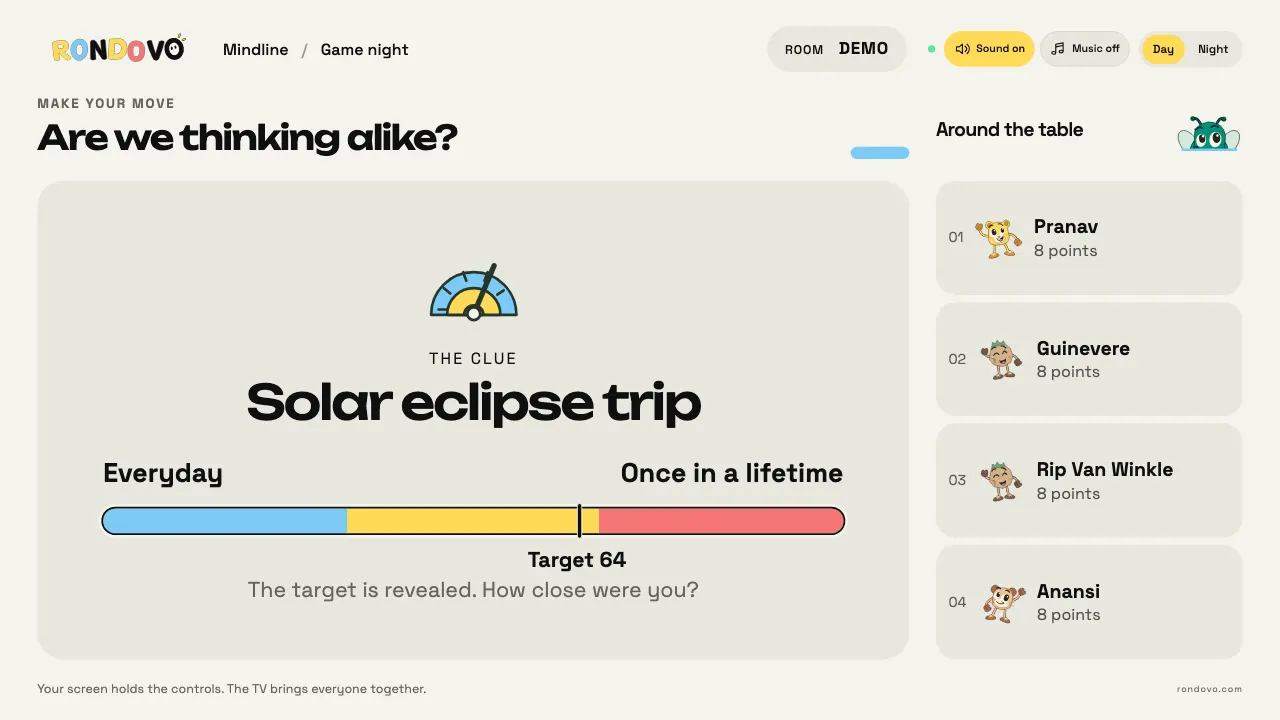
Builds communication. 2 to 16 players, 10 to 15 minutes, works remotely. One clue giver sees a secret spot on a line between two extremes, say Fragile and Tough, and names something that sits there: "a cardboard box". Everyone else slides a guess on their own screen. It is a gentle way to see how differently colleagues interpret the same words, which is most of what goes wrong in real work. Mindline runs free in a browser: the host makes a room, everyone joins at rondovo.com with the four letter code, and on a call each person picks "Just this screen" so nobody has to share theirs.
Debrief: Which clue split the room most, and why?
4. Five Letters
Builds energy. 2 to 16 players, about 10 minutes, works remotely. Everyone races on the same five letter word on their own screen; the shared board shows only coloured squares, so nobody can copy. A two minute burst of friendly competition. Try Five Letters.
5. Rock Paper Scissors Tournament
Builds energy. 10 or more, 5 minutes, in person. Pairs play; each loser becomes the winner's supporter and follows them. The final has two players and the whole room cheering. No skill, no risk, lots of noise.
6. Common Ground
Builds trust. Groups of 3 to 5, 10 minutes, works remotely in breakout rooms. Each group finds three things they all share that are not obvious or work related. Each group reports its most surprising one.
7. Show One Thing
Builds trust. Up to 15, 10 minutes, remote. Everyone picks up one object within reach and explains it in 20 seconds. Cameras optional; describing it works too.
For more quick openers like these, plus 120 icebreaker questions, see our icebreaker games guide.
20 to 30 minute team building activities
Long enough for a real task and a proper debrief. Good for a team meeting with a slot set aside, or the first block of an offsite.
8. Spy Grid (or any one-word-clue team game)
Builds communication. 4 to 16 players, 15 to 20 minutes, works remotely. Two teams share a 5×5 grid of words. One handler on each side knows which words are theirs and gives one-word clues with a number; teammates discuss and pick. The discussion is the team building: you hear how people reason, who speaks up, and who gets talked over. The publisher's Codenames Online is free in a browser as of October 2026 (its separate mobile app is paid); our own take is Spy Grid, where everyone sees the grid on their own screen and each handler's key stays private on theirs.
Debrief: How did your team decide when it disagreed? Did everyone's guess get heard?
9. Hush
Builds communication and energy. 4 to 16 players, about 15 minutes, works remotely. A clue giver describes a word without saying any of six forbidden words, while the other team buzzes slips. It forces people to find a second way to explain something, a real work skill. The Taboo rules guide covers the original format; Hush is our own take, with forbidden words shown on the other team's screens.
10. Chain Sketch
Builds communication. 4 to 12 players, about 10 minutes a round, works remotely. Everyone picks a secret word, and the books go round the group, drawing and guess in turn, until each one comes home. At the end every chain replays, and you watch "quarterly review" turn into "a cow reading a newspaper". It is the clearest demonstration of how messages degrade as they pass along. Play Chain Sketch, or Gartic Phone, which is free in a browser.
Debrief: Where did the chain break? What would have kept it on track?
11. Odd One Out
Builds communication. 4 to 12 players, about 15 minutes, works remotely. Most players share a secret word; one or two get a related word. Everyone types a hint and the group votes on who does not belong. It rewards precise language: vague hints look suspicious, too-clear ones give the word away. Play Odd One Out.
12. Personal Map
Builds trust. 4 to 10, 20 minutes, works remotely. Each person sketches a simple mind map of themselves on one page: home, work history, hobbies, what energises them. Share for two minutes each. Make it clear people choose what goes on the map. New teams get the most from this one.
13. Lost and Found Priorities
Builds problem solving. Groups of 4 to 6, 25 minutes, works remotely. Give each group a scenario (stranded after a storm, a delayed launch with a fixed budget) and a list of 12 items or tasks. Each person ranks them alone for five minutes, then the group agrees one ranking in fifteen. Compare individual and group rankings. Groups usually beat their average member, and the debrief explains why.
Debrief: Whose ranking moved most? Did the loudest view win, or the best one?
14. Silent Line Up
Builds communication. 8 to 30 people, 10 minutes, in person. Line up by start date at the company, by distance from home to office, or by birthday, without talking. Gestures only. Offer a seated version where people hold up numbers on paper.
15. Blind Build
Builds communication. Groups of 3 to 5, 20 minutes, in person or partly remote. One person sees a small model made of blocks or paper shapes. They describe it; the builders, who cannot see it, recreate it. Rotate roles. Remotely, the describer is on the call and builders use paper and pens.
45 to 60 minute team building activities
For offsites, quarter kickoffs, or a team day. Leave 10 to 15 minutes of each hour for the debrief; that is where the value is.
16. Marshmallow Challenge
Builds problem solving. Groups of 4, about 45 minutes with debrief, in person. Each team gets 20 sticks of spaghetti, a yard of tape, a yard of string and one marshmallow, and has 18 minutes to build the tallest free-standing structure with the marshmallow on top. Designer Tom Wujec popularised it and publishes the full instructions for free. Teams that build, test and rebuild early tend to beat teams that plan for 15 minutes and build once.
Debrief: When did you first put the marshmallow on? What would you do differently with another 18 minutes?
17. Build the Brief
Builds problem solving. Groups of 4 to 6, 45 to 60 minutes, works remotely. Give each group a fictional client brief (design a lunch menu for astronauts, plan a festival for 200 people with a tiny budget). They have 30 minutes to produce a one page plan and a two minute pitch. Rotate the roles of timekeeper and presenter so the usual voices do not dominate.
18. Team Quiz
Builds energy. Any size, 30 to 45 minutes, works remotely. Mixed teams of four or five, five rounds of eight questions. Include one round about the team itself (whose desk plant is this, which colleague has visited 30 countries), gathered beforehand with permission. For a no-prep version online, a few rounds of Speed Wits works as a ready-made word puzzle round.
19. Mini Escape Puzzle
Builds problem solving. Groups of 4 to 6, 45 to 60 minutes, works remotely. Write a chain of four or five puzzles where each answer opens the next: a cipher, a word ladder, a logic grid, a locked final code. Commercial virtual escape rooms exist if you would rather buy one. Either way, split information across team members so nobody can solve it alone.
20. Two Truths, team edition
Builds trust. 3 to 12 players, 15 minutes, works remotely. Each person writes two true facts and one false one. The team guesses the lie. Warn people a day ahead so they can choose comfortable facts. Our Two Truths game keeps guesses private until the reveal, so nobody is visibly wrong. Our Two Truths and a Lie guide has ideas for statements.
21. Game tournament
Builds energy. 8 to 40 people, 45 to 60 minutes, works remotely. Split into rooms of four to eight. Each room plays the same short game, and the winners meet in a final. With Rondovo, each room needs one host, and each game holds up to 16 players (12 for some), so a 40 person team needs three or more rooms. For bigger events, see our party games for large groups, and for lighter office socials, our office party games and the wider party games guide.
Virtual team building games
Remote teams need three things a room gives you for free: a way to take turns, a way to see each other's work, and a reason to talk that is not work.
22. Chat Waterfall
Builds trust. Any size, 3 minutes. Ask a question, everyone types an answer without sending, then all send at once. No first or last, no copying.
23. Browser games on a call
Builds communication and energy. 3 to 16 per room, 15 to 45 minutes. Pick games where everyone plays on their own screen at the same time: skribbl.io and Gartic Phone for drawing, Codenames Online for teams, or our Mindline, Spy Grid, Hush, Chain Sketch and Five Letters. Everyone opens the game on their own device while staying on the call, so nobody has to share a screen. No installs to clear with IT, and guests need no account. Our virtual game night ideas has a full running order.
24. Async photo challenge
Builds trust. Any size, a week. For teams across time zones: a weekly theme ("your lunch", "the view from your desk"), posted in a team channel. Nobody needs to be online at once.
Remote tips: keep cameras optional, schedule inside working hours for every time zone, use breakout rooms of four to six, and let the person running the game, not the most senior person, do the explaining.
How to facilitate team building games
The game is a third of the job. The rest is setting it up and closing it well.
- Say why. One line: "We're doing a 15 minute game because we've got three new people and I want everyone to hear each other before we plan." People join in more when they know the point.
- Make it opt-in. Offer a role for anyone who would rather not play: timekeeper, judge, scorer.
- Mix the teams. Assign them yourself, so cliques and reporting lines split up. Counting off by numbers is fine.
- Explain in under a minute. Then play a practice round. Questions answer themselves in play.
- Watch, do not hover. Note moments for the debrief: a good question, a breakthrough, someone talked over.
- Debrief for two to ten minutes. Three questions cover most games: What happened? What helped? What would we do differently at work?
- Close on time. Ending early is fine. Running over is how team building gets its reputation.
Inclusive team building, by default
Design every session so the whole team can take part without asking for an exception.
- No physical contact required. Trust falls, human knots and blindfolds exclude people for reasons they should not have to explain.
- Seated options. Every active game should have a seated version.
- No alcohol needed. Plenty of people do not drink. Make the activity the point, not the bar.
- Work safe content. No questions about family, health, money, bodies, religion or politics.
- Language and pace. Give written instructions as well as spoken ones. Word games can be harder in a second language, so mix word games with drawing or logic.
- Accessibility. Check that browser games work with the devices people have, offer large screens or text, and do not rely on colour alone where you can avoid it.
- Time zones and caregiving. Run sessions in working hours. An after hours "optional" event is rarely optional for someone's career.
- Nobody is the joke. Avoid games that rank people, reveal private information or single someone out.
Questions people ask
What are good team building games for work?
Back to Back Drawing and Mindline for a quick ten minutes, a one-word-clue team game or Lost and Found Priorities for half an hour, and the Marshmallow Challenge or a mini escape puzzle for a full hour. Always finish with a short debrief.
What are quick team building games?
One Word Check-in, Rock Paper Scissors Tournament, Common Ground and Five Letters all take ten minutes or less with no preparation.
What are good virtual team building games?
Browser games everyone joins with a link, such as Codenames Online, skribbl.io, Gartic Phone, or Rondovo's Spy Grid and Mindline. Chat Waterfall and Show One Thing are good openers.
How do you make team building not cringe?
Keep it short, explain why you are doing it, make it opt-in, avoid anything physical or personal, and end with a real conversation instead of forced enthusiasm.
How long should a team building activity be?
Ten minutes inside a regular meeting, 20 to 30 minutes as a dedicated slot, and up to an hour at an offsite. Include debrief time in that.
What team building games build trust?
Personal Map, Common Ground, Two Truths and One Word Check-in build trust gradually, because people choose how much they share.
Start with ten minutes
You do not need an offsite to start. Next team meeting, open Mindline or Spy Grid, paste the four letter code in the chat, and play one round before the agenda. Everyone joins at rondovo.com on their own device, with no download and no account for guests.
Codenames, Codenames Online, Taboo, skribbl.io, Gartic Phone and Google are trademarks of their owners. Rondovo is not affiliated with them.