Party Games for Teens: 34 Games Teenagers Actually Want to Play
By The Rondovo team · Published · Updated · 10 min read
The party games teens enjoy most are the ones where they get to be funny, clever or sneaky in front of their friends: bluffing games like Mafia and imposter games, fast drawing and guessing, write-the-funniest-answer games, and team games like charades played against the clock. What they don't want is anything that looks organised by an adult or that puts one person on the spot to be laughed at. Pick games with short rounds, a bit of competition and a way to sit out, and let the teens run them.
In short
- 13 to 15 year olds like games with clear rules and a winner: charades, a taboo style word game, Spoons, imposter games.
- 16 to 19 year olds lean towards talking and bluffing games: Mafia, two truths and a lie, "most likely to", Wavelength style guessing.
- Sleepovers need quieter games that work late at night with 4 to 8 people.
- Online, pick games where everyone has a job at the same moment, so nobody is waiting on a muted mic.
- Kind by default: no dares that embarrass, no votes on looks, and a "pass" that costs nothing.
What makes a good party game for teenagers
Teenagers are a tough crowd for party games. Too structured and it feels like a school trip. Too loose and the evening turns into everyone on their own phone in a circle.
The games that work have three things in common. Rounds are short, so nobody is stuck in a bad turn for long. There is a performance moment that is optional: you can ham it up or play it straight. And the scoring gives quieter players a fair chance, often by letting everyone answer at once rather than shouting.
The parent or host's best move is to set up and step back. Have the first game ready, explain it in one minute, then leave. Teens will happily play something an adult suggested, as long as the adult isn't standing in the doorway watching.
Party games for teens with no props
These need nothing but people. Good for when the party is already going and you need something now.
- Mafia (or Werewolf). Secret roles, night kills, day votes. The best game for 8 to 16 teens who like arguing. One person narrates unless an app does it for you. Our step by step guide to how to play Mafia covers roles for every group size.
- Wink murder. One secret killer eliminates people by winking at them. A detective tries to catch the killer before the room empties. Great for 10 or more in a circle.
- Charades. Still works, especially as two teams racing a timer. Use film titles, songs (titles only) or things from their own group chats. Our charades ideas list has hundreds of prompts.
- Two truths and a lie. Each person says three things about themselves; the group spots the lie. Teens are very good at this. Our guide to two truths and a lie has scoring and example statements.
- Most likely to. Read a prompt, everyone points at once. Keep prompts silly, not personal; our list of most likely to questions is sorted by tone.
- Would you rather. Easy to start, easy to stop, works for any group size. We keep a long list of would you rather questions.
- Contact. One player thinks of a word and reveals the first letter. Others try to "make contact" by thinking of the same word from a clue, forcing the next letter out. Very satisfying for wordy groups.
- Categories in a circle. Pick a category (cereal brands, Pokémon, football clubs), go round, and anyone who repeats or freezes is out. Add a clap rhythm to make it harder.
- Fishbowl. Everyone writes names on slips. Round one: describe them. Round two: one word only. Round three: act them out. The same slips get funnier each round.
- Mafia's quieter cousin, the imposter game. Everyone gets the same secret word except one person, who gets a near miss or nothing. Take turns saying one word about it, then vote. Works from 4 players.
Party games for teens with simple props
A deck of cards, paper and pens, or a bag of sweets is enough.
- Spoons. Pass cards round fast; when someone gets four of a kind they grab a spoon, and everyone dives. One fewer spoon than players. Loud, physical, short.
- Pictionary on paper. Two teams, a big pad, a timer. Our Pictionary words list is sorted by difficulty.
- Telephone pictionary. Write a phrase, pass it, the next person draws it, the next writes what they think the drawing is. The final reveal is the whole point.
- Paper fortune tellers, the teen version. Fold one, fill it with dares that are silly rather than mean (talk in an accent for one round, swap seats with someone).
- Sticky note heads. Write a famous person or character on a sticky note and stick it on someone's forehead. They ask yes or no questions to guess.
- The sweet challenge. Wrapped sweets in a bowl, a die, oven gloves, a fork. Roll a six to grab the gloves and unwrap as many as you can before someone else rolls a six.
- Blind drawing. One person describes a picture, the other draws it without seeing it. Compare at the end.
- Scavenger hunt by photo. Teams get a list and take pictures: a team pyramid, something older than everyone there, a tree that looks like a person. Good for house parties with a garden.
- Uno or Exploding Kittens. Card games that every teen knows, so there is no teaching. Our card games for groups guide covers more.
- Jenga with questions. Write light questions on blocks ("best snack ever", "most useless talent you have"). Pull a block, answer it.
Sleepover games for teens
Late at night, the energy changes. The best sleepover games are quieter, sit-down, and can stop at any moment when people start falling asleep. For more, see our full list of sleepover games.
- Truth or dare, kind version. Truths about opinions and memories, dares that are silly and short. Our list of truth or dare questions keeps everything PG-13 at most and skips anything that humiliates.
- Never have I ever, without drinking. Everyone holds up ten fingers and puts one down each time they have done the thing. Last person with fingers up wins. Keep it about travel, food, school and mishaps, not secrets.
- Story chain. One sentence each, round the circle, and the story has to make sense. Someone records it on a phone to replay at breakfast.
- Movie night bingo. Make cards with things that always happen in the film you are watching. First line wins the last slice of pizza.
- Murder mystery in a box. Printable kits give every guest a character and a secret. Better at 15 and older.
- Sardines. Hide and seek in reverse: one person hides, everyone who finds them squeezes in too. Works in a big house with the lights off.
Party games for teens on screens
This is where teens are most at home, and also where a party can go flat if everyone is on a different app. The trick is one game, one room, everyone joining the same thing.
Jackbox Party Packs are the best-known option: one person buys the pack, the game runs on a TV, and everyone joins on their own phone. Player counts vary by game: Quiplash 3, for example, takes 3 to 8 players, and extra people can join as a voting audience (Jackbox's own listing, as of October 2026). Among Us works when everyone has it installed and a separate voice chat. Kahoot is good for a quiz someone writes about the friend group.
Free browser games are worth knowing too, because nobody has to buy or install anything. On Rondovo, which is free, one person hosts a room, everyone joins with a four letter code on any device, and a TV can be the shared screen if you have one (open rondovo.com/tv in its browser). Guests need no account. These are the ones teens play most:
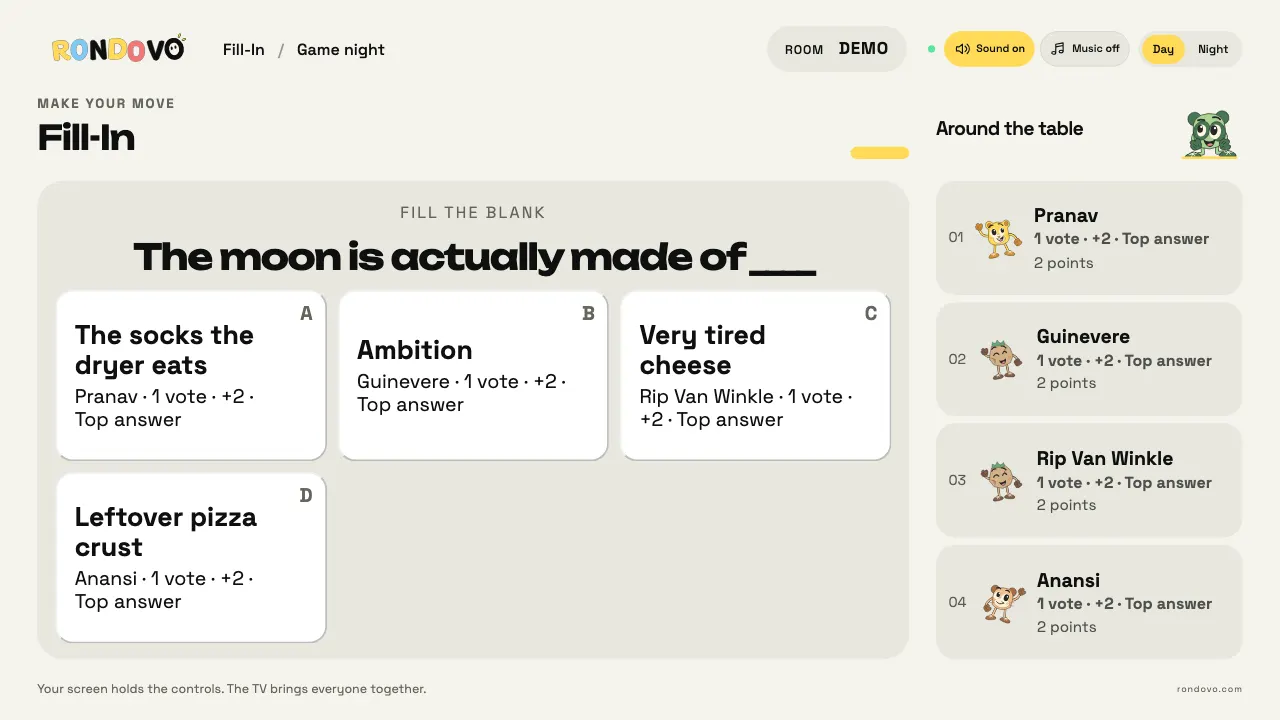
- Fill-In, 3 to 12 players. A sentence with a blank appears; everyone types the funniest ending; the room votes on anonymous answers. The anonymity is what makes it work for teens: you can be bold without your name on it until the end. Our prompts are written to be silly rather than crude.
- Most Likely To, 3 to 16 players. Our version uses prompts like "most likely to apologise to a chair after bumping into it". You score by guessing who the room will pick, so it rewards knowing your friends, not targeting one of them.
- Odd One Out, 4 to 12 players. Our imposter game: everyone gets a secret word except the odd one, who gets a related but different word and doesn't know it. Two rounds of hints, then a vote.
- Scrawl, 3 to 16 players. Draw on your screen, it appears for everyone, and the others type guesses. Faster guessers score more.
- Nightfall, 4 to 16 players. Our take on Mafia. The game itself narrates, so nobody has to sit out to run it, and roles stay private on each player's screen.
- Face Up, 3 to 12 players. Hold your screen to your forehead while everyone shouts clues, in the style of the forehead guessing apps. Decks include Movies and shows, Food and Animals.
Online party games for teens
When friends are in different houses, the setup matters more than the game. Get everyone on one video or voice call first, then share one room link or code. With Rondovo, everyone picks "Just this screen" and sees the game on their own device, so nobody has to share a screen. Games that work best online are ones where everyone does something at the same moment, so a laggy mic or a quiet friend never stalls the round.
- Online imposter games. Hints are typed, so they work on a laggy call. Odd One Out runs this, and our article on games like Spyfall covers the others.
- Online drawing games. Scrawl and skribbl.io both let everyone guess at once. Our guide to online drawing games compares them.
For more ideas when nobody is in the same room, see our online party games roundup.
Which game for which teen party
| The party | Group size | Try first | Then |
|---|---|---|---|
| Birthday at home, mixed friend groups | 8 to 15 | Charades in teams, Spoons | Mafia or Nightfall |
| Small house party | 4 to 8 | Two truths and a lie | Fill-In, Odd One Out |
| Sleepover | 3 to 8 | Never have I ever (fingers) | Story chain, movie bingo |
| Online with friends far away | 3 to 12 | Odd One Out | Scrawl, Fill-In |
| Church youth group or club night | 10 to 30 | Wink murder, fishbowl | Two teams of charades |
| Teens and parents together | 6 to 12 | Most Likely To | Pictionary in teams |
Keeping teen party games kind
Most teen party games have a version that is fun and a version that leaves someone upset on the drive home. The difference is usually a few small rules, and they work best when the teens agree to them before the first round rather than having an adult impose them halfway through.
- Anyone can pass, every time, with no penalty. A pass that costs a forfeit is not really a pass.
- Votes are about funny habits, never looks, bodies, crushes or who is unpopular. "Most likely to trip over nothing" is fine; "most likely to be single forever" is not.
- Dares stay in the room and off camera. No filming someone's dare without asking them.
- No drinking games, and no "drink if" rules. Points, sweets or bragging rights do the same job.
- Rotate who picks the game. Otherwise the loudest friend chooses every round.
If a game starts to go wrong, the easiest fix is to change the game, not to lecture. Switching to a team game resets the mood fast.
Questions people ask
What are good party games for 13 year olds?
Charades, Spoons, sticky note heads, Pictionary and imposter games all suit 13 year olds: clear rules, short rounds and lots of movement. Save heavy bluffing games like Mafia for groups that already know each other well, because younger players can take accusations personally.
What games can teenagers play at a party without anything?
Mafia, wink murder, two truths and a lie, most likely to, would you rather, categories and charades all need nothing but people. Our list of games to play with no props has more.
What are fun indoor games for teens?
Spoons, Pictionary, Jenga with questions, sardines and any drawing or imposter game on screens. Indoors, pick one loud game and one quiet game so the party can change gear.
Are there free party games for teens online?
Yes. skribbl.io, Gartic Phone and Rondovo's games are free in a browser. Rondovo needs no download and no account for guests; Jackbox is paid, but only the host needs to buy it.
How do you play never have I ever without drinking?
Everyone holds up ten fingers. When a statement is true for you, put a finger down. Last person with fingers up wins. Our never have I ever questions are sorted by tone, with a clean section for teens.
If you are planning a bigger party, our party games guide covers every age and size, and house party games has more for when the whole house is full.
Jackbox, Jackbox Party Pack, Quiplash, Among Us, Kahoot, Uno, Exploding Kittens, Jenga, Pictionary, Pokémon, skribbl.io, Gartic Phone, Spyfall and Wavelength are trademarks of their owners. Rondovo is not affiliated with them.