House Party Games: 34 Games to Play at a House Party, in the Order to Play Them
By The Rondovo team · Published · Updated · 16 min read
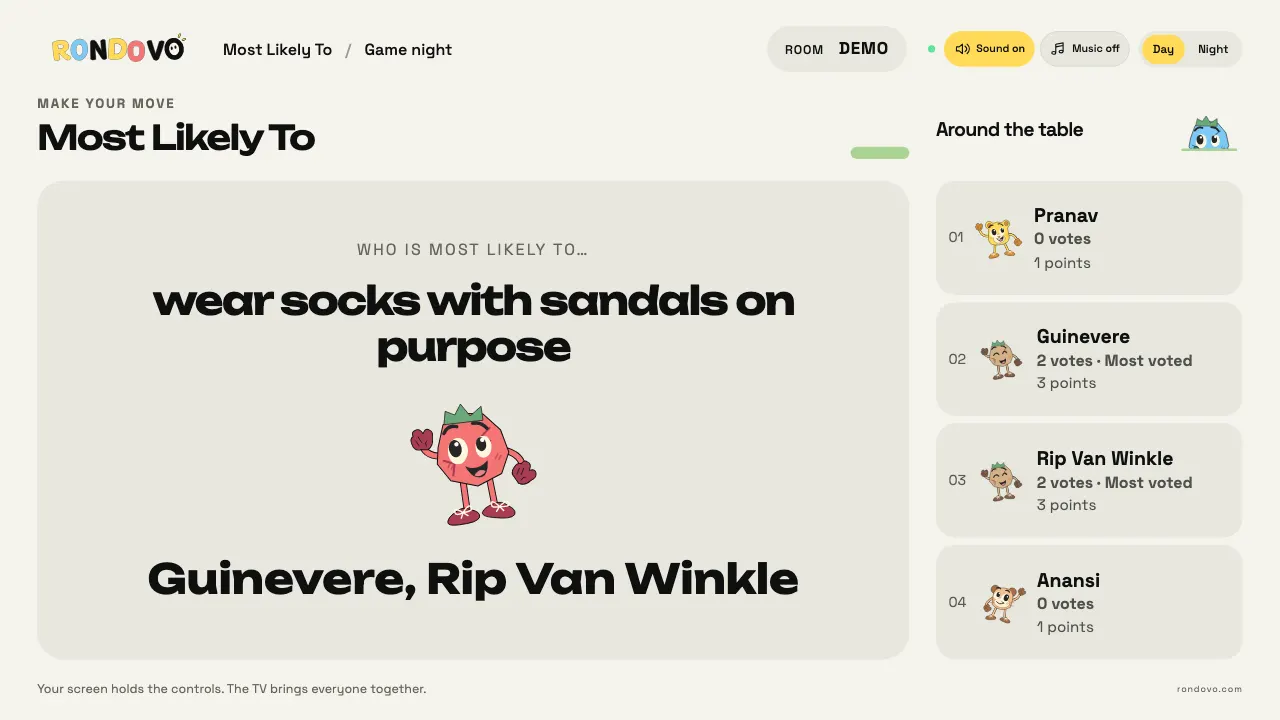
The best house party games are the ones people can join halfway through, play with a drink or a plate in one hand, and hear over music. Start with drop-in games while guests arrive (Human Bingo, secret missions, Who Am I sticky notes), move to a seated warm-up like Most Likely To once most people are there, run one big team game such as Fishbowl or Charades at the peak, and finish with Mafia or Wink Murder late on. Below are 34 games sorted into that running order, with what each needs and how to play.
Most lists of games to play at a house party are written as if everyone arrives at 8pm sharp, sits in a circle and has nothing in their hands. Real house parties do not work like that. This one is planned around the living room you actually have.
In short
- While people arrive: games with no start time. Human Bingo, secret missions and sticky note Who Am I let latecomers join with a sentence of explanation.
- Warm-up: everyone answers at once, nobody performs alone. Most Likely To, Would You Rather, Fill-In.
- Main event: one team game for the whole room. Fishbowl is the best; Charades, Taboo and Pictionary are close.
- If there is space and energy: Spoons, one-minute challenges, a cup flip relay with water.
- Late night: Mafia, Wink Murder, Psychiatrist. Low movement, high drama.
- Small flat or sleeping neighbours: stick to the word and screen games and skip anything with shouting.
Why house party games are different
A board game night has a start time, a table and the same six people all evening. A house party has none of that. These five realities should decide what you play.
People arrive at different times. The first guests are in at 7:30, the last at 10. A game that needs everyone from round one either waits forever or leaves people out. Fix: play drop-in games first, and only start a team game once at least two thirds of the guests are there.
It is noisy. Music, kitchen chatter, two conversations at once. Games that depend on hearing one quiet voice (Twenty Questions, Botticelli) die in a loud room. Fix: choose games where answers are written, shown, or shouted by a whole team.
The group is mixed. Work friends, school friends, partners who know nobody. Games about shared history leave newcomers out; games about personal confessions make them uneasy. Fix: start with games about opinions and imagination, not secrets.
The room is small. A living room with a sofa, a coffee table and fifteen people does not have space for musical chairs. Fix: games that work sitting or standing in place, and save the active ones for a garden or a cleared room.
Hands are full. A drink in one hand, food in the other. Fix: games played by talking, pointing or voting, or on a screen you can tap with a thumb. Hold the card games and the drawing until plates are down.
A running order for the evening
This is the plan we use for a house party of about 10 to 20 people. Shift the times to suit your night.
| Time | Phase | What is happening | Play |
|---|---|---|---|
| 7:30 | Arrivals | People trickle in, food is out | Drop-in games: Human Bingo, secret missions, Who Am I |
| 8:30 | Warm-up | Most guests are in, groups are mixing | Most Likely To, Would You Rather, Fill-In, Contact |
| 9:15 | Main event | Everyone is here and fed | One team game: Fishbowl, Charades, Hush or Pictionary |
| 10:15 | Free time | Music, drinks, conversation | Nothing. Let it breathe |
| 10:45 | Second wind | Energy comes back | Spoons, one-minute challenges, Name That Tune |
| 11:30 | Late night | Fewer people, sofas, lower voices | Mafia, Wink Murder, Psychiatrist, Odd One Out |
Two rules make this work. One host decides when a game starts and ends, so it does not drag. And the free time is part of the plan: a house party is not a game night, and people came to talk too.
Games while guests arrive
These run in the background and need no start time. Explain the rules on a card by the door or as you take coats.
1. Human Bingo
8 to 40 players · all evening · a printed grid per guest, pens
Each guest gets a 4 by 4 grid of descriptions ("has been to Japan", "can juggle", "was born in winter"). Find a different person for each square and get their name on it. First full card, or the most squares by 9pm, wins.
2. Secret missions
6 to 30 players · all evening · a folded card per guest
Hand each guest a sealed card with a small mission: get three people to say "pineapple", find out everyone's middle name, get someone to swap seats with you. At the end, everyone reveals their mission and who they caught. It turns small talk into a game without anyone noticing.
3. Sticky note Who Am I
6 to 30 players · drop in · sticky notes, a pen
As each guest arrives, stick a famous name on their back. They ask other guests yes or no questions, one per person, until they guess it, then they get a new one. Because it is played one to one, it doubles as a way to meet people.
4. Guess the baby photo
8 to 30 players · all evening · photos from guests in advance, a board, answer slips
Collect a childhood photo from each guest before the party and pin them up with numbers. Guests write down who they think each one is; reveal at the end. Ask first: not everyone has or wants to share one.
5. Whose song is it?
8 to 30 players · all evening · a shared playlist, answer slips
Before the party, each guest adds two songs to a shared playlist. As each one plays, people guess who added it. Score at the end of the night, or just argue about it in the kitchen.
6. The question jar
4 to 20 players · drop in · a jar of questions on folded paper
Leave a jar of light questions on the kitchen counter ("best meal you've ever had", "worst haircut", "most useless skill"). Anyone can pull one out and ask whoever is nearby. Our icebreaker games has more questions that suit mixed groups.
7. Doodle Recall
2 to 16 players · 8 minutes · a screen each
On our site, everyone draws the same words against a clock, then names their own drawings from memory at the end. It is short enough to play twice while people are still arriving, and a latecomer can join the next game.
Warm-up games for the first half hour
Most people are in. Plates are still in hands. These games have everyone answering at once and nobody on the spot for long.
8. Most Likely To
4 to 20 players · 10 to 15 minutes · nothing, or a screen each
Read out a prompt ("most likely to cry at an advert"); on three, everyone points at someone. Ask the winner to defend themselves. On Rondovo the votes are secret until the reveal and you score for reading the room, which keeps it kind. Our most likely to questions has prompts for every kind of group.
9. Would You Rather
Any number · 10 minutes · nothing
Pose two choices and make people go to opposite sides of the room. Good questions are close calls ("always be 10 minutes late or always 20 minutes early?"). Moving around the room mixes groups who would otherwise stay put.
10. Fill-In
3 to 12 players · 15 minutes · a screen each
A sentence with a blank appears on the TV or each screen, everyone types an answer, and the room votes on them without knowing who wrote what. It works with a drink in hand: you only need a thumb.
11. Contact
4 to 10 players · 15 minutes · nothing
One person holds a secret word and gives its first letter. Others give clues for any word starting with those letters; when someone gets the clue, both shout "contact" and say their word. If they match before the holder guesses, the holder gives the next letter. Good for a cluster on the sofa.
12. Never Have I Ever (finger points)
4 to 15 players · 15 minutes · nothing
Everyone shows ten fingers. Each turn someone names a thing they have never done, and anyone who has done it folds a finger. Last with fingers wins. At a mixed party keep it to travel, food and harmless disasters.
13. Five Letters
2 to 16 players · 10 minutes · a screen each
Everyone solves the same five letter word on their own screen at once; the TV shows only coloured squares, so nobody can peek at answers. A good one for word lovers in a corner while the rest of the room chats.
14. Categories
4 to 12 players · 10 minutes · nothing
Clap a steady beat round a circle. The leader names a category (pizza toppings, ex-Prime Ministers, things in a handbag) and each player names one on their beat. Repeat or stall and you sit out the next category.
The main event: one big team game
Everyone is fed and here. Turn the music down, clear the coffee table, and play one game that involves the whole room. Two teams works for up to about 20 people. Mix couples and friend groups across both.
15. Fishbowl
6 to 20 players · 45 minutes · slips of paper, pens, a bowl, a timer
Everyone writes five names (people, characters, things everyone knows) on slips into a bowl. Teams take one minute turns to get through as many as they can. Round one: describe with any words. Round two: one word only. Round three: mime. The same slips come back each round, so by the end a single gesture means something to the whole room. If you only play one game at a house party, play this.
16. Charades
6 to 20 players · 30 minutes · slips, a timer
The classic, played in two teams with a one minute timer. Let each team write the prompts for the other, so you get the right mix of films, songs and in-jokes. Our charades ideas has ready-made lists.
17. Act It Out
4 to 16 players · 15 minutes · a screen each
Our charades game: the other team picks the first word of your turn (or the deck does, and it supplies the rest), only your screen shows it, and you tap each correct guess yourself. No slips, no peeking, no arguments about the timer.
18. Taboo, or Hush
4 to 16 players · 15 to 30 minutes · cards you write, or a screen each
Get your team to guess a word without saying it or any of the forbidden words listed with it. The other team watches for slips. Hush is our version: the card shows on the clue giver's screen and on the other team's screens (your own team sees nothing), and the other team buzzes a slip from there. Full rules in how to play Taboo.
19. Pictionary, or Scrawl
4 to 16 players · 30 minutes · paper and pens, or a screen each
One player draws, their team guesses within a minute. At a house party, draw on a big pad propped on the sofa so the whole room can see. On Scrawl, the drawing appears live on the TV and everyone guesses on their own screen, so the whole room plays every turn instead of one team.
20. Telephone Pictionary
6 to 15 players · 20 minutes · a folded sheet or small notebook each
Write a phrase, pass it on, the next person draws it, the next writes what they see, and so on round the room. Read every chain aloud at the end. With a big group, run two circles.
21. Pub quiz about the host
8 to 40 players · 30 minutes · questions, answer sheets
Write 20 questions about the host, the guests and the year everyone has had, with a few general knowledge rounds in between. Teams of four. It is the one game where knowing nobody at the party is not a disadvantage, because half the answers are guesses anyway.
22. Name That Tune
6 to 40 players · 20 minutes · a speaker, a playlist
Play the opening seconds of a song; first team to shout title and artist scores. It is the main event game that survives a loud room, because the room is supposed to be loud.
Second wind: games with movement
Only if there is space and nobody is worried about the furniture.
23. Spoons
4 to 13 players · 10 minutes a round · a deck of cards, spoons (one fewer than players)
Pass cards round the table fast, looking for four of a kind. Whoever gets it quietly takes a spoon, and the last person to notice ends up without one. Put the spoons in the middle of a table, not on the floor, to save knees. More ideas in card games for groups.
24. Cup flip relay (with water)
8 to 24 players · 10 minutes · plastic cups, a table, water
Two teams line up on either side of a table. Each player drinks a little water from their cup, then flips the empty cup from the table edge until it lands upside down, and the next player goes. First team through wins. Water keeps it open to everyone.
25. One-minute challenges
6 to 30 players · 20 to 30 minutes · cups, balloons, cookies, tape
A handful of 60 second tasks: stack a cup pyramid, move a cookie from forehead to mouth with no hands, bounce a ping pong ball into a cup. Teams send one player per challenge and keep score on the fridge.
26. Balloon keepy-uppy
4 to 20 players · 5 minutes · balloons
Keep two balloons (then three, then four) off the floor as a group for a full minute. Small rooms make it harder, which is the fun. A good one for clearing heads after a long team game.
27. Sardines
6 to 20 players · 15 minutes a round · a house with hiding places
One person hides; everyone else searches, and anyone who finds them squeezes into the same hiding spot in silence. The last seeker left loses. Agree on which rooms are off limits first.
Late night games
Fewer guests, sofas, lower voices. These are games of talk and suspicion rather than noise.
28. Mafia
6 to 16 players plus a moderator · 30 minutes · nothing, or a deck of cards for roles
The classic hidden role game: a few Mafia secretly pick off the town at night, and the town debates and votes by day. It is at its best at midnight. Our how to play Mafia guide has role counts for every group size.
29. Nightfall
4 to 16 players · 20 minutes · a screen each, a TV if you have one
Our Mafia game with no moderator: roles appear on each player's screen, and the game narrates the night on the TV, or on everyone's screens when there is no TV. Useful when nobody wants to sit out as the narrator, or when the host is too tired to run it.
30. Wink Murder
6 to 20 players · 10 minutes a round · a deck of cards for roles
Deal a card to each player; whoever has the ace of spades is the murderer. They kill by winking, and victims die dramatically after a few seconds. Anyone can accuse, but a wrong guess puts you out. Perfect for a room of people already sitting facing each other.
31. Psychiatrist
5 to 12 players · 15 minutes · nothing
One player steps out while the group agrees a rule for answering questions (say, everyone answers as if they were the person to their right). The psychiatrist comes back and asks questions until they work out the rule.
32. Odd One Out
4 to 12 players · 15 minutes · a screen each
Everyone gets the same secret word except one or two, who get a related word and do not know they are different. Give hints, then vote. Very good for a smaller late group that likes to bluff.
33. Fortunately, Unfortunately
4 to 12 players · 10 minutes · nothing
Build one story round the room, each line starting with "fortunately" or "unfortunately" in turn. Hesitate or break the story and you start the next one.
34. Botticelli
3 to 8 players · 15 minutes · nothing
One person picks a famous name and says the first letter of the surname. Others ask indirect questions ("Are you a singer?"), and the holder must name someone who fits or let the asker have a straight yes or no question. Ideal for the last four people on the sofa.
Which games fit your room
| Your situation | Best picks | Skip |
|---|---|---|
| Small flat, 8 to 12 people | Most Likely To, Fill-In, Contact, Fishbowl, Wink Murder | Sardines, cup flip relay |
| Neighbours asleep / keep it quiet | Five Letters, Odd One Out, Psychiatrist, Botticelli, Telephone Pictionary | Name That Tune, Charades |
| Big house, 20+ people | Human Bingo, pub quiz, Name That Tune, two Fishbowl games in two rooms | One game for everyone round one table |
| Everyone holding food or drink | Most Likely To, Would You Rather, Fill-In, Categories | Spoons, drawing games |
| Mixed group, many strangers | Secret missions, sticky note Who Am I, Two Truths and a Lie, pub quiz, Fishbowl | Never Have I Ever, inside joke quizzes |
| Housewarming | Question jar, Whose song is it?, a pub quiz about the new place | Sardines in someone's freshly painted cupboards |
For bigger crowds, our guide to party games for large groups has games that scale to 50. If your party is adults only and you want sharper games, see party games for adults. And for the full library sorted by group and mood, start at our party games hub.
The house party game kit
Keep these in one box and you can run every game above:
- A stack of A4 paper and a pad of sticky notes
- Eight pens (they disappear)
- A bowl for slips
- Two decks of cards
- A bag of balloons and a sleeve of plastic cups
- A speaker and a playlist
- A timer on any device
- A whiteboard or the fridge door for scores
If your TV can open a web page, add that to the kit. Many of the screen games above, ours included, show the shared view on the TV while everyone plays on their own screen. Our TV games without a console guide explains how to get a browser game on any TV.
Playing house party games on Rondovo
Rondovo is our free site of party and board games. The host opens a room on any device, everyone else joins on their own screen with a four letter code, and the TV is optional. Guests do not need a download or an account. That suits a house party for three reasons: latecomers can join the next game in seconds, votes and answers stay secret on each screen, and nobody has to sit out to moderate or keep score.
It is weaker where a party needs bodies and noise. Fishbowl, Sardines and Charades in a cramped living room are still better in person, and a single game tops out at 16 players. We would use it for the warm-up (Most Likely To, Fill-In) and the late night (Nightfall, Odd One Out), and keep the main event on paper, or on Scrawl if the room is too full for a drawing pad.
Questions people ask
What games do you play at a house party?
Drop-in games while people arrive (Human Bingo, secret missions), a warm-up where everyone answers at once (Most Likely To, Would You Rather), one big team game at the peak (Fishbowl or Charades), and a hidden role game late at night (Mafia or Wink Murder).
How do you make a house party fun with games?
Plan a running order, not a list. Start games only once most guests are in, play one team game for the whole room, keep each game under 30 minutes, and leave time for people to just talk.
What are good house party games without drinking?
All 34 here work without drinking. Score with points or fingers, and give the winner the next pick of the playlist or the last slice of cake. The cup flip relay uses water.
What games work for a small house party?
With 6 to 10 people, play Contact, Fishbowl, Telephone Pictionary, Psychiatrist and Odd One Out. They need little space and get better when everyone knows each other a bit.
What are good games for a housewarming party?
The question jar, a pub quiz about the new place and the host, Whose song is it? and secret missions. They work with people arriving at different times, which housewarmings always have.
How do you get guests to join in party games?
Start with games where nobody performs alone, and invite rather than insist. Ask a couple of outgoing friends to play first; others follow once they see it is fun. Give anyone who wants to watch a job, like timekeeper or judge.
Taboo, Pictionary and Name That Tune are trademarks of their owners. Rondovo is not affiliated with them.