Card Games for Groups: 15 Games for 4 to 12 Players, With a Standard Deck or Without
By The Rondovo team · Published · Updated · 12 min read
The best card games for groups need one standard deck and about two minutes of explaining. For a big group, play Spoons, Cheat or President. For exactly four, play Hearts or the team game Kemps. If you want something boxed, Exploding Kittens and Sushi Go Party are easy wins, and if half the group is remote, a browser card game lets everyone hold their own hand on their own screen.
Below are the rules for each, short enough to read aloud, plus which games break down at which group size. We also explain where a second deck helps and where it ruins the game.
In short
- 8 or more people, one deck: Spoons (or two decks past 13 players), Cheat, President.
- Exactly 4 people: Hearts for thinkers, Kemps for loud teams, Crazy Eights for everyone.
- 5 to 7 people: Rummy, Crazy Eights, President, Teen Patti with play chips.
- Boxed games for groups: Exploding Kittens (2 to 5), Sushi Go Party (2 to 8), Coup (2 to 6).
- Playing online: free browser card games where each player sees only their own cards, including our own Showdown!, Nine Lives and Summit.
How to pick a card game for your group
Three questions decide it.
How many of you are there? Most trick-taking games want exactly four. Shedding games (empty your hand first) stretch to eight. Grab and bluff games like Spoons and Cheat keep working at ten or more, because everyone plays at the same time or turns are a few seconds long.
Do you want to talk or to think? Cheat and Kemps are loud. Hearts is quiet and tactical. Spoons is mostly screaming.
How long is the slot? A hand of Spoons takes two minutes. A full game of Hearts to 100 points takes 45 minutes to an hour. Rummy sits in between.
| Game | Best players | Deck | Time | Noise |
|---|---|---|---|---|
| Spoons | 4 to 13 | One standard deck, plus spoons | 2 min a hand | Very high |
| Cheat (Bluff) | 3 to 10 | One deck (two past 8) | 15 min | High |
| President | 4 to 8 | One deck | 5 min a hand | Medium |
| Crazy Eights | 2 to 7 | One deck (two past 5) | 10 min | Medium |
| Kemps | 4 or 6 in pairs | One deck | 15 min | High |
| Hearts | 4 (3 to 6 with tweaks) | One deck | 45 to 60 min | Low |
| Rummy | 2 to 6 | One deck (two past 4) | 20 to 30 min | Low |
| Teen Patti | 3 to 7 | One deck, play chips | 5 min a hand | Medium |
Card games for large groups (6 to 13 players)
Spoons
Spoons is the best card game for a large group that has never played together. Nobody needs strategy, the rounds are short and the ending is a scramble.
Setup: Put spoons in the middle of the table, one fewer than the number of players. Use four cards of each rank for every player (with 7 players, take sevens through aces, for example) and deal four to each person.
Play: The dealer draws a card from the pile, keeps it or passes it to the left, always holding four. Everyone passes at once, as fast as they like. When someone collects four of a kind, they quietly take a spoon. The moment anyone notices, they grab one too. The player left without a spoon takes a letter: S, then P, and so on. Spell SPOON and you are out.
Tips from playing it: Sit close enough that everyone can reach the middle. Use plastic spoons, or tokens if you have a coffee table made of glass. Past 13 players, shuffle two decks together and allow any four of a rank to count.
Cheat (also called Bluff or I Doubt It)
Deal the whole deck out. Starting with aces, players take turns placing one to four cards face down and calling the next rank in order ("two aces", "three twos", "one three"). Anyone can call "Cheat!" If the cards were a lie, the liar picks up the whole pile. If they were true, the accuser picks it up. First to empty their hand wins.
Cheat gets better with more players, up to about eight. Past that, add a second deck and let calls go up to eight cards.
President
President (also called Scum, or Kings and Peasants) is a climbing game, and the best one for a group that will play several rounds. Deal the whole deck. The first player leads a single card, a pair, a triple or four of a kind. Each next player must play the same number of cards at a higher rank, or pass. Twos are highest. When everyone passes, the last player to play leads again. The first to empty their hand becomes President; the last becomes Scum.
The part that makes it social: before the next hand, Scum gives their two best cards to the President, who gives back any two. The rankings even decide the seating. It produces a running story across the evening, which is why it suits a party better than a one-off hand. Full rules and variants are on Pagat's President page.
Crazy Eights with two decks
Crazy Eights works for 2 to 5 with one deck and 6 to 8 with two shuffled together. Deal five cards each (seven with two players). Turn one up. On your turn, play a card matching the top card's suit or rank. An eight is wild: play it any time and name the new suit. If you cannot play, draw until you can. First to empty their hand wins the round. Pagat lists dozens of house versions, and almost every group has its own.
If Crazy Eights is your group's favourite, you probably already know the boxed game built on the same idea. Our guide to games like UNO covers the alternatives.
Card games for 4 players
Hearts
Hearts is the classic for four. Everyone gets 13 cards. Before each hand, pass three cards (left, then right, then across, then no pass, repeating). The player holding the two of clubs leads it. Follow suit if you can. The highest card of the led suit takes the trick.
You want to avoid points: each heart taken is 1 point and the queen of spades is 13. Hearts cannot be led until a heart has been discarded on another suit. Shooting the moon is the twist: take every heart and the queen of spades in one hand, and everyone else gets 26 instead. The game ends when someone reaches 100, and the lowest score wins.
For 3 players, remove the two of diamonds and deal 17 each. For 5, remove the two of diamonds and the two of clubs, deal 10 each, and the three of clubs leads. Pagat's Hearts page has the full scoring.
Kemps
Kemps is a team game for four (two pairs) or six (three pairs). Before you start, each pair agrees a secret signal in private: a wink, a tap on the table, a word in a sentence.
Deal four cards to each player and lay four face up in the middle. On "go", everyone swaps cards with the middle at the same time, one for one, trying to collect four of a kind. When nobody wants the middle cards, the dealer replaces them. When you hold four of a kind, give your partner the signal. If they call "Kemps!", your team wins the round. If an opponent spots the signal and calls "Stop Kemps!" while you hold four of a kind, they win it instead.
The best signals are boring. A pair who both always rub their left ear will be caught in two rounds.
Spades and Euchre
Spades (four players in two partnerships, spades always trump, bid the number of tricks you will take) and Euchre (four players, 24 card deck, partners) are the games people play for years. They need one patient teacher and a couple of practice hands, so they suit a regular group more than a party.
Card games for 3 people and up to 6
With three, most four player games feel thin. Rummy, Crazy Eights, Teen Patti and three player Hearts (below) all hold up.
Rummy
Deal 10 cards each for two players, 7 each for three or four, 6 each for five or six (add a second deck past four). Turn one card up to start a discard pile. On your turn, take the top card of the deck or the discard, then discard one. Lay down sets (three or four of a rank) and runs (three or more in order of one suit) when you have them, and add to anyone's melds. First to get rid of every card wins the hand, and scores the cards left in other hands. Pagat's Rummy page covers scoring.
If your group likes the "complete a goal, then go out" feeling, our article on games like Phase 10 is next.
Teen Patti (with play chips only)
Teen Patti is the three card game played across India, especially around Diwali. Each player gets three cards. Hands rank, from best: trail (three of a kind), pure sequence (a straight flush), sequence, colour (a flush), pair, high card.
Everyone puts a boot (a small starting bet) in the pot. Players can play blind (without looking, betting at half the rate) or seen. Each turn you either stay in and add to the pot or fold. When two players remain, one can pay to call a show, and the better hand takes the pot.
Play Teen Patti without money: chips, matchsticks or sweets. It is just as tense with sweets, and betting for real money is gambling, which is restricted or illegal in many places. Check your local laws before anyone suggests otherwise. Pagat's Teen Patti page explains blind and seen betting in detail.
Boxed card games for groups worth buying
A standard deck goes a long way, but a few boxed games teach themselves faster. Player counts are the ones printed on the current boxes as of October 2026.
| Game | Players | Time | Why groups like it |
|---|---|---|---|
| Exploding Kittens | 2 to 5 | About 15 min | Draw until someone explodes. Silly art, very fast to teach. |
| Sushi Go Party! | 2 to 8 | About 20 min | Pick one card, pass the hand. Everyone plays at once, so 8 players is no slower than 3. |
| Coup | 2 to 6 | About 15 min | Bluff about the two roles you hold. Short and sharp. |
| The Mind | 2 to 4 | About 15 min | Play numbers in order without talking. Small box, big silences. |
| UNO | See the box for your edition | Varies | Everyone already knows it, which is its main strength at a mixed party. |
What the boxes do better: they need no explaining beyond the rulebook, the art carries the mood, and a game like Sushi Go Party! scales smoothly because nobody waits. What a standard deck does better: it costs almost nothing, fits in a pocket, and plays fifty games.
For the draw-and-dodge family in particular, see games like Exploding Kittens.
Card games online with friends
When some of you are on a video call, a physical deck stops working, because every player needs a private hand. You have three options.
- One person deals in real life and reads out cards. Fine for Bingo-style games, useless for anything with hidden hands.
- A free card site with rooms. Board Game Arena hosts many card games in the browser for free, and sites like Pagat point to online versions of the classics.
- A party-style game where each player uses their own screen. The host opens a room, everyone joins with a code, and each player sees the table and their own hand on their own device. Nobody has to share their screen on the call.
That third option is what we built Rondovo for. It is free, guests never sign up, and if some of you are in one room, a TV is optional (open rondovo.com/tv in its browser). These are our own takes on card game families, not the branded games:
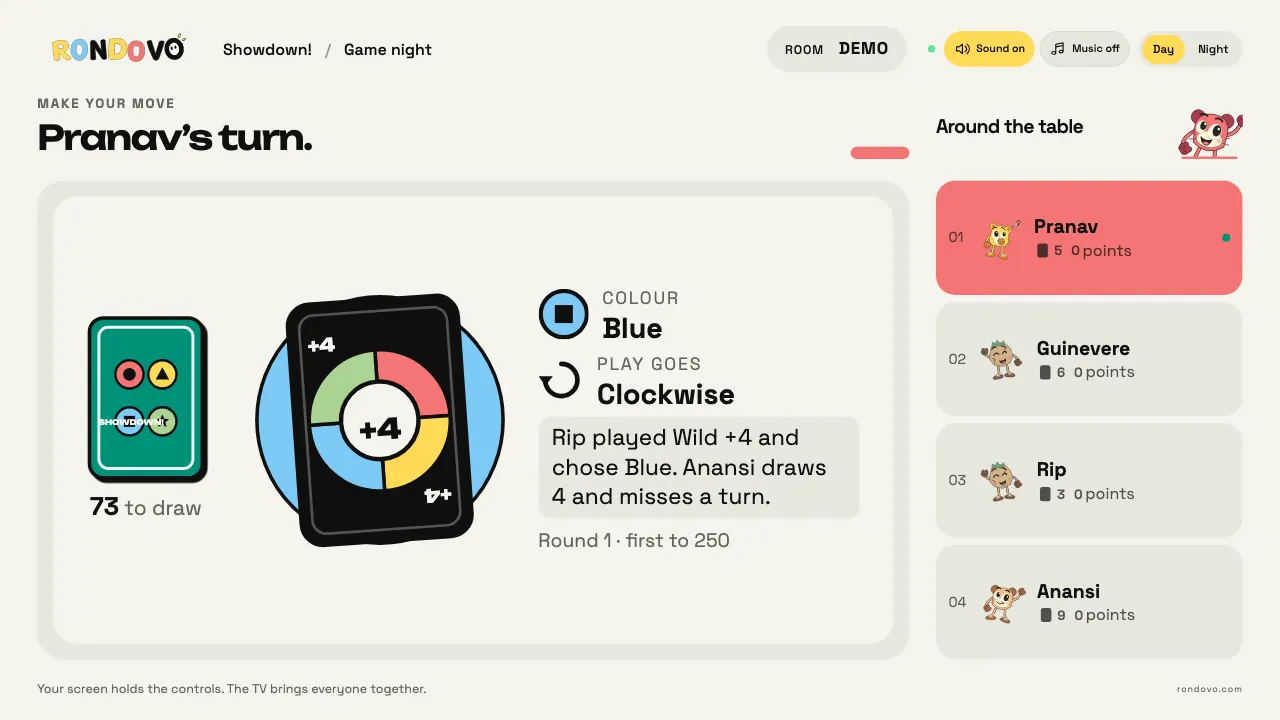
Showdown! is our match the colour or number game for 2 to 10 players: Blocks, Flips, +2s and Wilds, and a Showdown! button you have to press before someone presses Catch! on you. First to 250 points wins by default, or play a single round.
Nine Lives is our draw until someone draws the Kaboom game for 2 to 10 players. You start with one Spare Life, and a Hiss! card can cancel any action (and be hissed back). It plays well at 6 to 8, where the Kaboom keeps moving around the table.
Summit is our ten stage rummy climb for 2 to 6 players: sets, runs and seven of one colour, with Ropes as wilds and Storms to make someone miss a turn. A full game takes about 45 minutes.
Low Deck is a golf-style game for 2 to 8: twelve hidden cards each, swap in lower ones, and three matching cards in a column are removed. Revealing your whole grid first is risky, since your score doubles unless you are the sole lowest.
AfterMath sits between a card game and a board game: play a card to claim its square, make five in a row. It takes up to 12 players, in two teams from four players and two or three from six, which makes it the one on this list for a big mixed group.
Where we are weaker: we have no trick-taking game yet, so for Hearts or Spades online you will want another site. And a real deck at a real table still beats any screen for Spoons.
What to play when
- Twelve people, one deck, first time together: Spoons, then President for the next hour.
- Two couples after dinner: Kemps, then Hearts if everyone wants to sit down.
- A family gathering with kids and grandparents: Crazy Eights with two decks.
- Diwali card night: Teen Patti with sweets or chips, and Tambola between hands (it is a numbers game, not a card game; our Tambola guide has the rules, and Diwali party games has the rest of the evening).
- Half the group on a video call: Showdown! or Nine Lives, each player on their own screen.
If you are planning a whole evening rather than one game, start from our party games guide.
Questions people ask
What is the best card game for a large group?
Spoons is the easiest win: it takes up to 13 players with one deck, teaches in a minute and every round ends in a scramble. For a quieter group, President keeps going for hours because the ranks carry over from hand to hand.
What card games can 4 players play with a standard deck?
Hearts, Spades, Euchre (with a 24 card deck), Kemps in two pairs, Rummy, Crazy Eights and President all work with four. Hearts is the classic if you want to think; Kemps if you want to laugh.
What card games can 10 people play?
Spoons, Cheat with two decks, President with two decks, and Crazy Eights with two decks. Online, UNO-style games and Nine Lives handle 10 on their own screens.
Do you need two decks for big groups?
For Spoons, only past 13 players. For Cheat, Crazy Eights and Rummy, add a second deck at about 8, 6 and 5 players respectively, or the hands get too small to be fun.
Can you play Teen Patti without money?
Yes, and you should. Played for money it counts as gambling in many places, so use chips, matchsticks or sweets. The hand rankings and the bluffing work the same.
What card games can you play with one deck of cards?
Almost all the classics: Spoons, Cheat, President, Crazy Eights, Hearts, Spades, Kemps, Rummy and Teen Patti all need just one standard 52 card deck at normal group sizes.
UNO, Exploding Kittens, Sushi Go Party!, Coup, The Mind and Board Game Arena are trademarks of their owners. Rondovo is not affiliated with them.