Phase 10 Rules: All Ten Phases Explained With Example Hands, Where to Play Phase 10 Online, and Games Like Phase 10
By The Rondovo team · Published · Updated · 11 min read
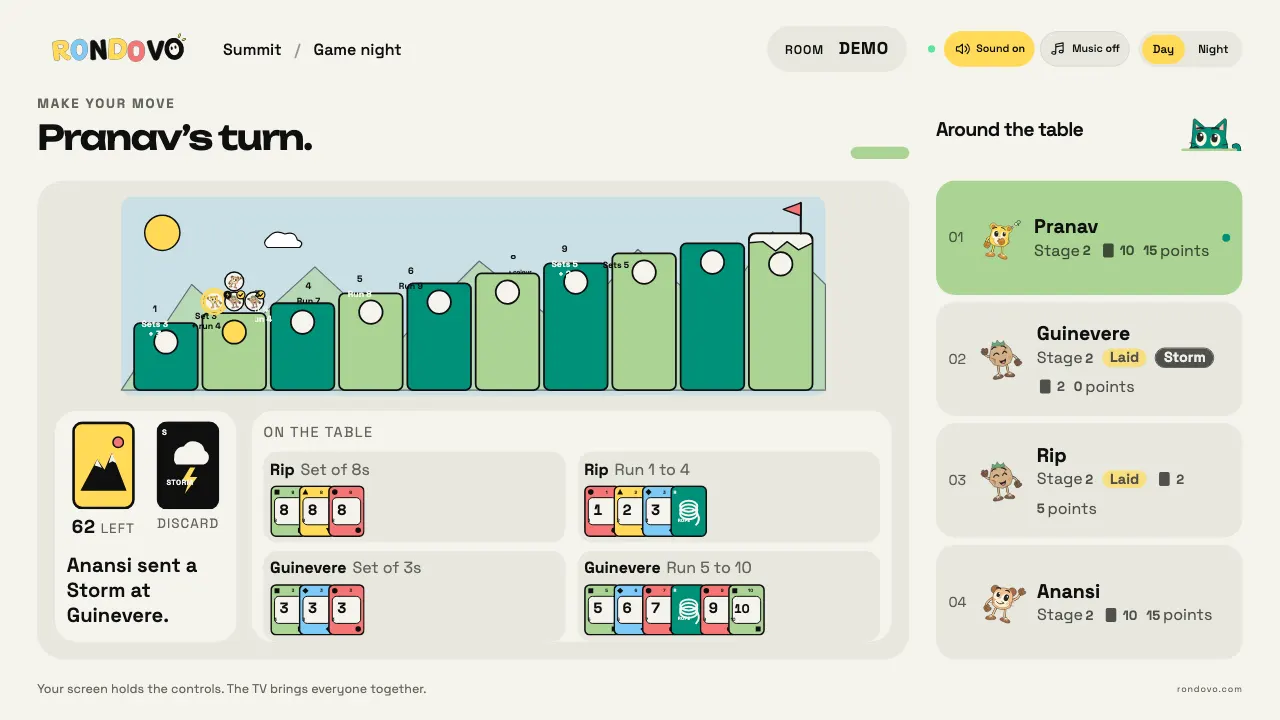
Phase 10 is a rummy-style card game where everyone works through the same ten phases in order, one phase per hand at most. Each phase asks for a specific combination, from two sets of three at Phase 1 to a set of five plus a set of three at Phase 10, and the first player to complete Phase 10 wins. To play Phase 10 online, Mattel's official app is Phase 10: World Tour on mobile; for a free browser game with the same structure, there are rummy climbers like our own Summit.
This guide covers all ten phases with example hands, the rules as Mattel prints them, scoring, strategy that actually helps, and what to play once you have climbed all ten.
In short
- The goal: complete Phases 1 to 10 in order. You can finish at most one phase per hand.
- The deck: 108 playing cards: numbers 1 to 12 in four colours (two of each), 8 Wilds and 4 Skips.
- A turn: draw, lay down your phase if you can, add to phases on the table if you have laid down, discard.
- Scoring: cards left in your hand cost points. Low is good. It only breaks ties.
- Online: Phase 10: World Tour (official, mobile) or a browser game such as Summit.
What is Phase 10?
Phase 10 is a commercial version of contract rummy, a family of card games where each hand has a required "contract" to meet before you can go out. Kenneth Johnson created it in the early 1980s, and Mattel publishes it today. Where UNO is about getting rid of cards, Phase 10 is about collecting the right ones, so it plays slower and rewards planning.
A game usually takes an hour or more with four players, because players who miss a phase repeat it. That length is its main weakness, and the reason many groups play a shorter version (more on that below).
All ten phases of Phase 10, with example hands
First, two definitions from the official rules:
- A set is two or more cards of the same number, in any colours. Three 7s is a set of 3.
- A run is four or more cards in number order, in any colours. 3, 4, 5, 6 is a run of 4. Runs do not wrap: 11, 12, 1, 2 is not a run.
| Phase | What you need | Example hand |
|---|---|---|
| 1 | 2 sets of 3 | 4, 4, 4 and 9, 9, 9 |
| 2 | 1 set of 3 + 1 run of 4 | 6, 6, 6 and 1, 2, 3, 4 |
| 3 | 1 set of 4 + 1 run of 4 | 11, 11, 11, 11 and 5, 6, 7, 8 |
| 4 | 1 run of 7 | 2, 3, 4, 5, 6, 7, 8 |
| 5 | 1 run of 8 | 4 through 11 |
| 6 | 1 run of 9 | 1 through 9, or 3 through 11 |
| 7 | 2 sets of 4 | 10, 10, 10, 10 and 2, 2, 2, Wild |
| 8 | 7 cards of one colour | Any seven greens, numbers do not matter |
| 9 | 1 set of 5 + 1 set of 2 | 8, 8, 8, 8, Wild and 12, 12 |
| 10 | 1 set of 5 + 1 set of 3 | 5, 5, 5, 5, 5 and 1, 1, 1 |
A few things that trip people up:
- Both sets can be the same number. In Phase 1, three 10s and three more 10s is legal. The deck has eight of every number (two in each colour), so this happens more than you would think.
- Phase 8 ignores numbers. Seven blues of any numbers count. Wilds can stand in for the colour.
- Phases 4 to 6 are the wall. A run of 9 needs nine different numbers out of twelve. Most games stall here, and it is where Wilds matter most.
- Phases 9 and 10 are about volume. You need five of one number. Start holding pairs early and keep the number with the most cards already gone into the discard pile in mind.
Some editions, such as Phase 10 Twist, use a different set of phases. The table above is the standard one printed in the classic box.
Phase 10 rules: how a hand works
These rules follow Mattel's instruction sheet for the standard game (service.mattel.com). Most boxes are sold for 2 to 6 players, ages 7 and up.
Setup
The dealer deals ten cards to each player. The rest of the deck becomes the draw pile, and the top card is turned over to start the discard pile. The player to the dealer's left goes first, and play goes clockwise.
Your turn, step by step
- Draw one card, either from the draw pile or the top of the discard pile.
- Lay down your phase if you hold all of it. The whole phase goes down at once, face up. You can only make one phase per hand.
- Hit if you have already laid down your phase: add cards to any phase on the table, yours or anyone else's, as long as they fit. A 9 on someone's run of 4 to 8, for example.
- Discard one card to end your turn.
Wild cards
A Wild can stand in for any number or colour. You can use as many Wilds as you like in a phase, as long as it has at least one numbered card. Once a Wild is placed in a phase, it stays there for the rest of the hand.
Skip cards
A Skip has one job: discard it and choose a player who loses their next turn. A Skip can never be taken from the discard pile and never used in a phase.
Ending a hand
The hand ends when one player goes out by discarding their last card (they must have laid down their phase first). Everyone who completed their phase moves on to the next one. Everyone else tries the same phase again next hand. This is the heart of Phase 10: you can be "ahead" in cards and still fall behind by a phase.
Scoring
Points count against you, so lower is better:
| Card left in your hand | Points |
|---|---|
| 1 to 9 | 5 |
| 10 to 12 | 10 |
| Skip | 15 |
| Wild | 25 |
Only cards still in your hand count, never the ones on the table.
Winning
The first player to complete Phase 10 wins. If two or more players finish Phase 10 in the same hand, the lowest total score wins. That is the only moment the points really matter, so do not obsess over them earlier.
Phase 10 strategy that actually works
Read the discard pile, not just your hand
Every card your opponents take from the discard pile tells you what they are building. If the player on your left picks up two 7s, stop throwing 7s. If they are on Phase 8 and grab a red, stop throwing reds.
Keep pairs, not singles, on the set phases
On Phases 1, 7, 9 and 10, a pair is worth more than two random cards. When choosing what to discard, break up loners first. A lone 12 is the classic discard.
On the run phases, hold the middle
For runs of 7, 8 and 9, numbers 4 to 9 fit into almost any run; 1, 2, 11 and 12 fit into few. Discard the edges first unless you are already building from an edge.
Save Wilds for the hard phases
A Wild on Phase 1 is a waste if you are close anyway. Holding one into Phase 4 or 6 can save a whole hand. The cost: a Wild left in your hand when someone goes out is 25 points, so dump it if you can see a hand ending.
Use Skips on the right player
Skip the player closest to going out, or the player one phase ahead of you, not the person on your left out of habit. On Phase 10, a well-timed Skip often decides the game.
Go out fast once you have laid down
After your phase is down, every turn you hold cards is a turn someone else might finish. Hit everything you can onto the table and empty your hand. Ending the hand early also traps everyone still stuck on their phase.
Where to play Phase 10 online
Phase 10: World Tour (official)
Mattel's games studio publishes Phase 10: World Tour, the official mobile version, which adds new phases, monthly events and location themes. It is free to download on mobile. It suits players who want to dip in alone or against strangers; check the app's friends features if you want a private game.
A deck and a video call
Phase 10 works better over video than most card games, because hands stay in your hands and phases go face up on the table. The dealer's camera needs to show the table clearly, and someone needs to keep score. Still, with more than three players it becomes slow.
Browser rummy climbers
If you want a private game with friends on any device and no installs, a browser game with the same climbing structure is the simplest route. That is why we built Summit.
Summit: our take on the ten stage rummy game
Summit is our own version of the ten stage climb. It is not Phase 10 and does not use its name or cards, but the structure is familiar on purpose, and someone who knows Phase 10 can play it at once.
What carries over:
- The same ten stages, from two sets of 3 up to a set of 5 and a set of 3, including 7 cards of one colour at stage 8.
- The same deck shape: numbers 1 to 12 in four colours (Coral, Gold, Blue, Green), two of each, plus 8 Ropes (our wild) and 4 Storms (our skip).
- The same turn: draw from the deck or take the discard (never a Storm), lay down your whole stage at once, then add cards to any group on the table, then discard.
- The same scoring: 5 for 1 to 9, 10 for 10 to 12, 15 for a Storm, 25 for a Rope. Fewest points breaks a tie at the top.
What is different, and why:
- Your screen checks your stage for you. Drag cards into the slots and it tells you what is missing ("Add 2 more", "Every number must match"). No more laying down a "run" with a gap in it.
- A Short climb option plays stages 1 to 5 only. It is the version we recommend for a weeknight; the full climb takes about 45 minutes and often longer.
- Turns have a timer, 45 seconds by default (the host can set 20 to 90), so nobody can stall a hand.
- A Storm can only target a player who is not already waiting out a Storm, so two players cannot lock out the same person.
Summit plays with 2 to 6 players. One person hosts a room and shares the four letter code; everyone else joins in a browser on their own screen, no download and no account. A TV is optional (open rondovo.com/tv in its browser); without one, each player picks "Just this screen" and sees the table and their own hand together, which also suits a video call. The TV view shows the mountain with everyone's position on it, which is a nice way to watch who is stuck on stage 6.
Games like Phase 10
Rummy and Gin Rummy
The parent family. Rummy uses an ordinary deck and the same sets and runs, without fixed phases. Gin Rummy is the best two-player version. Board Game Arena has Rummy if you want to play online, and our card games for groups guide has the rules for a standard deck.
Contract rummy (Liverpool Rummy, Shanghai)
The direct ancestor of Phase 10. Each hand has a required contract that gets harder, played with ordinary decks. If you like Phase 10 but find the special deck childish, this is your game. Board Game Arena hosts a Liverpool Rummy variant.
Hand and Foot
A partnership rummy game in the Canasta family, played with several decks and two hands each. Longer and more social than Phase 10. Also on Board Game Arena.
Rummikub
Rummy with tiles. Sets and runs again, but you can rearrange everything already on the table, which makes it a puzzle. Better for players who like rearranging to win than for those who like collecting.
Skip-Bo
From the same publisher. Instead of sets and runs, you build shared piles from 1 to 12 and race to empty your stockpile. Lighter than Phase 10 and good with kids.
UNO and Showdown!
If Phase 10 runs too long for your group, the matching game is the quicker cousin. See our UNO guide, or try Showdown!, our own match-the-colour game for 2 to 10 players.
Low Deck
If what you like about Phase 10 is the low score winning, try Low Deck, our grid card game: twelve hidden cards, swap and reveal, clear matching columns, lowest total wins. It plays in about 30 minutes with 2 to 8.
Which one to play when
| You want | Play |
|---|---|
| Phase 10 itself, on mobile | Phase 10: World Tour |
| Phase 10 style with friends in a browser | Summit |
| Phase 10 in 20 minutes | Summit with Short climb on |
| More strategy, ordinary cards | Contract rummy |
| Something lighter and faster | UNO, or Showdown! |
| A mean, funny filler afterwards | Nine Lives, our draw-until-it-explodes game |
Questions people ask
How many cards do you deal in Phase 10?
Ten cards to each player. The rest form the draw pile, with one card turned up to start the discard pile.
What are the 10 phases in Phase 10?
1: two sets of 3. 2: a set of 3 and a run of 4. 3: a set of 4 and a run of 4. 4: a run of 7. 5: a run of 8. 6: a run of 9. 7: two sets of 4. 8: seven cards of one colour. 9: a set of 5 and a set of 2. 10: a set of 5 and a set of 3.
Can you complete more than one phase in a hand?
No. You can lay down one phase per hand. If you finish it early, spend the rest of the hand hitting cards onto the table and going out.
Can a phase be made entirely of Wild cards?
No. You can use as many Wilds as you like, but each phase needs at least one numbered card.
Can you pick up a Skip from the discard pile?
No. A Skip can never be taken from the discard pile and can never be part of a phase.
Who wins if two players finish Phase 10 in the same hand?
The player with the lower total score. That tiebreak is the main reason to keep score at all.
Can you play Phase 10 with two players?
Yes, and it moves faster, because Skips hit the only opponent and discards are easier to read. Summit also plays well with two.
Is there an official Phase 10 app?
Yes. Phase 10: World Tour is Mattel's official mobile game, free to download.
Phase 10, Phase 10: World Tour, Phase 10 Twist, Mattel, UNO, Skip-Bo, Rummikub and Board Game Arena are trademarks of their owners. Rondovo is not affiliated with them.