Wavelength Game Online: Board Game Rules, 128 Spectrum Ideas, and How to Play With 2 or 3
By The Rondovo team · Published · Updated · 12 min read
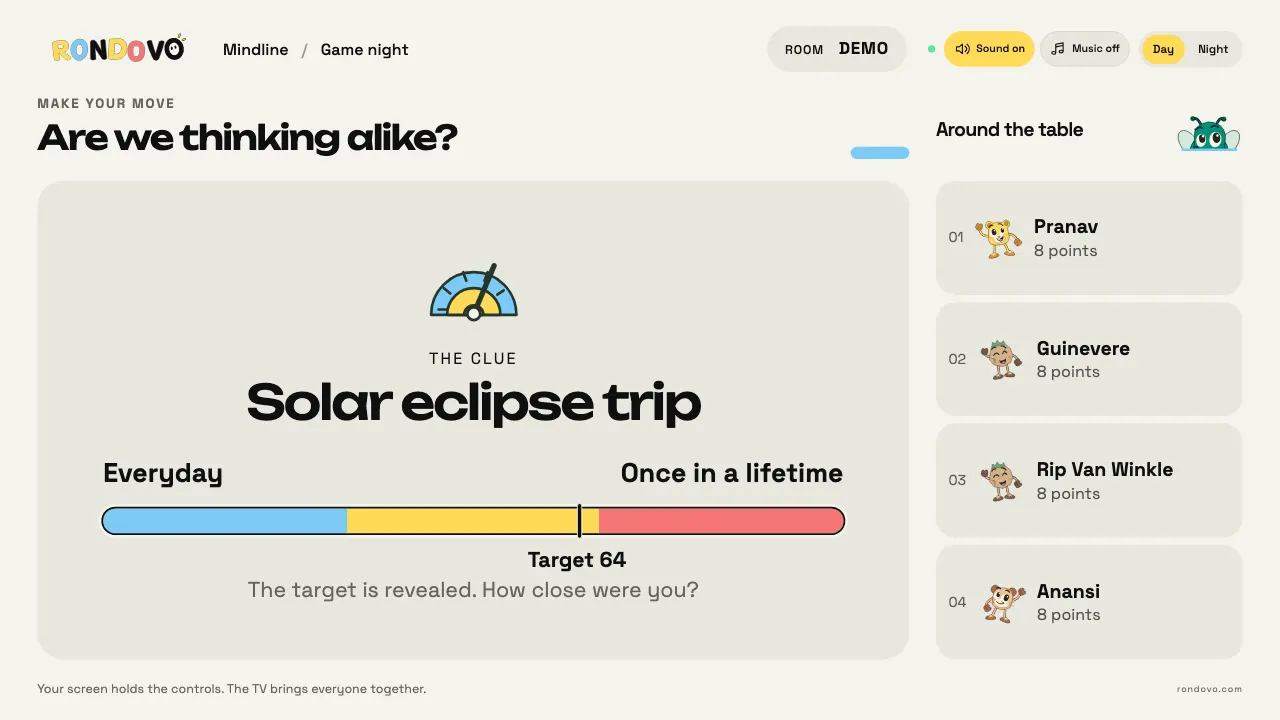
Wavelength is a party game about reading minds. One player secretly sees a target on a dial between two opposites, such as Cheap and Expensive, and gives a one-off clue to show where it sits; their team turns the dial to where they think it is. To play the Wavelength game online, use the official free Wavelength app for iOS and Android (2 to 10 players), play a free browser game built on the same idea such as Mindline on Rondovo, or use the 128 spectrum ideas below with a drawn line on a video call.
This guide covers the board game rules and scoring, how to play online with friends, versions for 2 and 3 players, how to give good clues, and a long list of original spectrums for when you have used every card in the box.
In short
- The board game: two teams, a dial, a screen and a deck of spectrum cards. Bullseye scores 4. First team to 10 wins. The box lists 2 to 12 players.
- The official app: free on iOS and Android, no ads, 2 to 10 players, optional packs from $0.99 to $4.99, no web version (as of October 2026).
- In a browser: Mindline on Rondovo, free for 2 to 16 players, every guess scored on its own.
- Two or three players: play cooperatively, scores added together. Details below.
- Need spectrums? 128 original pairs in eight themes below.
What is Wavelength?
Wavelength is a social guessing game designed by Alex Hague, Justin Vickers and Wolfgang Warsch and published in 2019 by CMYK, with Palm Court credited on some editions. Retail and library listings give 2 to 12 players and 30 to 45 minutes. CMYK sells it for $34.99 on its own store as of October 2026.
The box has a big plastic dial with a sliding screen, a red pointer, and a deck of double-sided spectrum cards, each showing two opposites like Hot and Cold. The magic is that there is no right answer to argue with: if the target is near Hot and the clue is "a cup of tea", half the table will think it is far too hot for that.
Wavelength board game rules
Setup
- Split into two teams of roughly equal size. The team going second starts with 1 point; the team going first starts with 0.
- The first team picks a Psychic, the player who gives the clue this turn.
A turn
- The Psychic draws a spectrum card and puts it in the dial, for example Tiny ... Huge.
- Everyone else looks away while the Psychic spins the wheel, closes the screen and peeks at where the target landed.
- The Psychic gives a clue: one idea that sits at that point on the spectrum. If the target is three quarters of the way to Huge, "a horse" might work.
- The Psychic's team discusses and turns the dial to their guess. The Psychic keeps a straight face.
- The other team then guesses whether the real target is left or right of the dial.
- Open the screen and score.
Wavelength scoring
| Result | Points |
|---|---|
| Dial in the centre band (bullseye) | 4 to the Psychic's team |
| Dial in the next band either side | 3 |
| Dial in the outer band | 2 |
| Dial outside the target | 0 |
| Other team called left or right correctly | 1 to the other team, unless the Psychic's team hit the bullseye |
If the dial sits on a line between two bands, take the higher score.
Catch-up rule and winning
If the Psychic's team scores the 4 point bullseye and is still behind, they take another turn straight away with a new Psychic. The first team to 10 points ends the game and the higher score wins. A tie is settled by sudden death rounds.
How to play Wavelength online
As of October 2026 there are three good ways to play Wavelength online with friends.
The official Wavelength app
CMYK's app is free to play with no ads, for 2 to 10 players, on iOS and Android. Unlike the box, the app is fully cooperative: everyone writes clues at the start, then the whole group debates and turns one dial together. Players connect through online servers, so it works on a video call or in the same room. Optional packs add new spectrums and avatars for $0.99 to $4.99, and only the host needs to own a pack for everyone to use it. There is no PC, Mac or web version, and the app's FAQ says everyone must be on the latest version and set to the same server region in Settings. It has no voice chat, so run a call alongside.
Mindline, our browser take
Mindline is a free game on Rondovo built on the same idea, for 2 to 16 players, about 15 minutes. It is our own design, not the official game, and the rules differ:
- Everyone guesses separately. The clue-giver sees a secret target on a line between two extremes. Everyone else reads the clue, moves a slider on their own screen, and locks in. Guesses stay hidden until all are in.
- Scoring is by distance. Exact scores 10 points; 1 to 5 away scores 9; 6 to 10 away scores 8, and so on down to zero. The clue-giver scores the group's rounded average, so a clear clue pays.
- Everyone takes a turn. One to three clues per player, 45 seconds to give a clue and 30 to guess by default.
- It runs in any browser. One person hosts and gets a four letter code; the others join at rondovo.com on any device. A TV is optional and shows the reveal. On a video call, everyone picks "Just this screen" and sees the line on their own device, so nobody shares a screen.
What the official game has that Mindline does not: teams, the left or right counter-guess, the catch-up rule, a physical dial, and a far bigger set of spectrums (Mindline has 20 built in). What Mindline adds: individual scores, so nobody hides behind their team, and play on any device including laptops.
Wavelength without the board game
You can play on a call, or at a table, with a list and a number:
- The Psychic picks a spectrum from the lists below and a random number from 1 to 100 (any random number generator does it).
- They give their clue. Everyone else agrees on a number together, or writes their own.
- The Psychic reveals the target. Score 4 points within 5, 3 within 10, 2 within 15, or use Mindline's 10 point scale.
Wavelength with 2 people or 3 people
The team game needs four or more. With two or three, play cooperatively: take turns as the Psychic, the others guess together, and add every score to one shared total. Play seven spectrums and aim to beat your best score.
- With 2 people: alternate Psychic and guesser. A good target is 20 points from seven rounds using the 4, 3, 2 scoring.
- With 3 people: the two guessers must agree on one answer, which brings back the arguing that makes the game fun.
Mindline works the same way at small sizes, since every guess scores on its own. It is playable with 2 and better with 3 or more.
How to give a good Wavelength clue
Most of the game is the clue. A few habits make a big difference:
- Picture the whole line first. Before you clue, think of an obvious thing at each end and the middle. Then find something between your markers.
- Use one well-known thing. "A slice of toast" is better than "a slightly burnt sourdough with butter" because the team can feel where it goes.
- Do not describe the number. "Pretty much in the middle" or "70 percent" is against the spirit of the game, and in Mindline it is against the rules.
- Know your audience. A clue that depends on a film only you have seen will land anywhere.
- Use the extremes on purpose. If the target is right at an end, give the most extreme thing you can think of.
- Guessers, talk it through. Ask what the clue means on this line, not in general. "A cat" on Good pet / Terrible pet sits somewhere very different from "a cat" on Quiet animal / Noisy animal.
Example clues
| Spectrum | Target | A clue that works |
|---|---|---|
| Cheap / Expensive | About 85 | A new car |
| Cute animal / Scary animal | About 50 | A goose |
| Easy job / Hard job | About 90 | Air traffic controller |
| Breakfast food / Dinner food | About 30 | Pancakes |
| Normal / Weird | About 70 | Pineapple on toast |
128 Wavelength spectrum ideas
These spectrums are all written for this page, sorted by theme. Use them with the board game when you have played every card, on a call with a random number, or as a warm-up before a game of Mindline. Read each pair as left end / right end.
Easy spectrums for a first game
- Quiet / Loud
- Tiny / Huge
- Cheap / Expensive
- Slow / Fast
- Soft / Hard
- Light / Heavy
- Short / Long
- Young / Old
- Dark / Bright
- Smooth / Rough
- Sweet / Salty
- Calm / Chaotic
- Clean / Filthy
- Dry / Soaking wet
- Weak / Strong
- Rare / Everywhere
- Simple / Complicated
- Safe / Dangerous
- Boring / Thrilling
- Low tech / High tech
Food and drink
- Breakfast food / Dinner food
- Snack / Full meal
- Mild / Too spicy
- Healthy / Pure junk
- Easy to cook / Chef only
- Eat with hands / Needs cutlery
- Smells great / Smells awful
- Kids love it / Kids refuse it
- Best hot / Best cold
- Party food / Sad desk lunch
- Messy to eat / Tidy to eat
- Fancy restaurant / Street stall
- Acquired taste / Everyone likes it
- Better fresh / Better the next day
- Sweet treat / Savoury treat
Everyday life
- Morning task / Night task
- Chore / Treat
- Five minute job / All day job
- Do it alone / Do it with friends
- Indoors / Outdoors
- Needs a plan / Totally spontaneous
- Annoying noise / Soothing noise
- Waste of money / Worth every penny
- Old habit / New habit
- Would lend it / Would never lend it
- Small talk topic / Deep talk topic
- Weekday / Weekend
- Easy to forget / Impossible to forget
- Lasts a day / Lasts a lifetime
- Embarrassing to own / Proud to own
People and jobs
- Easy job / Hard job
- Badly paid / Well paid
- Boring job / Dream job
- Desk job / Active job
- Hero / Villain
- Introvert / Extrovert
- Needs a uniform / Wear what you like
- Night owl job / Early bird job
- Respected / Underrated
- Trustworthy / Shady
- Bad role model / Great role model
- Would ask for directions / Would avoid eye contact
- Calm under pressure / Panics instantly
- Nerdy / Sporty
- Famous for one day / Famous forever
Places and travel
- Relaxing trip / Exhausting trip
- Close to home / Other side of the world
- Tourist trap / Hidden gem
- Crowded / Empty
- City / Countryside
- Cheap holiday / Luxury holiday
- Safe to visit / Risky to visit
- Summer place / Winter place
- Day trip / Two week stay
- Overrated place / Underrated place
- Good for kids / Adults only
- Easy to get to / Hard to get to
- Peaceful / Noisy
- Flat / Hilly
- Modern / Ancient
Animals and nature
- Cute animal / Scary animal
- Good pet / Terrible pet
- Land / Sea
- Lazy animal / Busy animal
- Easy to draw / Hard to draw
- Harmless / Deadly
- Fluffy / Scaly
- Common / Endangered
- Smart animal / Silly animal
- Quiet animal / Noisy animal
- Nice weather / Awful weather
- Garden plant / Jungle plant
- Tiny creature / Giant creature
Pop culture and fun
- Underrated film genre / Overrated film genre
- Guilty pleasure / Proud pleasure
- Family film / Grown-up film
- Good superpower / Useless superpower
- Classic / Forgotten
- Great board game night snack / Worst board game night snack
- Funny / Serious
- Good karaoke pick / Bad karaoke pick
- Old fashioned / Futuristic
- Mainstream / Niche
- Best gift / Worst gift
- Easy costume / Hard costume
- Good sequel / Should not exist
- Hobby for kids / Hobby for grandparents
- Fictional / Real
Ideas and opinions
- Bad idea / Good idea
- Normal / Weird
- Myth / Fact
- Small problem / Huge problem
- Rule / Suggestion
- Fair / Unfair
- Lucky / Unlucky
- Polite / Rude
- Easy to explain / Hard to explain
- Ugly / Beautiful
- Mild crime / Terrible crime
- Fading trend / Here to stay
- Matter of taste / Objectively true
- Worth the wait / Not worth the wait
- Simple pleasure / Big life event
- Hot take / Cold take
- Feels long / Feels short
- Optimistic / Pessimistic
- Needs skill / Pure luck
- Romantic / Unromantic
Tips for making your own spectrums
- The two ends should be clear opposites, but not mathematical ones. Cold / Hot gives better arguments than 0 degrees / 100 degrees.
- Subjective is good. Overrated / Underrated starts debates, which is the point.
- Avoid spectrums about people in the room. "Least likely to be on time" belongs in a different game; our most likely to questions are for that.
- Test it. Can you think of a clear thing at each end and in the middle? If not, the team will struggle too.
Games like Wavelength
| Game | Similar because | Players |
|---|---|---|
| Codenames | One clue, teammates read your mind | 2 to 8, two teams |
| Just One | Cooperative one-word clues | 3 to 7 |
| Mindline (Rondovo) | Spectrum clues, each guess scored | 2 to 16 |
| Spy Grid (Rondovo) | Team clues on a word grid | 4 to 16 |
| Hush (Rondovo) | Describe a word, avoid six forbidden ones | 4 to 16 |
If the clue-giving is your favourite part, Spy Grid and our guide to games like Codenames are the natural next step. For a word game with more laughs than tension, Fill-In has the room voting on the funniest answer. Our guides to word games for groups, virtual game night ideas and party games have plenty more.
Questions people ask
Can you play Wavelength online?
Yes. The official Wavelength app is free on iOS and Android for 2 to 10 players, and browser games like Mindline on Rondovo use the same idea with no download. You can also play on a video call with a spectrum list and a random number.
Is there a free Wavelength online game?
The official app is free with no ads as of October 2026, with optional paid packs. Mindline is free in any browser.
How many players do you need for Wavelength?
The box lists 2 to 12. The team game works best with 4 or more; with 2 or 3, play cooperatively and add your scores together.
How do you win Wavelength?
The first team to reach 10 points ends the game, and the team with more points wins. Ties go to sudden death rounds.
What is the catch-up rule in Wavelength?
If a team scores the 4 point bullseye and is still behind after scoring, it immediately takes another turn with a different Psychic.
Can you play Wavelength on PC?
Not the official app, which is iOS and Android only as of October 2026. Browser games like Mindline work on a PC, Mac or any device with a browser.
How many spectrum cards come with Wavelength?
Listings for the board game mention a main deck plus a set of advanced cards, each double-sided. Check the box of your edition; and if you have played them all, use the 128 ideas above.
Find your wavelength
Pick a spectrum, think of a number and give a clue. If your group would rather play on screens, open Mindline, share the four letter code (it is free, and nobody signs up), and the first clue-giver gets their target as soon as everyone is in.
Wavelength, CMYK, Palm Court, Codenames, Just One, App Store and Google Play are trademarks of their owners. Rondovo is not affiliated with them.