How to Play Sequence: Rules for Every Team Size, Jack Strategy, Where to Play Sequence Online and Games Like Sequence
By The Rondovo team · Published · Updated · 10 min read
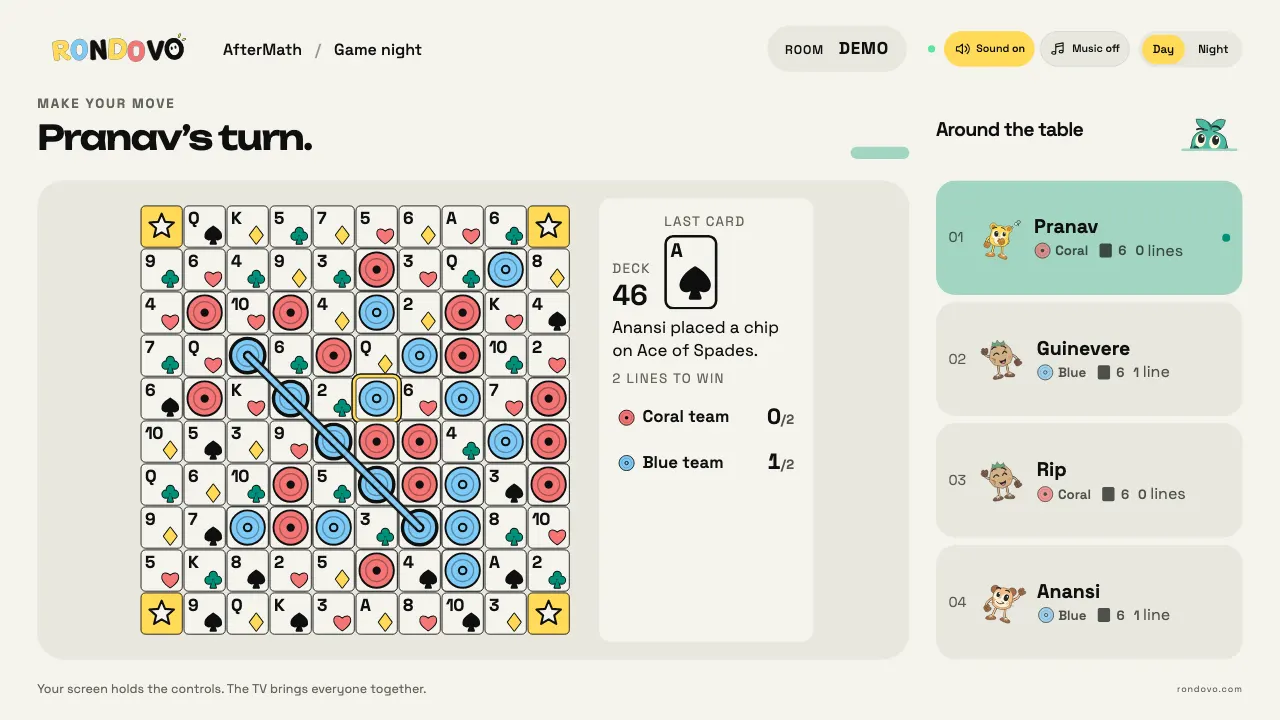
Sequence is a card and board game for 2 to 12 players where you play a card from your hand, place a chip on the matching square of the board, and try to make rows of five. With two players or two teams you need two sequences to win; with three players or three teams, one is enough. Two-eyed jacks are wild and one-eyed jacks remove an opponent's chip. To play the Sequence board game online, the official app is Sequence World from Goliath, and browser versions such as our own AfterMath play by the same classic rules.
This guide covers the full rules, the exact team setups and hand sizes for every player count, jack strategy that wins games, the online options, and what to play next.
In short
- Players: 2 to 12, as individuals (2 or 3) or in two or three equal teams. The classic rules do not allow 5, 7 or 11.
- Turn: play a card, place a chip on one of its two squares, draw a card.
- Jacks: two-eyed jacks (diamonds, clubs) are wild; one-eyed jacks (hearts, spades) remove a chip.
- Win: two sequences with two players or teams, one with three.
- Online: Sequence World (official, free with in-app purchases) or AfterMath in a browser.
What is Sequence?
Sequence was published in the early 1980s and is sold today by Goliath for 2 to 12 players, ages 7 and up. It mixes a card game and a five in a row board game. The luck of the draw decides what you can play; the strategy is where you put it.
The board is a 10 by 10 grid showing every card from two standard decks except the jacks, so every card appears twice. The four corners are free squares that count for everyone. The game uses two ordinary decks of cards, with all eight jacks in play.
How to play Sequence, step by step
Setup
- Split into players or teams (see the table below). Teammates share one chip colour and sit so that turns alternate between teams.
- Shuffle both decks together and deal each player the number of cards shown for your player count.
- Put the rest of the cards face down as a draw pile.
A turn
- Play a card from your hand face up on your own discard pile.
- Place a chip of your colour on one of the two board squares showing that card. Either one, as long as it is open.
- Draw a card to end your turn.
That is the whole turn. If you forget to draw before the next player draws, you lose that card and play the rest of the game a card short, so draw straight away.
Jacks
There are no jacks on the board. Instead:
- Two-eyed jacks (diamonds and clubs) are wild. Place a chip on any open square.
- One-eyed jacks (hearts and spades) remove one opponent's chip from the board. You do not place a chip that turn.
- A chip in a completed sequence can never be removed.
If you can never remember which is which, look at the jack's face: if you can see both eyes, it is the friendly one.
Dead cards
If both squares for a card in your hand are covered, the card is dead. On your turn, before you play, you may discard it, say so, and draw a replacement. Once per turn. Then take your normal turn.
Sequences and winning
A sequence is five of your chips in a row, across, down or diagonally. A free corner counts as one of your chips. When you need two sequences, they may share one chip but no more.
Table talk is not allowed. In team games you cannot tell a teammate what to play or warn them off a move. Expect this rule to be broken constantly at family tables.
Sequence teams and cards dealt by player count
This is the table everyone searches for. The figures below match the published rules as summarised by independent rules sites and Wikipedia; check the sheet in your own box if it differs.
| Players | How to play | Cards each | Sequences to win |
|---|---|---|---|
| 2 | One against one | 7 | 2 |
| 3 | Each for themselves | 6 | 1 |
| 4 | Two teams of 2 | 6 | 2 |
| 6 | Two teams of 3, or three teams of 2 | 5 | 2 with two teams, 1 with three |
| 8 | Two teams of 4 | 4 | 2 |
| 9 | Three teams of 3 | 4 | 1 |
| 10 | Two teams of 5 | 3 | 2 |
| 12 | Two teams of 6, or three teams of 4 | 3 | 2 with two teams, 1 with three |
5, 7 and 11 players cannot split evenly, so the classic rules do not allow them. In real life, groups either sit someone out as a coach or let one team have an extra player. Our own version, below, handles odd numbers by making teams as even as it can.
Sequence strategy: how to win more games
Treat two-eyed jacks as finishers
A wild jack can complete a sequence nobody saw coming. Spending one early to grab a random square is the most common beginner mistake. Hold it until it finishes a line or blocks a four.
Use one-eyed jacks to break fours, not threes
Removing a chip from a three is usually wasted: your opponent has another card for that line. Removing one from an open four (four in a row with an empty square at the end) saves the game. If you have no immediate threat to answer, keep the jack.
Play the corners
A corner is a free chip in four directions for everyone. Lines through the corners need only four of your own chips. Squares next to corners are worth more than they look.
Count the duplicates
Every card has two squares. Before you place a chip, check where the other copy is. If both squares are useful, play the one your opponent can block more easily, and keep the other as a backup for the second card.
Watch the discard piles
Each player's discards are public. If both 7 of hearts have been played, those two squares are as good as settled. If none has been played and you need one, someone may be holding it.
Build where lines overlap
A chip that sits in two possible lines (a row and a diagonal, say) is worth two chips. Once you need two sequences, a shared chip is allowed, so build an L or a cross rather than two separate lines.
Play defensively with more teams
With three teams and only one sequence to win, the game moves fast. Block any four immediately and any open three when you can. With two teams, you can afford to build.
Teammates: think in turns, not hands
You cannot talk, but you can read your teammate's chips. If they placed next to your chips last turn, they are building with you. Help them before you start a new line.
How to play the Sequence board game online
Sequence World (official)
Goliath's own mobile game is Sequence World, published by Goliath BV on the App Store. As of October 2026 it is free to download with in-app purchases, offers real-time online matches against players worldwide, and adds a travel theme where winning opens up new cities. Game Center support means you can find friends on Apple devices.
Unofficial apps
The app stores have several unofficial Sequence-style apps from small developers. Some are offline only, some support only two players, and quality varies a lot. Read the recent reviews and the multiplayer description before you get your group to install one.
A real board over video
Sequence is one of the few hidden-hand games that half works on a video call: the board is public, and each player can hold their own cards at home if everyone has a deck. But someone has to place everyone's chips, and remote players have to call out squares like "10 of diamonds, top left", which gets old fast.
Browser versions
For a group on mixed devices, a browser game where everyone holds their own hand is the most practical option. That is what we built.
AfterMath: our take on the card and board line game
AfterMath is our own five in a row game played with cards. It is not Sequence, and the board layout is our own, but it follows the classic rules closely, so anyone who knows Sequence can play straight away.
What is the same:
- Every card except the jacks appears twice on a 10 by 10 board, and the four corners are free for everyone.
- Play a card, put your chip on one of its two squares, then draw.
- A Wild Jack (diamonds or clubs) goes on any open square. A Remove Jack (hearts or spades) takes a rival chip off, but never one in a finished line.
- Dead cards can be swapped once a turn, before you play.
- Classic win rule: two lines, or one line with three players or three teams. Two lines may share one chip.
- The same hand sizes: 7 cards for two players, down to 3 for ten or more.
What is different:
- Odd player counts work. Five, seven or eleven players split into teams as even as possible (three against two, for example), and teams still take turns side by side.
- Two or three players play alone; four or more play in teams automatically. With six or more, the host chooses two or three teams.
- The host can change the target to one, two or three lines, whatever the player count.
- Turns are timed, 40 seconds by default (the host can set 20 to 90), and your screen highlights the squares your cards can reach.
- No table talk problem: your hand is on your own screen, so nobody can see what their teammate holds.
AfterMath plays with 2 to 12 players in about 30 minutes. One person hosts a room and shares a four letter code; everyone joins in a browser on their own screen, with no download and no account. A TV is optional: open rondovo.com/tv in its browser and it shows the whole board, which is the best way to play with a big group in one room. Without a TV, or on a video call, everyone picks "Just this screen" and sees the board and their own hand together.
Games like Sequence
Five in a row games
Gomoku is the pure version: two players take turns placing stones, first to five in a row wins. No cards, no luck. Pente adds captures, which plays a bit like a one-eyed jack you earn with skill. Board Game Arena has both Gomoku and Pente, and papergames.io runs Gomoku free in a browser with a shareable link.
Connect Four and Drop Four
Four in a row with gravity: discs fall to the lowest open space, so every move changes what the next player can do. Board Game Arena hosts Connect 4, and our own Drop Four plays the same idea for two players or two teams, up to eight people.
Tic tac toe, grown up
If you like blocking more than building, try Ultimate tic tac toe: nine small boards, and the square you play sends your opponent to the matching board. It is a mode in our XOXO, a two-player game.
Team games with the same family feel
Sequence's best feature is the team play. If that is what your group loves, a team word game is a good follow-up: Codenames and our own Spy Grid are built around one clue-giver per team. For more two-player picks, see our two player online games guide, and for more games with a standard deck, card games for groups.
Which version to play when
| Situation | Play |
|---|---|
| Two people, on Apple devices, happy with an app | Sequence World |
| A family table, same room, real board | The Sequence box |
| Mixed devices, 2 to 12 players, no installs | AfterMath |
| Five, seven or eleven people | AfterMath (uneven teams allowed) |
| A quick two-player warm-up | Drop Four or XOXO |
Questions people ask
How many players can play Sequence?
2 to 12. Two or three play as individuals; four or more play in two or three equal teams.
Can you play Sequence with 5 players?
Not under the classic rules, because five cannot split into equal teams. Many groups play with one team of three and one of two anyway; it is slightly unbalanced but fun. AfterMath allows it by design.
How many cards do you get in Sequence?
7 each with two players, 6 with three or four, 5 with six, 4 with eight or nine, and 3 with ten or twelve.
How many sequences do you need to win?
Two when there are two players or two teams, one when there are three players or three teams.
Which jacks are wild in Sequence?
The two-eyed jacks, diamonds and clubs. The one-eyed jacks, hearts and spades, remove an opponent's chip instead.
Can you remove a chip from a completed sequence?
No. Once five in a row is complete, those chips are safe for the rest of the game.
Do the corners count in Sequence?
Yes. Each corner counts as a chip for every player, so a line through a corner needs only four of your own chips.
Is there an official Sequence app?
Yes. Sequence World by Goliath is free on the App Store as of October 2026, with in-app purchases and online play.
Sequence, Sequence World, Goliath, Codenames, Connect 4, Board Game Arena, Pente, Game Center and papergames.io are trademarks of their owners. Rondovo is not affiliated with them.