Classroom Games Online: Free Review Games and Brain Breaks Students Join Without Accounts
By The Rondovo team · Published · Updated · 9 min read
The most useful classroom games online are the ones students can join in under a minute, on a school laptop or tablet, without making an account. For review, quiz platforms like Kahoot, Blooket, Gimkit and Baamboozle let you load your own questions. For brain breaks and vocabulary practice, free browser games work well: a five letter word race, word picture puzzles, a Codenames style team grid, or a taboo style describing game. Pick games where typing is limited or checked, keep rounds short, and split big classes into teams.
In short
- For reviewing your own content, use a quiz tool that takes custom questions (Kahoot, Blooket, Gimkit, Baamboozle). Our games don't.
- For brain breaks and vocabulary, quick word games work at every age and need no prep.
- For safety, choose games with no free chat, ask students to use first names only, and keep the room code inside the class.
- For big classes, play in teams or pairs on one device each, or run two rooms.
- No devices? A dozen classic games need only a board and a timer.
What teachers need from an online classroom game
Every teacher forum asks the same questions, and they matter more than the game itself.
Can students join without accounts? Every account is a privacy form, a forgotten password and five lost minutes. The best tools let students join with a code and a first name.
Will it run on what we have? School Chromebooks, a projector and patchy wifi. Browser games with nothing to install are the safest bet.
Can students type anything they like? Free text boxes are where problems start: rude nicknames, inside jokes, worse. Prefer games where answers are checked against a word list or never shown to the class.
Does it teach anything? Some games review content directly. Others build vocabulary, spelling, reasoning or teamwork. Both have a place, but be honest about which one you're playing.
How long does it take? A 5 to 10 minute game at the end of a lesson is a reward. A 30 minute game needs a learning goal.
The well known classroom game platforms
These are built for teachers, and they are the right answer when you want to review your own material.
- Kahoot. Quiz show style: questions on the projector, students answer on their own devices. According to Kahoot's support pages (as of October 2026), players join with a game PIN, link or QR code and don't need an account unless the host asks for an identifier. Free and paid plans differ in features and player numbers, so check the current plan page.
- Blooket and Gimkit. You build or borrow a question set, then play it in different game modes. Students join with a code. Students love the modes; some teachers find the strategy elements distract from the questions.
- Baamboozle. Team quiz games played from one screen, with no student devices needed, according to its site. Great for classes without laptops.
- Educaplay and similar builders. Make crosswords, matching games and word searches from your own word lists.
None of these is a party game, and that is fine. Use them for review, and use the games below for everything else.
Classroom games online for students: word and team games
These don't use your lesson content, but they practise vocabulary, spelling, inference and teamwork, and students ask for them again.
Five letter word races
Everyone gets six tries to find the same hidden five letter word, with colours showing right letters in the right place, right letters in the wrong place, and letters not in the word. As a class race, it's a spelling and reasoning exercise disguised as a game.
On Rondovo: in Five Letters, 2 to 16 players solve the same word on their own screens. Every guess must be a real word from the game's list, and the shared screen shows only coloured squares, never the letters, so nobody can copy and nobody can type something rude onto the projector. The host picks 1 to 10 words, easy words by default, and 60 to 240 seconds a word.
Word picture puzzles (rebuses)
A phrase hidden in the way words are arranged: the word "head" written above "heels" means head over heels. Students love arguing about them, and they build figurative language.
On Rondovo: Speed Wits shows one of these puzzles on the shared screen and everyone types their answer. Answers stay hidden until the reveal, and faster correct answers score more. The host chooses 4 to 16 puzzles, how hard the hardest one gets (1 to 5), and 20 to 180 seconds a puzzle.
Codenames style team grid
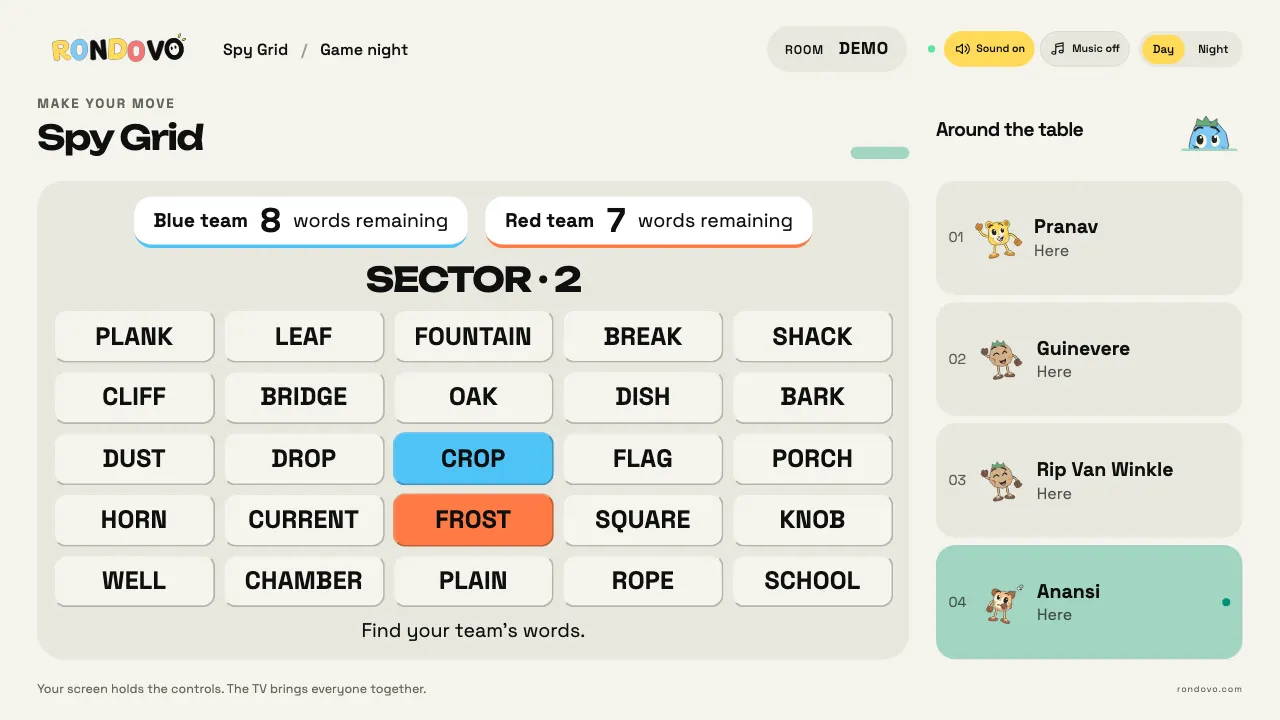
A grid of 25 words. Each team has a "handler" who knows which words belong to their team and gives one word clues to link several of them. It is the best association and vocabulary game we know for older students.
On Rondovo: Spy Grid takes 4 to 16 players in two teams. The handler's clue must be a single word and cannot be a word on the grid. The host can set or remove time limits for thinking and guessing. Our article on games like Codenames compares other versions, including the official app.
Taboo style describing game
Describe a word without saying the obvious clue words. It is a speaking game: perfect for language classes and for students who need to practise explaining ideas.
On Rondovo: Hush runs two teams of up to 16 players in total. The other team sees the forbidden words and buzzes if the clue-giver slips. Nothing is typed at all. Our guide to how to play Taboo covers the paper version.
Drawing and guessing
Pictionary style games help younger students and language learners link words to images.
On Rondovo: in Scrawl, the drawer picks one of three words (the host can choose easy words) and everyone guesses on their own screen. Guesses are typed, so it suits classes where you trust the room. For more options, see our guide to online drawing games.
Bingo
Our Bingo is classic number bingo (1 to 75), not vocabulary bingo. You can't load your own words into it. It works as a calm reward game or for number recognition with younger learners. For vocabulary bingo, use paper cards or a quiz tool that takes your own list.
Classroom games with no materials or prep
For days when the projector is broken or there is no device trolley:
- Heads down, thumbs up. Classic for younger classes; quiet and calm.
- Hangman with lesson vocabulary. Two minutes on the board.
- Twenty questions. One student thinks of a historical figure, element or book character; the class asks yes or no questions.
- Around the world. Flashcard duels moving round the room. Good for times tables and vocabulary.
- Charades with lesson terms. Act out "photosynthesis" and you never forget it. Our charades ideas have general lists too.
- Categories race. A letter and five categories; one minute to fill them in.
- Would you rather, subject edition. "Would you rather live in ancient Rome or ancient Egypt?" Then defend it.
- Two truths and a lie for the first week. A gentle icebreaker; our list of icebreaker games has more.
- Stand up if... Stand if the statement is true. Fast review of facts.
- Silent ball. Pass a soft ball without talking; drop it or speak and you sit.
Classroom games by age
| Age | What works | Watch out for |
|---|---|---|
| Middle school (11 to 14) | Team quiz games, five letter word races, charades, drawing games | Free text answers and nicknames; keep games under 15 minutes |
| High school (14 to 18) | Codenames style grids, describing games, rebus puzzles, debate games | Students drifting to other tabs; use team play to keep everyone in |
| College | Codenames style grids, quiz tools for review, icebreakers early in term | Feeling childish; frame word games as a warm-up or a reward |
How to run an online class game safely
Whatever platform you use, a few habits prevent most problems.
- Names first, game second. Ask for a first name and last initial. Anything else, remove them and ask them to rejoin. On Rondovo, the host can remove a player from the lobby by tapping the cross next to their name, then tapping again to confirm.
- Share the code only in the room. Put it on the projector, not on a class website. A room code lets anyone who has it in.
- Choose low text games for new groups. Five Letters, Speed Wits, Spy Grid, Hush and Bingo keep typed input checked, hidden or out of the picture. Save games with open answers for groups you know.
- No accounts means less data. Rondovo students need no account and nothing to install. Typed names, drawings and answers are shown to other players in the room, so the usual rule applies: no personal information.
- Late arrivals wait. A student who joins mid-game watches and is in from the next game.
Big classes: 25 to 35 students
Our rooms hold up to 16 players, which is a real limit for a full class. Three ways round it:
- Pairs on one device. Fifteen pairs fit in one room. This works especially well for Five Letters, Speed Wits and Spy Grid, where discussing with a partner is part of the fun.
- Two rooms. Two hosts and two shared screens, one for each half of the class.
- Teams. For Hush or Spy Grid, the number of devices matters less than the number of voices, because teams discuss out loud.
If you need 30 individual scores on one leaderboard, a quiz platform is the better tool.
Honest limits of our games in class
We'd rather you know these up front:
- No custom content. You can't add your own words, questions or vocabulary lists to any of our games.
- No teacher dashboard, no reports, no grades, and no link to Google Classroom or other school systems.
- English only. Our word lists and puzzles are in English.
- 16 players per room.
- We are a party games site, not an education company. The games build vocabulary and reasoning, but they are not mapped to any curriculum.
What we do offer: free games that start in under a minute, with no student accounts and no download, that students already like playing. For remote lessons, each student opens the room on their own device and picks "Just this screen", so nobody needs to share a screen on the call.
For more group word games outside class, see word games for groups, and for staff socials, team building games. Our party games guide covers every kind of group.
Questions people ask
What are good online classroom games for students?
For reviewing content: Kahoot, Blooket, Gimkit and Baamboozle. For brain breaks: five letter word races, rebus puzzles, Codenames style word grids and describing games, which you can play free in a browser.
Are there classroom games online like Kahoot?
Blooket, Gimkit and Baamboozle are the closest, since they all run your own question sets. If you want a game rather than a quiz, word and team games are a good change of pace.
What are good classroom games for college students?
Codenames style grids, describing games, debate style would you rather, and quiz tools for review before exams. College students enjoy the same party games adults do, as long as it's framed as a warm-up.
What classroom games need no materials?
Twenty questions, hangman, charades, categories, around the world, silent ball and stand up if. None need devices or printing.
Do students need an account to play Rondovo games?
No. The teacher makes a room, and students join at rondovo.com with the four letter code on any device with a browser. It is free, and nobody downloads anything.
Kahoot, Blooket, Gimkit, Baamboozle, Educaplay, Codenames, Taboo, Pictionary, Chromebook and Google Classroom are trademarks of their owners. Rondovo is not affiliated with them.